Corpus
IIT Wiki — Part I: Ontological Foundations
Integrated Information Theory as a Theory of Consciousness
Source: https://www.iit.wiki/overview
Summary
Why does it feel like something to be you, right now? You are seeing these words on the screen, which may trigger cascades of thoughts. You might also hear ambient sounds, feel the light pressure of a seat beneath you, and so on. Why do these experiences feel the way they do? And, for that matter, why should there be any feeling at all?
Integrated information theory (IIT) aims to answer such questions—that is, to offer a scientific account of consciousness, of what it feels like to be you right now. This page gives an intro overview of how IIT constructs this account.
The IIT method can be summarized as "consciousness first." It starts from the fact that one's experience exists, right now, and it uses introspection to characterize the properties of experience. The theory then asks how we might account for these properties of experience in physical terms—which means in terms of something we can observe and manipulate "out there." IIT offers an answer in what is called a complex and the associated Φ-structure ("phi structure"), which will become clearer as you read on.
As regards empirical validation, IIT provides several predictions and explanations with regard to consciousness in the human brain. The theory also offers a powerful basis to make inferences about, for example, consciousness in non-human animals and in artificial systems, and the place of consciousness in nature.
Contents
- What does it mean to explain consciousness scientifically?
- The IIT Method
- 1. Introspect to characterize phenomenal structure
- 2. Formulate phenomenal properties in physical (causal) terms
- 3. Establish the identity of a phenomenal structure and a Φ-structure
- 4. Account for contents of experience
- 5. Validate empirically in humans
- 6. Extrapolate beyond humans
- Frequently Asked Questions
- Cite this page
This page discussed on our YouTube channel:
Embedded YouTube video: https://www.youtube.com/embed/krUr_D8zdAA
Technical Summary (click)
IIT aims to account for consciousness (or experience) in physical terms. The theory starts from phenomenology to identify the essential properties of experience (axioms); it then formulates these as physical properties (postulates)—understood as cause–effect power—and provides a mathematical formalism for assessing these properties. The tools of IIT allow us to assess the cause–effect power of any substrate of units in a state (e.g., a system of neurons, some firing and some silent), and to fully unfold the cause–effect structure which that substrate specifies.
In this way, IIT accounts for consciousness through its explanatory identity: an experience is identical to a specific cause–effect structure in both quality and quantity. This identity can be applied to account for why specific experiences feel the way they do (e.g., why space feels extended and time flowing). IIT offers a parsimonious explanation of empirical evidence, makes testable predictions, and permits inferences and extrapolations—for example, about the place of consciousness in nature and about ontology, free will, and ethics.
What does it mean to explain consciousness scientifically?
We all know consciousness intimately—so intimately, in fact, that we may struggle to define it. It is what fades every night when we fall into dreamless slumber, and what reappears every morning when we awake. Consciousness is our "inner world" in its entirety; it encompasses everything it is "like to be you"[1]—every experiential state you have had, are having now, and will have. Consciousness is experience itself, no matter what that experience is[2].
In IIT's view, to explain consciousness scientifically means to answer two questions:
-
Why is experience present vs. absent?
-
Why do specific experiences feel the way they do?
The first question can be subdivided. First, why is consciousness present in humans when awake or vividly dreaming, and why does it fade in dreamless sleep or general anesthesia? Second, why should consciousness depend on some parts of our brain and not others?
As for the second question, if consciousness is present, it is always present in a specific way. Thus, a full account of consciousness cannot settle for mere presence vs. absence; it needs to explain why, say, the sound of a bell feels the unique way it does, and why it does not feel like, say, the taste of vanilla.
In approaching these questions, IIT carefully distinguishes three things: what needs to be explained, how it is explained, and how the explanation is validated[3]:
As outlined already, what needs to be explained is experience—its presence and its contents. This is a unique scientific challenge since science is presumed to be the objective study of objective phenomena. But in a science of consciousness, what must be explained is—by definition—not objective; it is subjectivity itself (see this FAQ). We may indeed discover objective correlates of consciousness—be they neural, functional, or behavioral. For example, my experience of a light on a screen may be accompanied by activity in visual cortical areas (neural correlate), by my directing attention to the light source (functional correlate), and by my pressing a button when I see it (behavioral correlate). However, these objective correlates are not what needs to be explained and cannot be swapped in as proxies. What needs to be explained, as said already, is rather the fact that I experience the bright light in the first place, and why exactly it feels "bright" and "light" as opposed to, say, the smell of lavender.
In contrast, how consciousness is explained, in IIT, must be in terms of objective, measurable properties and lead to testable predictions. Hence, IIT formulates the essential properties of experience in objective, physical terms, and then turns to empirical neuroscience to validate these conjectures.
How the explanation is validated must start in humans who can introspect and report their experiences. Only then can we confidently use the theory to extrapolate to unresponsive patients, non-human animals, and artificial systems, and ultimately to draw conclusions about the place of consciousness in nature.
For more, see
-
Consciousness and the Fallacy of Misplaced Objectivity (academic paper)
-
FAQ: Why not build a theory of consciousness starting from empirical neuroscientific research?
-
FAQ: If IIT starts from experience, isn't this method "subjective" and thus unscientific?
Footnotes
[1] This is an oft-cited way of defining consciousness from Nagel, T. 1974. What is it like to be a bat? The Philosophical Review, 83(4), 435–450. Also see FAQ: What do you mean by consciousness?
[2] In IIT, we often use the terms consciousness and experience interchangeably, in the sense that being conscious is synonymous with having an experience. But some nuances are worth mentioning. Consciousness refers to having experiences regardless of their content, while experience is always of something specific. Hence we describe a patient as "losing consciousness" but not as "losing experience," and we might say "my experience changed" (from one content to another) but not "my consciousness changed." Also note that some people use terms such as "subjective experience" or "phenomenal experience." However, we prefer simply experience, since there is no such thing as an experience that is not subjective and phenomenal. Also see FAQ: What do you mean by "consciousness"?
[3] For the philosophically minded, we must distinguish the explanandum, the explanans, and the validation.
The IIT Method
The IIT method can be outlined in six steps. It starts from phenomenology to characterize the properties of experience, and then aims to account for these properties in physical terms. IIT builds its explanation of consciousness from first principles, and then turns to empirical neuroscience for validation. If its account of consciousness is correct, the IIT framework can be seen not just as a theory of consciousness but as an intrinsic ontology, offering principled answers to many perennial questions in metaphysics.
Click the steps on the image to learn more, and find longer explanations below. These six steps are also discussed on our YouTube channel here.
Slideshow 1: IIT Method — the deck embedded on the wiki page.
Slides: iit-wiki-slides-overview
Image sources
Robot image by James Sutherland from Pixabay (modified by cropping to isolate head and torso)Fetus image by Weslley Carvalho de Souza Weslleycs97 from Pixabay (slightly modified by reducing length of umbilical cord)Octopus Image by themarioman56 from DeviantArtComa patient image generated by OpenAI DALL·E, 24 October 2024Visual cortex with popout from Song et al. 2017, reproduced with permissionPosterior hotzone image from Siclari et al. 2017, reproduced with permission All other images are original.
1. Introspect to characterize phenomenal structure
The IIT method begins with recognizing that there is something it is like to be you: you are conscious, and your consciousness is immediately and irrefutably present for you (see 0th axiom). You can use introspection to notice and highlight properties of a given experience—a single moment, "right here, right now" [1]. Step 1 in the IIT method is to use introspection to recognize which properties are true of every experience you have ever had or could ever have.
For instance, imagine you are the person in the image, lying on a bed with a book in your hands. This experience has countless features that distinguish it from other experiences. Yet it also has some properties that are common to every experience. For example, every experience is integrated: though you experience your body, the book, the bed, etc. as different components, your experience of them is at the same time a unitary whole. We call the properties that are true of every experience essential phenomenal properties. According to IIT, there are five such properties, captured in the five axioms of the theory. These axioms guide us in characterizing any experience as a phenomenal structure, which is what we aim to then account for scientifically (see previous section).

Some argue that introspection is "unscientific"—that it is a "subjective" technique that has no place in the "objective" practice of science. But the science of consciousness is unlike any other area of science in that the thing to be explained is experience itself. The "object" of study, so to speak, simply is subjectivity. Hence, introspection is our indispensable first step.
For more, see
-
(previous section)What does it mean to explain consciousness scientifically?
-
FAQ: If IIT starts from experience, isn't this method "subjective" and thus unscientific?
-
FAQ: Why not build a theory of consciousness starting from empirical neuroscientific research?
Footnotes
[1] Of course, introspection is an imperfect tool since it requires reflection and reasoning, which necessarily take us out of the experience "right here, right now." Despite this limitation, introspection is our only option to begin to characterize the properties of experience. For more, see FAQ: If introspection requires reflection, how can we be sure that non-reflective experiences exist at all?
2. Formulate phenomenal properties in physical (causal) terms
For each essential property of experience, IIT asks, What could account for this property in physical terms? Here, physical is meant in parsimonious, operational terms of cause–effect power—the ability to "take and make a difference." We uncover cause–effect power through manipulating and observing things in the world—for example, a substrate of neurons, represented by iAbcdo here [1].
Step 2 is to formulate each essential phenomenal property (the axioms) as an essential physical property (as a postulate)—that is, as a property of the cause–effect power of the substrate of that experience. We use the term formulate in this step because it is not a formal deduction but rather an inference to a good explanation, and whether it is indeed "good" depends on various factors.
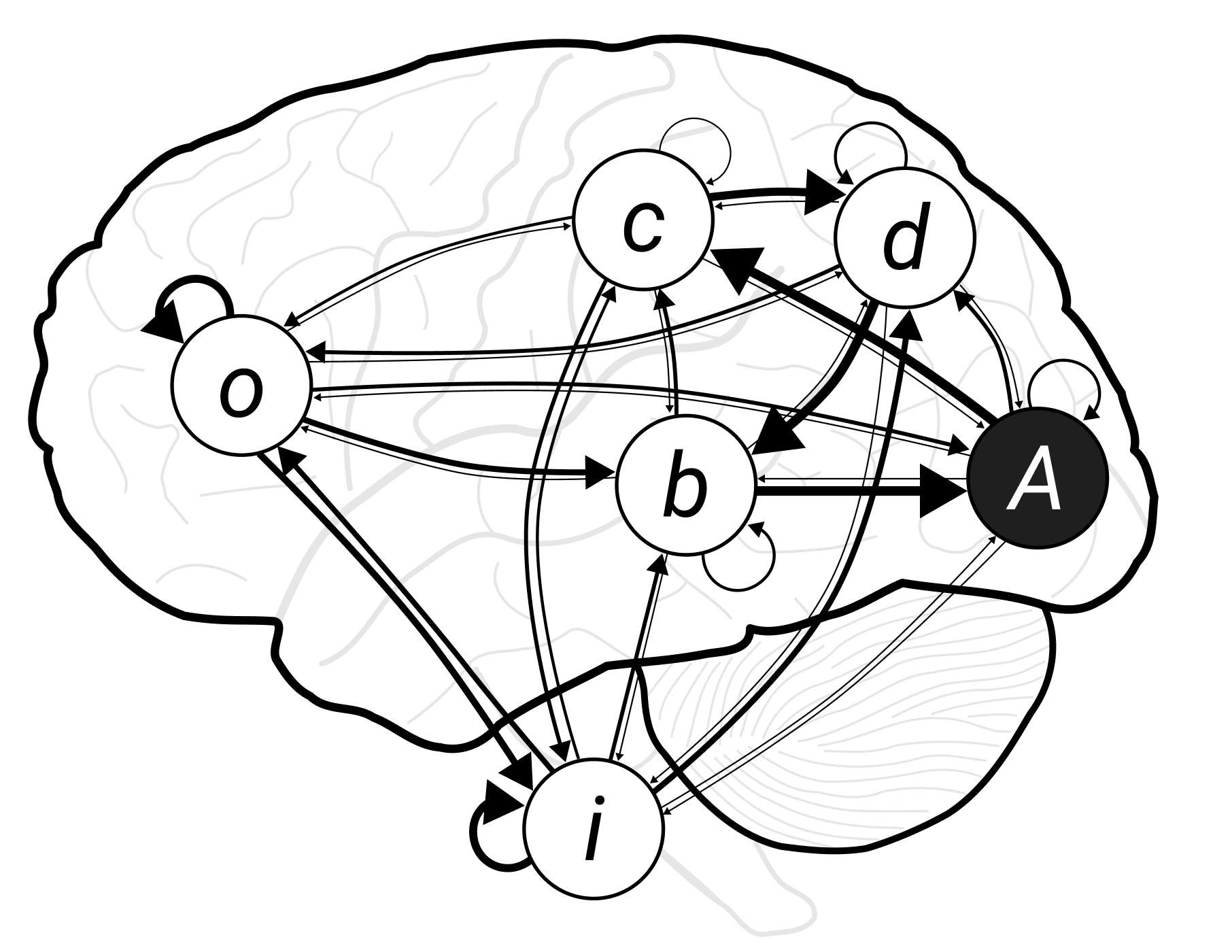
Substrate iAbcdo (uppercase ON, lowercase OFF)
For example, we saw in step 1 that integration is an essential phenomenal property—that every experience is a unitary whole. In step 2, therefore, we ask, What physical (i.e., causal) property might account for this? A natural answer is that the cause–effect power of a substrate must also be a unitary whole. We can probe this by "cutting" the system in different ways to figure out whether it causally "hangs together" as a unitary whole [2]. These sorts of insights have been formalized in mathematical terms in the technical IIT papers (see IIT 4.0).
The upshot of step 2 is the notion of a Φ-structure (pronounced "phi structure"). Also called a cause–effect structure, a Φ-structure is a mathematically precise way to account for the properties of an experience in terms of the cause–effect power of the substrate of that experience (called a complex). The image here, for example, depicts the Φ-structure unfolded from the four-unit substrate Abcd (a subset of iAbcdo above).
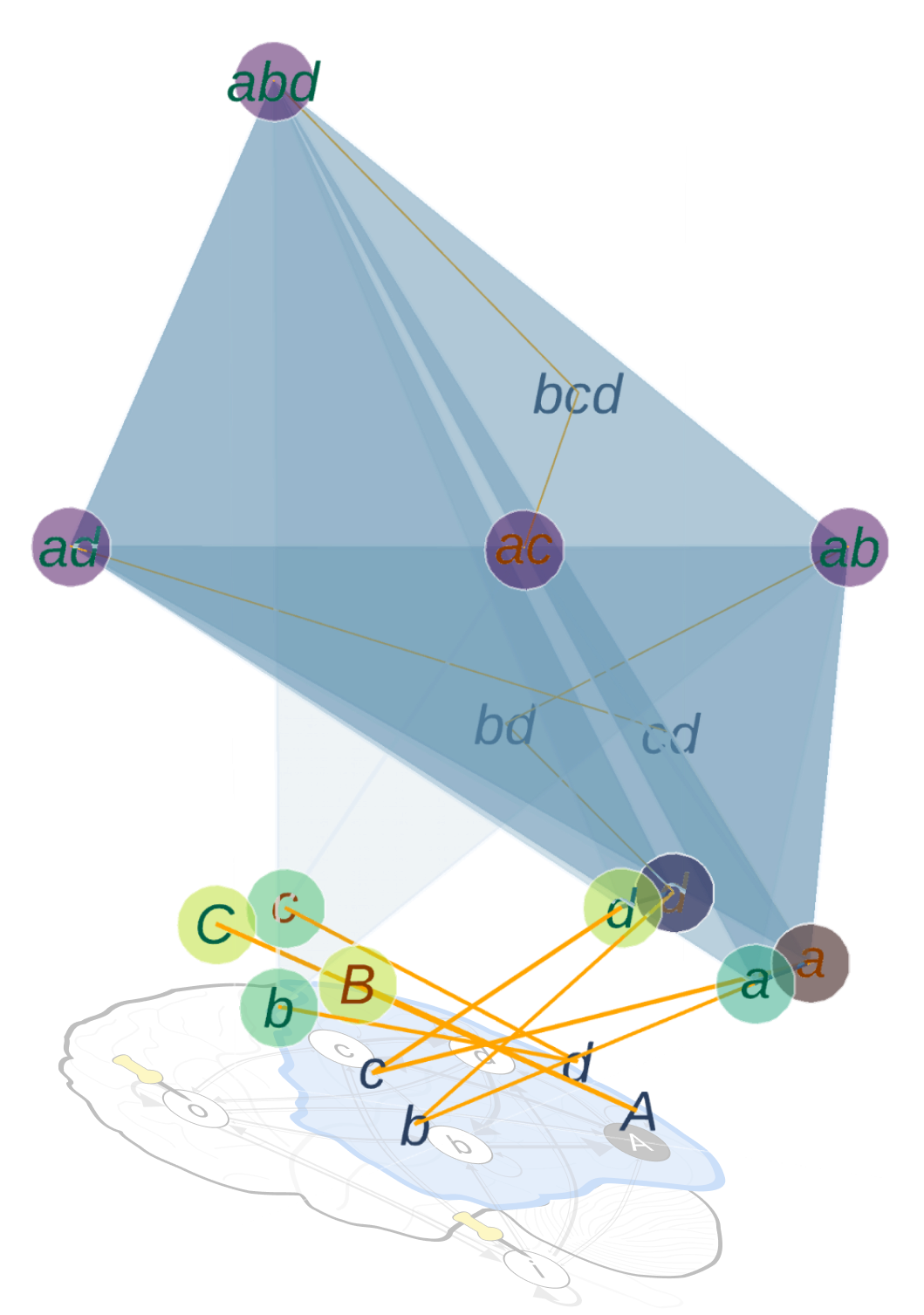
Φ-structure unfolded from Abcd
For more, see
Footnotes
[1] Just as we aim to introspect a single experience, we analyze the cause–effect power of systems in a given state—for example, in the figure here, unit A is ON (uppercase) and all others are OFF (lowercase). [2] More precisely, we assess whether a system is irreducible—whether a partition makes any difference to the intrinsic information specified by the system in its current state.
3. Establish the identity of a phenomenal structure and a Φ-structure
Step 3 is less of a "step" than a moment to pause, zoom out, and make a conjecture based on steps 1 and 2. This conjecture is the explanatory identity of IIT: an experience and a Φ-structure should correspond one-to-one in every respect. The quality of experience corresponds to the specific "shape" of the Φ-structure; in IIT, all quality is structure. And the quantity of experience corresponds to the amount of integrated information (Φ value) of the structure.
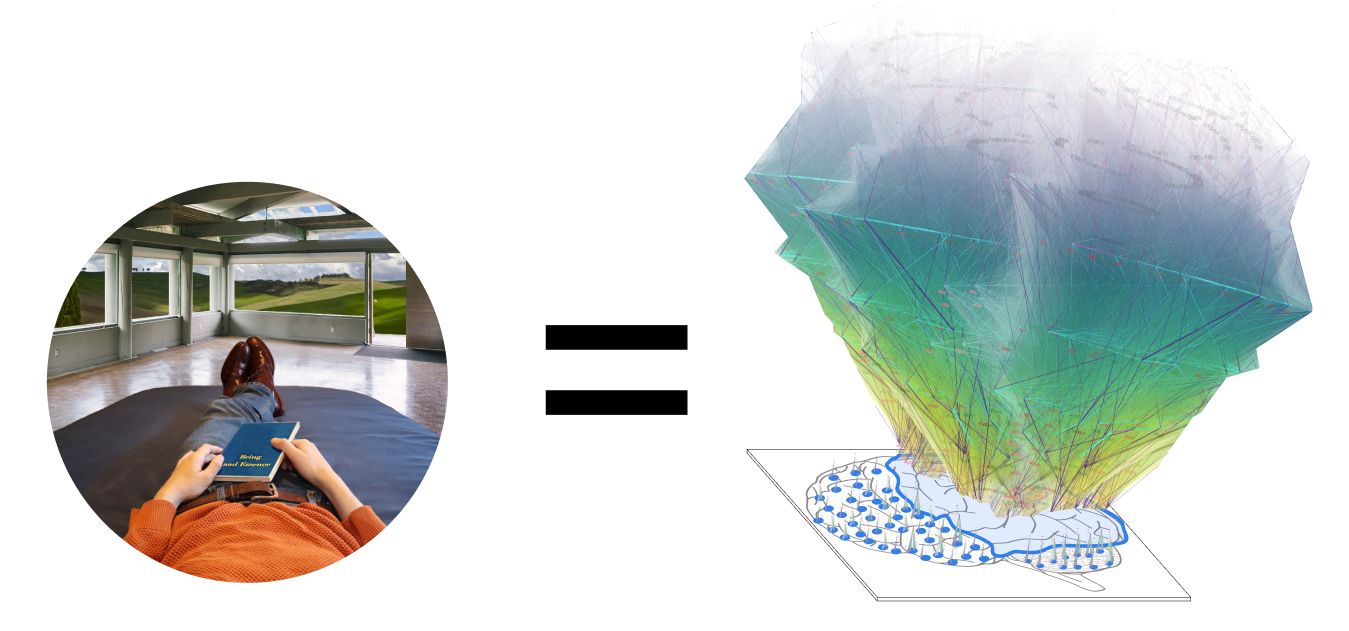
The explanatory identity between an experience (left) and a Φ-structure (right), unfolded from the neural substrate of consciousness, thought to be found in posterior cortex
The fundamental identity between an experience and a Φ-structure is what allows IIT to answer the two key why questions of a theory of consciousness (as outlined above): 1) An experience should be present when the integrated information of the Φ-structure specified by its substrate is high, and it should vanish when integrated information breaks down. 2) A specific experience feels the way it does because the Φ-structure specified by its substrate is composed the particular way it is.
If IIT is right, the neural substrate of consciousness in the human brain unfolds into a Φ-structure of unfathomable richness, as illustrated schematically here.
For more, see
4. Account for contents of experience
The fundamental identity of IIT is a mere conjecture unless it can be demonstrated that all properties of an experience indeed correspond one-to-one with the properties of its corresponding Φ-structure. Hence step 4 is to demonstrate how the tools of IIT allow us to account not only for the essential properties of experience but also for its accidental properties—those that vary across different experiences. For example, in the sample experience depicted above, dominant features include the sight of various objects (e.g., the walls, bed, book) occupying visual space (which has a left side, a right side, etc). All such accidental properties of experience need to be explained, and IIT proposes that we account for these properties as sub-structures in the corresponding Φ-structure.
Hence, step 4 can be thought of as iterating through steps 1–3, but now for the accidental properties of experience. (These iterations are indicated by the large circular arrow in the main graphic). For example, recent work has accounted for why space feels the way it does by analyzing the Φ-structure unfolded from a grid-like substrate (such as that found in posterior cortex). In a similar vein, current IIT projects aim to account for the experiences of time and objects, and future projects aim to account for local qualities such as color.
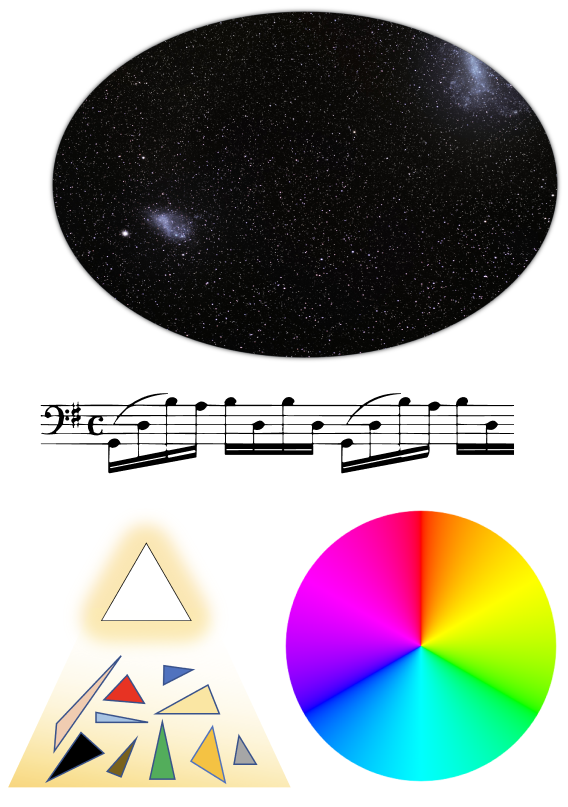
Each of these accounts demonstrates the explanatory power of the fundamental identity and bolsters the IIT framework as an overall good explanation of consciousness.
For more, see
5. Validate empirically in humans
To validate the fundamental identity scientifically, IIT then turns to the brains of humans who can introspect and report their experiences. The theory offers both explanations of well-established facts about the brain and predictions that can be empirically tested.
For example, IIT gives a principled explanation of a long-standing paradox: the cerebral cortex (or a part of it) is tightly linked to consciousness while the cerebellum is not, despite its having the lion's share of neurons. IIT answers this by contrasting the specific causal properties of the two brain architectures: parts of the cortex are organized in such a way that suggests it would unfold into a rich Φ-structure corresponding to an experience, while the cerebellum is not organized in such a way—it would rather unfold into many trivially small Φ-structures. As regards predictions, the most basic one is that integrated information should be high when consciousness is present and negligibly low when consciousness is seemingly absent. This prediction has found substantial evidence using proxy measures of Φ, opening a path toward developing a bedside "consciousness meter" to detect consciousness in unresponsive patients.
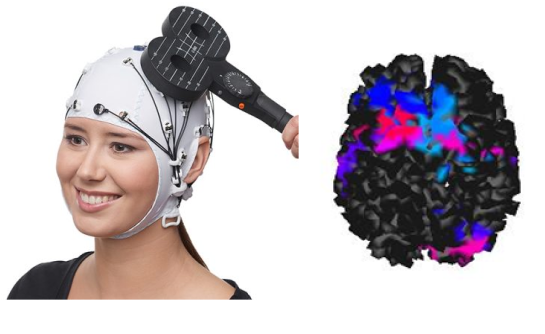
Some of IIT's predictions are quite counterintuitive. For example, IIT predicts that neurons that are inactive (but not inactivated [1]) can contribute to an experience. This may be surprising since inactive neurons are usually assumed to contribute nothing to consciousness. Such predictions are currently being explored empirically.
As indicated by the dotted arrow in the main method graphic above, insights from step 4 about neural connectivity and physiology may indeed feed back into the previous steps to help refine the theory. For example, in our account of spatial experience, we make use of the knowledge that visual cortical areas are arranged as stacks of grids with relatively strong nearest-neighbor connections. Such insights not only help validate the account of space but have also been a useful intuition pump for how to construct the account in the first place.
For more, see
Footnotes
[1] To say that the neurons are inactive but not inactivated means that they are not currently firing but they could fire if stimulated. Inactivated refers to neurons that will not fire even if stimulated.
6. Extrapolate beyond humans
As empirical evidence grows, the IIT account may become increasingly robust as an overall good explanation of both the quantity and quality of consciousness. Only then can we make inferences from a good explanation: principled inferences about consciousness beyond human subjects who can report their experience.

For example, the theory would guide us in assessing consciousness in unresponsive patients (with the support of adequate technology). The principles of IIT also let us predict that typical computers would not be conscious [1] (but an artifact that fulfills the postulates might be). Of course, any conclusions about consciousness beyond humans who can report their experiences will always remain an inference. However, those inferences become more compelling the more thoroughly IIT fulfills the criteria of a good explanation.
Finally, the theory opens the way for principled positions on millennia-old questions about, for example, the place of consciousness in nature, meaning, causation, free will, and even ethics.
For more, see
-
Part III: Implications of IIT's Intrinsic Ontology (in development)
Footnotes
[1] Findlay G, Marshall W, Albantakis L, Mayner WGP, Koch C, Tononi G. Dissociating Intelligence from Consciousness in Artificial Systems – Implications of Integrated Information Theory. In: Proceedings of the 2019 Towards Conscious AI Systems Symposium, AAAI SSS19; 2019 and forthcoming.
>>> Foundations: Phenomenal & Physical Existence
Frequently Asked Questions
What do you mean by consciousness?
Why not build a theory of consciousness starting from empirical neuroscientific research?
If IIT starts from experience, isn't this method "subjective" and thus unscientific?
What constitutes a "good explanation" of consciousness, according to IIT?
Cite this page
Hendren, Jeremiah, Matteo Grasso, Bjørn Erik Juel, and Giulio Tononi. "Overview: IIT as a Theory of Consciousness." In Integrated Information Theory Wiki. Center for Sleep and Consciousness, University of Wisconsin–Madison, 2024. Last modified 19 December 2024. DOI: 10.5281/zenodo.14160283. https://www.iit.wiki/overview.
Archived versions of this page: 30 June 2024
BibTeX
@misc{hendren2024overview,
author={Hendren, Jeremiah and Grasso, Matteo and Juel, Bj{\o}rn Erik and Tononi, Giulio},
title={Overview: {IIT} as a Theory of Consciousness},
howpublished={In {\em {Integrated Information Theory Wiki}}},
year={2024},
publisher={Center for Sleep and Consciousness, University of Wisconsin--Madison},
note={Last modified 19 December 2024. DOI: 10.5281/zenodo.14160283},
url={https://www.iit.wiki/overview}
}
Foundations of IIT: Phenomenal & Physical Existence
Source: https://www.iit.wiki/foundations
Summary
The starting point of integrated information theory (IIT) is the existence of experience (0th axiom). This truth is not the result of an inference; it is rather immediate and confirmed through introspection. From here, IIT asks how we might account for experience in physical terms—that is, in terms of a substrate we can observe and manipulate.
IIT probes this question employing three methodological assumptions: realism, operational physicalism, and atomism. This allows us to postulate the most basic criterion for a substrate of consciousness (0th postulate): it can be characterized operationally by cause–effect power: its units must take and make a difference.
Contents
- 0th Axiom
- Three Methodological Assumptions
- Realism
- Operational physicalism
- Atomism
- 0th Postulate
- Frequently Asked Questions
- Cite this page
This page discussed on our YouTube channel:
Embedded YouTube video: https://www.youtube.com/embed/AHFSJLNYxwo
0th Axiom
Experience exists: there is something.
Imagine that the scientific community found agreement on a measure of consciousness and selected you—a paradigmatic case of a conscious entity—to test the measure. You are awake and aware while they hook you up to the machine, but, to your surprise, the machine displays, "Zero consciousness detected."
Should you trust the machine? Of course not. Whatever the best theories say about consciousness, you require no outer proof to confirm that you are conscious.
This thought experiment is a modern twist on Descartes's famous cogito argument: "I think; therefore I am": even if an evil demon were able to show everything you thought existed to be an illusion, they could never convince you that you aren't experiencing something. Not only does your consciousness exist, but it is the basis for your knowledge about what exists. In philosophers' terms, your consciousness is the foundation of both ontology (the study of what exists) and epistemology (the study of what can be known).
Experience exists [1]. There is "something it is like" to be me, you, or anyone having an experience in a given moment. The existence of experience can also be called phenomenal existence and is the point of departure for IIT. Phenomenal existence is immediate in the sense that you know it directly or "by direct acquaintance"—not through inference. It is also irrefutable—not because you can't doubt it, but because the very act of doubting it confirms its truth; hence it cannot be refuted.
How, then, should we begin to offer a naturalistic account of consciousness (or experience)? From the 0th axiom, IIT takes gradual steps to construct a parsimonious, rigorous, scientific explanation of consciousness in physical terms. This account will refer regularly to the image here as a sample experience.

For more, see the discussion of the 0th Axiom on our YouTube channel.
Footnotes
[1] IIT phrases the 0th axiom as "experience exists" rather than "my experience exists" or "I am having an experience." The reason is that it's more parsimonious to affirm experience without reference to oneself.
Three Methodological Assumptions
Strictly speaking, each of us can only be sure that our own experience exists (0th axiom). Our knowledge about what may exist beyond our experience is inferred from within our experience. In this sense, experience is always primary in IIT. However, for a science of consciousness to get off the ground, we must make some methodological—or operational—assumptions that take us beyond our own experience. In IIT, these assumptions are realism, physicalism, and atomism, explained in turn below.
Each of these IIT describes as an inference to a good explanation. We say "good" here rather than the more typical "best," for where should we stand to judge what's best [1]? However, we can certainly derive "good explanations" in the sense that they allow us to thoroughly account for the regularities we experience (see FAQ: What constitutes a "good explanation" of consciousness, according to IIT?).
Footnotes
[1] The term "inference to the best explanation" is related to what is known as abductive reasoning. It requires multiple options of explanation in order to judge what is "best." To use a typical example, if my lawn is wet, I might infer that it rained last night by discarding other potential explanations—for instance, that my neighbor watered my grass, that a city water pipe burst, etc. IIT rather uses the phrase inference to a good explanation in an attempt to be more humble—to recognize that, when it comes to consciousness, there's no "objective" standpoint from which to determine the options and judge which is "best." With consciousness, we must bootstrap our explanation from the inside out. IIT aims for a "good" explanation, understood in terms of the seven S's presented here.
Realism
something exists independently of our own experience
If you consider the content of your waking experience, you notice regularities. For example, you're reading these words on a screen, with other objects in your visual field. This scene could be a hallucination that exists only as your experience, but it seems more likely that something exists independently of your experience. Why? Because if you close your eyes for a little while and reopen them, you see the same screen and same words in highly predictable ways.
The most reasonable explanation of such regularities is that something other than your own experience exists. In a dream, by contrast, the scenes you experience are often not persistent or predictable—a butterfly might spontaneously morph into a tiger. In other words, objects we experience when we dream do not seem to persist independently of our experience. (In casual speech, we say these contents are not "real"; however, your experience of them is indeed real.)
The only true alternative thesis to realism would be that your experience is all that exists in a solipsistic universe, but this explains nothing and predicts nothing [1]. We can therefore posit realism: something exists independently of your experience.
Note that we posit realism in the most minimal sense. We merely claim that something exists independently of one's experience, but we remain agnostic, for now, about what exactly exists and how. For example, the device you're reading on may or may not exist as "a computer" or "a smartphone," but its persistence and predictable behavior is at least an indication that something else is likely to exist besides your experience of it.
For more, see the discussion of realism on our YouTube channel.
Footnotes
[1] What about the thesis that we could be living in a computer simulation? This is not a true alternative to realism because this, too, would require that something other than your experience exists.
Operational physicalism
what exists can be characterized by cause–effect power
Realism alone, however, does not explain the regularities in experience. How can you check whether the piece of paper in front of you exists? The first step is to probe by manipulating it and observing what happens. If you place it further away, it looks smaller. If you push it off the table, it will drop to the floor. The paper "takes a difference" from you and "makes a difference" to you. Moreover, these manipulations take and make a difference in a way that is reliable and persisting. You see the paper drop to the floor every time you push it, and if you do it again tomorrow, it will behave the same way—that is, you won't see it suddenly turn into a dove instead of simply falling to the floor. Moreover, if you leave it on your desk and return tomorrow, it persists as the same piece of paper as yesterday.
Hence, in IIT, something exists physically if and only if it has the ability to "take and make a difference"—if it has cause–effect power [1].
Ideally, to assess whether something exists physically, we need to be able to manipulate its state and observe the effects of this manipulation. Imagine you find a remote control and suspect it belongs to a TV, but you don't see a TV anywhere. You click the power button and then hear the sound of a TV somewhere in the house (you "observe" it with your ears). You can be confident the TV exists because you could both observe it and manipulate it (through the remote). But imagine you click the remote, and nothing seems to happen. What can you conclude? Not much—it may be unplugged, it may have turned ON but be on mute, or it may not exist at all. What exists may turn out to be just the remote (which you certainly manipulated and observed).
Though we must rigorously observe and manipulate to assess the physical, this does not mean we must remain silent about the existence of things outside our reach or capacity for direct manipulation (e.g., distant stars, the core of planets, or the minds of others). For things we can observe but not manipulate, we infer their existence by analogy with things we can manipulate. For example, since we can observe the doppler effect with objects on earth, we can use the same principle to infer the existence of elements in a star's atmosphere.
In sum, the assumption of operational physicalism stems from our own experience interacting with external entities. But we have no reason not to generalize the assumption to anything that can "take a difference" from and "make a difference" to other things. In other words, anything with cause–effect power exists in a physical sense, and we probe this by observing and manipulating [2].
Note that this notion of physicalism does not presume a "materialist" basis of reality; it only assumes that the physical should be understood operationally as cause–effect power.
For more, see
-
FAQ: What is the meaning of cause–effect power in light of other notions of "causal power"?
-
FAQ: If IIT assumes "physicalism," does this make it a materialist theory of consciousness?
Footnotes
[1] This claim is related to the Eleatic principle first introduced in Plato's Sophist.
[2] When comprehensive observation and manipulation is not possible or convenient (e.g., in the human brain), a valid substitute is to rely on the best available knowledge and explanations for how the system would respond to manipulation. Thus, we can model systems and infer what exists based on these models (while recognizing their limitations).
Atomism
cause–effect power all the way down
So far, we have assumed that something exists besides our own experience (realism), and that the way to probe what exists is through observing and manipulating (physicalism). But to determine exactly what exists and how, a good strategy is to break larger things down into their smallest constituents and study them in detail independently. This strategy can be called "atomism" (in the original sense of atom, meaning that which cannot be further divided). Only when we have a good grasp of the constituents can we hope to provide an account of how they come together as a whole, without leaving anything out.
Atomism is the core of the "reductionist" approach; we use it even as children first exploring the world. For scientists, reductionism is often ontological: that the whole is "nothing but" its constituents. In IIT, however, reductionism is purely operational: to determine what exists and how, we should decompose the system into its constituents. Ideally, we would observe and manipulate the smallest possible constituents to determine the "atoms" of cause–effect power. But how far down can we actually go? This depends purely on the tools available—on the sophistication of our "atomic eyes" and "atomic hands."
As an operational principle, atomism is intended to make our inferences as precise as possible regarding what exists and how. For example, to explain whether and how a tree exists as "a tree," it may not be enough to merely explain it in terms of the cause–effect power of the roots, trunk, branches, and leaves. Perhaps an explanation starting from, say, the level of the woody and vascular tissue or the sugars produced by photosynthesis would provide a more satisfactory account for what the tree is (if it is anything at all).
Atomism is essential for explanatory completeness; it ensures that we can account for the cause–effect power of the whole based on the cause–effect power of its constituents. Note, however, that IIT's operational assumption of atomism does not make the theory reductionist in an ontological sense.
For more, see the discussion of atomism on our YouTube channel.
0th Postulate
The substrate of consciousness can be characterized operationally by cause–effect power: its units must take and make a difference.
Given that experience exists (0th axiom), we can now use the three operational assumptions above as a frame to ask, How can we account for the fact of experience in physical terms? The 0th postulate (also called the existence postulate) guides us to explore this question in purely operational terms—that is, to account for experience in terms of the cause–effect power of a substrate.
The term substrate refers to anything we can observe and manipulate. A substrate could be a set of neurons, which in the context of consciousness science is a reasonable place to begin. But there is no reason to limit ourselves to the brain.
The 0th postulate employs the assumptions of realism—"there must be something 'out there' that is a substrate of consciousness"—and of physicalism—"whatever that substrate turns out to be should be defined in terms of cause–effect power." The 0th postulate also implicitly includes the assumption of atomism in that a full characterization of a substrate of consciousness must be in terms of cause–effect power "all the way down."
To assess the cause–effect power of a substrate, we use a perturbational approach: we manipulate units (e.g., neurons ) and observe and record the results in a transition probability matrix (TPM). With a complete substrate TPM, we can then also represent the causal interactions visually using a substrate graph.
The slideshow below illustrates the existence postulate and the operational tools of TPMs and substrate graphs.
Slideshow 1: Existence - 0th Postulate - Dec. 2022 — the deck embedded on the wiki page.
Slides: iit-wiki-slides-foundations
As we will see in the coming pages, the 0th postulate puts a strict constraint on the IIT method: it guides us to formulate each essential phenomenal property (axiom) as an essential physical property of the substrate of consciousness (postulate), understood strictly in terms of cause–effect power.
For more, see
Frequently Asked Questions
Why not build a theory of consciousness starting from empirical neuroscientific research?
If IIT starts from experience, isn't this method "subjective" and thus unscientific?
What is the meaning of cause–effect power in light of other notions of "causal power"?
Why is the perturbational approach so important in IIT?
How do we get a TPM?
Cite this page
Hendren, Jeremiah, Matteo Grasso, Bjørn Erik Juel, and Giulio Tononi. "Foundations of IIT: Phenomenal & Physical Existence." In Integrated Information Theory Wiki. Center for Sleep and Consciousness, University of Wisconsin–Madison, 2024. Last modified 30 June 2024. DOI: 10.5281/zenodo.14160283. https://www.iit.wiki/foundations.
BibTeX
@misc{hendren2024foundations,
author={Hendren, Jeremiah and Grasso, Matteo and Juel, Bj{\o}rn Erik and Tononi, Giulio},
title={Foundations of {IIT}: Phenomenal \& Physical Existence},
howpublished={In {\em {Integrated Information Theory Wiki}}},
year={2024},
publisher={Center for Sleep and Consciousness, University of Wisconsin--Madison},
note={Last modified 30 June 2024. DOI: 10.5281/zenodo.14160283},
url={https://www.iit.wiki/foundations}
}
Axioms & Postulates of IIT: From Phenomenology to Physics
Source: https://www.iit.wiki/axioms-and-postulates
Summary
The five axioms of integrated information theory (IIT) express the essential properties of experience, discovered through introspection and reasoning. In the IIT method, we then ask, What physical properties of the substrate of consciousness might account for these five properties of experience? The answer is found by formulating each of the phenomenal axioms as a physical postulate that the substrate of consciousness must fulfill—that is, by formulating each axiom as a postulate in terms of cause–effect power.
This page offers a succinct overview of the axioms and postulates. Detailed explanations of each axiom–postulate pair can be found on the linked pages.
Contents
- Five Axioms: Essential properties of every experience
- The Axioms discussed on our YouTube channel
- Five Postulates: Essential properties of the substrate of consciousness
- Axiom → Postulate Summary
- Frequently Asked Questions
- Cite this page
Five Axioms: Essential properties of every experience
What are the differences between hearing a Bach fugue, feeling a toothache, dreaming of flying, and resting in deep meditative absorption? Try to list them out. You could spend the rest of your life on this list, and there would still be more to say. But what if you were to describe what these experiences have in common? This list would be short and pithy—getting to the heart of what it means to have any experience whatsoever.
You might begin by observing that in each case, there is "something it is like" to experience them [1]. The something is what varies, but the fact that they feel like something is shared across these and every other experience—otherwise, it wouldn't be an experience at all. Your own experience requires no proof: you know you are conscious. Likewise, experience is the single thing you cannot deny "from within" either. Paraphrasing Descartes's cogito argument, the presence of your experience is irrefutable and thus proof that something exists (see 0th Axiom) [2].
The five axioms of IIT begin where Nagel and Descartes leave off. They characterize the essential properties of all experiences from the only authoritative perspective—yours and mine as experiencing subjects. This step is necessary to study consciousness scientifically: before we develop hypotheses and enter the lab, we must agree on and thoroughly describe the object of study—in this case, the properties of experience. Though we must use introspection in this step, the result is nevertheless a set of axioms that are universal in the sense that they can (and should) be confirmed by each person independently. This step of characterizing experience has been often ignored in the science of consciousness, yet only by first characterizing experience precisely can we then account for it precisely.
The five axioms are essential properties of experience because they characterize what experience is—or the nature of experience—and because they are irrefutably true of every conceivable experience, as confirmed through introspection and reflection alone. The axioms can be most succinctly stated as follows (the links offer extended explanations):
Existence (0th axiom): Experience exists: there is something.
Intrinsicality: Experience is intrinsic: it exists for itself.
Information: Experience is specific: it is this one.
Integration: Experience is unitary: it is a whole, irreducible to separate experiences.
Exclusion: Experience is definite: it is this whole.
Composition: Experience is structured: it is composed of distinctions and the relations that bind them together, yielding a phenomenal structure that feels the way it feels.
In characterizing experience, the axioms characterize phenomenal existence. In line with Descartes's cogito, the existence of one's own experience is, strictly speaking, the only irrefutable truth. For IIT, this has not only epistemological but also ontological import: to reflect on the properties of experience is to reflect on the properties of existence.
The axioms of IIT are not necessarily self-evident, but they are indeed irrefutable. This means that one can try to doubt them, but through the process of doubting them, we necessarily confirm them [3]. They are also immediate in experience: just as Descartes needed no proof for his cogito, the axioms of IIT can only be discovered (and confirmed) through introspection and reflection.
In compiling a list of essential properties of consciousness, we should also consider what should be left off the list. Non-essential properties of consciousness are accidental (or "contingent") if they may apply to some experiences but not others. Some obvious candidates are color and pain because we can easily imagine experiences without them. Less obvious candidates might be space and time, yet, in IIT, these are not axioms as they are not essential properties of every conceivable experience.
As you grapple with the five axioms, keep in mind that you may at times feel like a fish trying to make sense of water: they aim to describe facts about every experience of your life—features that are omnipresent and thus challenging to recognize. In this sense, a given axiom may even appear trivial at points. The importance of each axiom, however, will become clearer once it is paired with its respective postulate, or essential property of the substrate of consciousness.
For more, see
-
FAQ: If the axioms are "immediate" and "irrefutably true," shouldn't they also be self-evident?
-
FAQ: Why aren't the experiences of space and time considered axioms in IIT?
Footnotes
[1] This is an oft-cited way of defining consciousness from Nagel, T. 1974. What is it like to be a bat? The Philosophical Review, 83(4), 435–450. Also see FAQ: What do you mean by consciousness?
[2] Descartes used the term "indubitable," though irrefutable is also more accurate for his intended meaning: we can indeed doubt whether we are having an experience, but through doubting, we discover that we cannot refute our experience—for doubting, too, is an experience.
[3] In math and logic, this form of reasoning is known as proof by contradiction or reductio ad impossibile. Also see FAQ: What is meant by the term axiom in IIT?
The Axioms discussed on our YouTube channel
Embedded YouTube video: https://www.youtube.com/embed/yxvE_KPF1Ag
Five Postulates: Essential properties of the substrate of consciousness
The five essential properties of experience outlined above must have an explanation—how might we account for them in physical terms? Based on minimal methodological assumptions, IIT answers this question by formulating each of the five axioms above as a postulate about the substrate of consciousness.
Why not just look directly at the brain to account for the axioms? Isn't first "formulating" the axioms as postulates a roundabout approach? A more complete response is given here. But, in short, we don't start from the brain because we have little idea what we're looking for. The human brain is, by many measures, the most complex known object in the universe, with approximately 80 billion neurons and 100 trillion synapses. We need guidance on what aspect of this sublime jumble might let us account for the two why questions that IIT aims to answer as a theory of consciousness.
IIT constrains the search in three ways. First, we look specifically for physical properties that correspond to the essential properties of experience (axioms). Second, we start from a highly parsimonious notion of the physical as cause–effect power—the ability to "take and make a difference," as demonstrated through operational interventions (see 0th postulate.) And third, we deliberately work with idealized systems of a few units, so that we can characterize cause–effect power as exhaustively as possible in a controlled setting. This approach does not mean that we ignore all we know about neurons and synapses, and about the neural, functional, and behavioral correlates of consciousness. Rather, we first use the postulates to establish a principled explanation of consciousness in physical terms, and then turn to empirical neuroscience to validate this explanation.
We saw above that each axiom characterizes an essential property of experience—one that defines what experience is. Each postulate, in turn, characterizes how the cause–effect power of a substrate of consciousness must be to account for the respective axiom. Thus they are called postulates because they are postulated based on what we know about the essential properties of experience.
The postulates can be most succinctly stated as follows (the links offer extended explanations):
Existence (0th postulate): The substrate of consciousness can be characterized operationally by cause–effect power: its units must take and make a difference.
Intrinsicality: Its cause–effect power must be intrinsic: it must take and make a difference within itself.
Information: Its cause–effect power must be specific: it must be in this state and select this cause–effect state.
Integration: Its cause–effect power must be unitary: it must specify its cause–effect state as a whole set of units, irreducible to separate subsets.
Exclusion: Its cause–effect power must be definite: it must specify its cause–effect state as this whole set of units.
Composition: Its cause–effect power must be structured: subsets of units must specify cause–effects over subsets of units (distinctions) that can overlap with one another (relations), yielding a cause–effect structure that is the way it is.
As a reminder, the postulates do not presume a substrate to exist as such. We rather treat the substrate as our operational basis to assess the physical properties in question. Only by applying all postulated properties together can we determine and characterize the substrate of consciousness. By IIT, what truly exists in the end is not the simple substrate of units per se, but rather a complex unfolded as a cause–effect structure (or Φ-structure). This is what truly exists because its properties are what correspond one-to-one with the properties of experience—the existence of which is immediate and irrefutable. For more, see the explanatory identity of IIT.
For more, see FAQ: Why are the postulates so important in IIT?
Axiom → Postulate Summary
Below is a synopsis of how each axiom is formulated as its corresponding postulate. This overview is meant to serve more as an abridged reference than as a learning tool; we suggest you click on the individual axiom–postulate pages to explore them more thoroughly.
Existence (0th)

Given that my experience exists, immediately and irrefutably (left), I infer that the substrate of consciousness can be characterized operationally by cause–effect power, which I can probe by observing and manipulating (eye & hand on brain) the states of its units. Its cause–effect power can be captured in a transition probability matrix (not shown) and depicted as a substrate graph (middle).
Intrinsicality

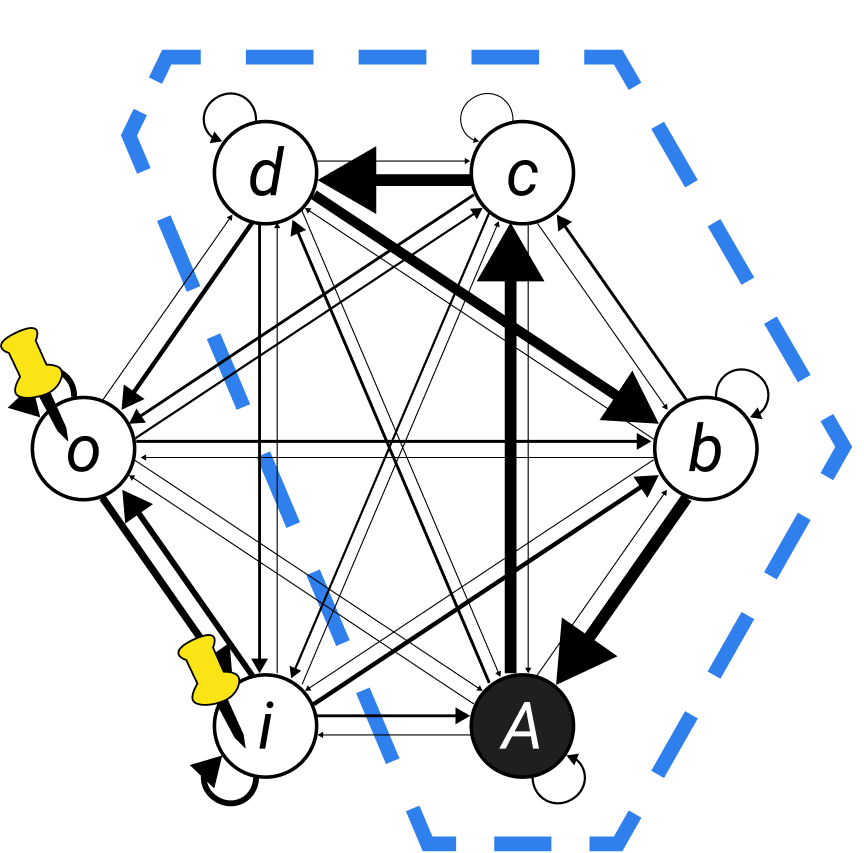
Just as my experience exists for itself (left), the cause–effect power of its substrate must be intrinsic—it must take and make a difference within itself (right). The dotted blue line on the substrate indicates a candidate substrate (ABCD), whose causal powers may be analyzed within itself, holding background conditions fixed (pins).
Information
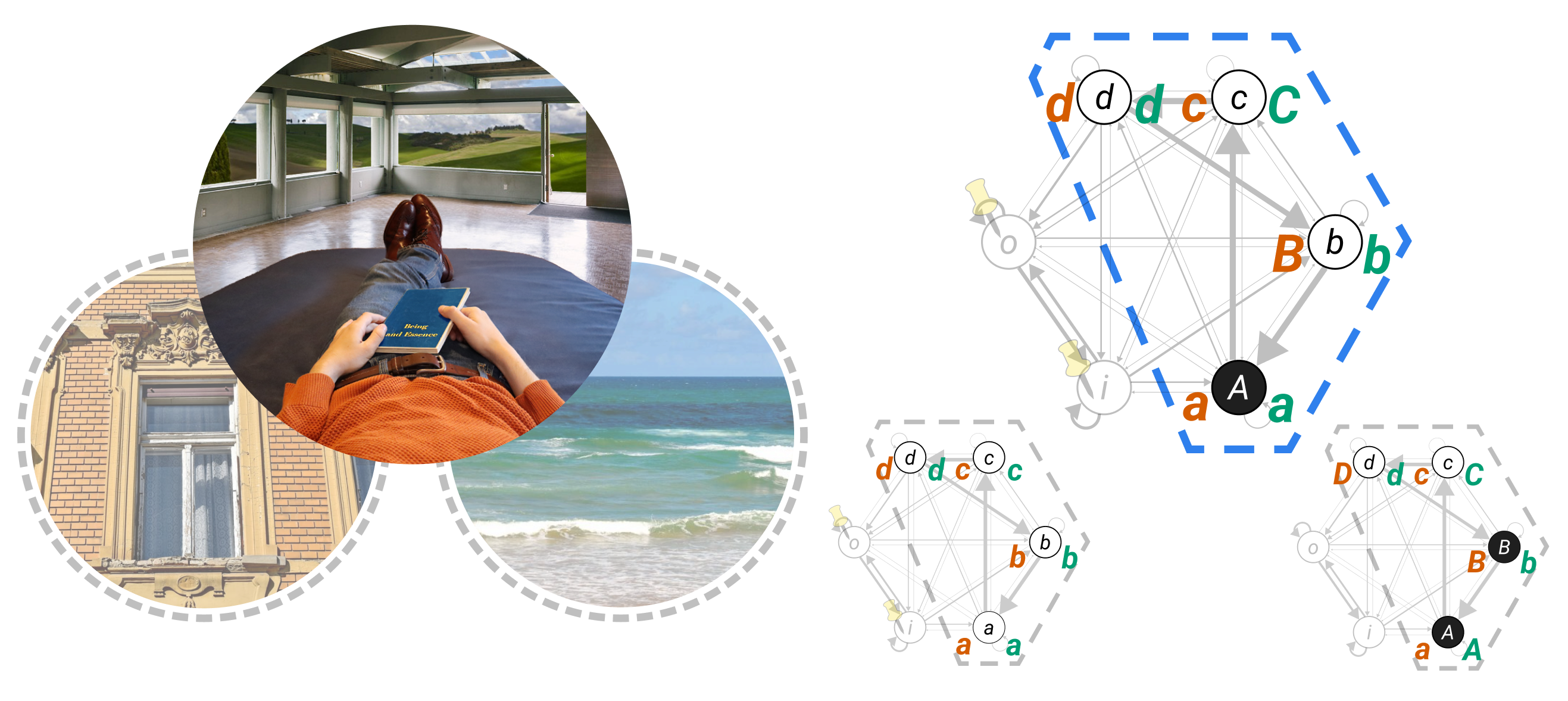
Just as my experience is specific (left), the cause–effect power of its substrate must be specific (right): it must be in a specific state (Abcd, uppercase ON, lowercase OFF) and select a specific cause–effect state (aBcd–abCd). And just as my experience—by virtue of being specific—differs from countless other experiences (left), the cause–effect state of its substrate is also differentiated from a repertoire of alternative states (right).
Integration
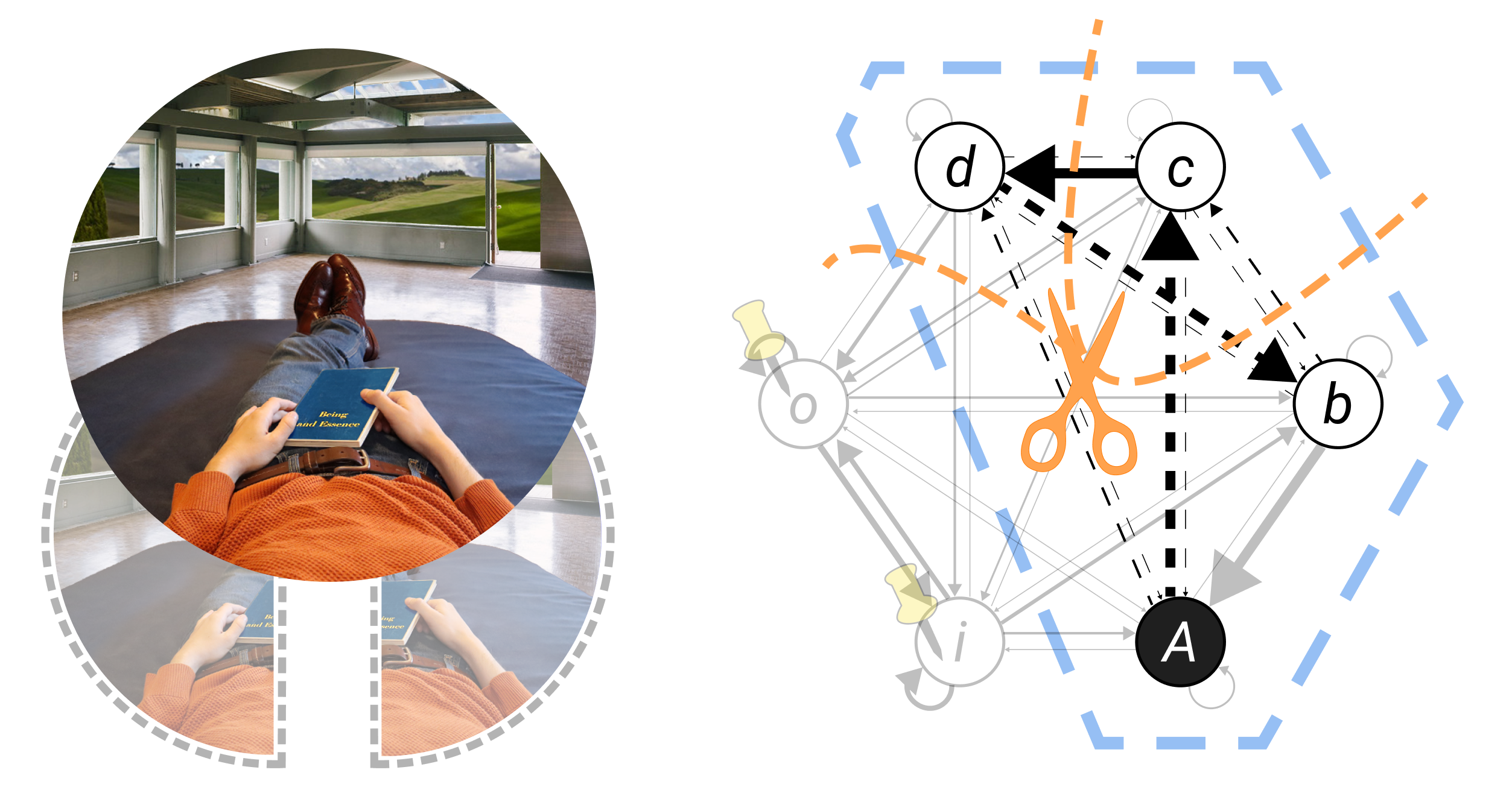
Just as my experience is unitary (left), the cause–effect power of its substrate must be unitary (right). This can be evaluated by finding the system's minimum partition (orange), which yields its integrated information (φs): the degree to which the cause–effect state specified by its current state (Abcd) cannot be reduced to that specified by separate parts (here, Ab, c, & d).
Exclusion
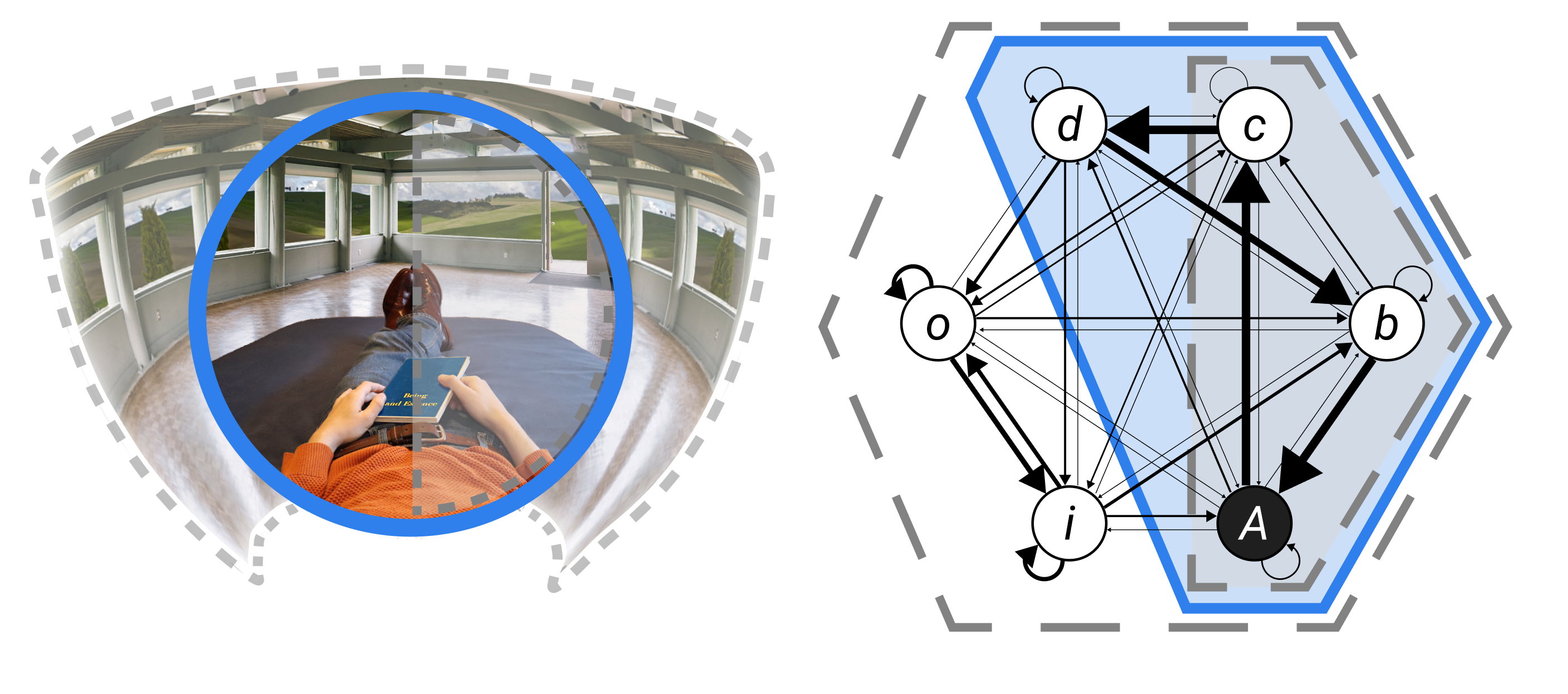
Just as my experience is definite (left), the cause–effect power of its substrate must be definite (right). A complex (Abcd) is the set of units that exists the most (for which φs is maximal), excluding all smaller or larger overlapping sets. Here Abcd exists the most (blue area), thus excluding, for example, Abc and iAbcdo (dashed gray lines).
Composition
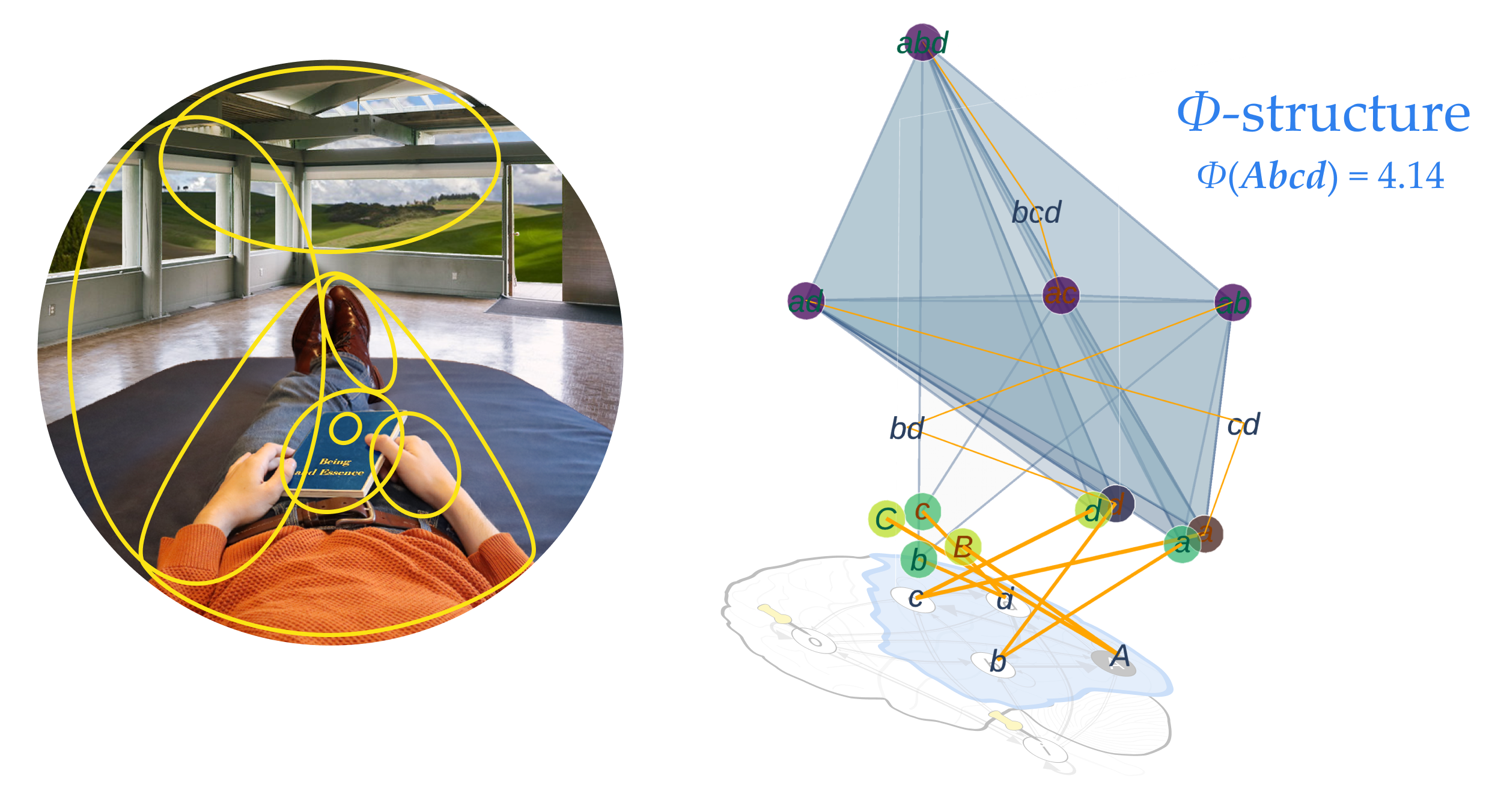
Just as my experience is structured by phenomenal distinctions and relations (left), the cause–effect power of the complex must be structured by causal distinctions and relations specified by subsets of units over subsets of units (right). Together, distinctions and relations compose the Φ-structure unfolded from a complex, which captures the quality and quantity of experience.
Frequently Asked Questions
If you would like to ask or upvote a new question, please see the discussion threads at the bottom of each specific axiom/postulate page.
Axioms/Postulates in General
What is meant by the term axiom in IIT?
If the axioms are "immediate" and "irrefutably true," shouldn't they also be self-evident?
Why aren't the experiences of space and time considered axioms in IIT?
Why are the postulates so important in IIT?
Existence Axiom/Postulate
If IIT starts from experience, isn't this method "subjective" and thus unscientific?
What is the meaning of cause–effect power in light of other notions of "causal power"?
Intrinsicality Axiom/Postulate
How does intrinsic in IIT relate to the notion as used in philosophy (e.g. Lewis)?
Information Axiom/Postulate
Is my experience "specific" owing to the potential experiences I could be having?
Can't I have a vague or generic experience, which isn't "specific"?
How is information in IIT different from "Shannon information"?
Integration Axiom/Postulate
If I have two unrelated contents of experience, doesn't this mean my experience is not "unitary"?
Exclusion Axiom/Postulate
Composition Axiom/Postulate
Aren't there some experiences that have no structure?
What counts as a "component" of experience?
Cite this page
Hendren, Jeremiah, Matteo Grasso, Bjørn Erik Juel, and Giulio Tononi. "Axioms & Postulates: From Phenomenology to Physics." In Integrated Information Theory Wiki. Center for Sleep and Consciousness, University of Wisconsin–Madison. Last modified June 30, 2024. DOI: 10.5281/zenodo.14160283. https://www.iit.wiki/axioms-and-postulates.
BibTeX
@misc{hendren2024axioms&postulates,
author={Hendren, Jeremiah and Grasso, Matteo and Juel, Bjørn Erik and Tononi, Giulio},
title={Axioms & Postulates: From Phenomenology to Physics},
howpublished={In {\em {Integrated Information Theory Wiki}}},
year={2024},
publisher={Center for Sleep and Consciousness, University of Wisconsin--Madison},
note={Last modified 30 June 2024. DOI: 10.5281/zenodo.14160283},
url={https://www.iit.wiki/axioms-and-postulates}
}
Intrinsicality
Source: https://www.iit.wiki/axioms-and-postulates/intrinsicality
1st axiom & postulate of IIT
Summary
Intrinsicality is an essential property of experience (an axiom) and, by inference, also an essential property of the substrate of consciousness (a postulate).
The axiom states that experience is intrinsic: it exists for itself. Formulated in physical terms, the postulate states that the cause–effect power of the substrate of consciousness must be intrinsic: it must take and make a difference within itself.
Contents
Intrinsicality Axiom
Experience is intrinsic: it exists for itself.
[Excerpt from Tononi, G. (in prep.), On Being. Citation details at bottom of page.]
Consider again the experience I have awakening from dreamless sleep. Soon enough, I will recognize my room, know where and who I am; thoughts and memories will rush in, and the onslaught of events, words, goals, and tasks will start. But sometimes, for a few moments, with my eyes still closed, I may not even realize who I am, whether I am human or some other animal, whether I am male or female, knowing nothing about where and when, without the intrusion of thoughts or memories. Yet something exists: a feeling of pure presence. And that feeling of pure presence, like every other feeling, exists from its intrinsic perspective, which may also be called subjective (symbolized by the halo in the figure).
Intrinsic thus denotes the property of existing for itself—from the inside—as opposed to existing for something else—from the outside. It does not denote the property of existing by itself—independently of anything outside. Likewise, subjective is meant in the classic sense of existing inside the mind, as opposed to objective in the sense of existing outside the mind. It does not imply that there is a subject "looking" at the experience as an object [1].

Intrinsicality was implicitly recognized by Descartes, as suggested by his use of the first person in "I think, therefore I am"—although he did not explicitly characterize intrinsicality as a property of existence. Again, in characterizing intrinsicality, the words I, my, and me should be understood as referring to the private nature of the experience, without implying the existence of a "self" or "person." William James, after recognizing existence ("thought goes on"), also singled out intrinsicality as an essential feature of experience: "In this room—this lecture-room, say—there are a multitude of thoughts, yours and mine […]. My thought belongs with my other thoughts, and your thought with your other thoughts. […] It seems as if the elementary psychic fact were not thought or this thought or that thought, but my thought, every thought being owned" [2].
Like phenomenal existence, intrinsicality is an axiom because it is immediate and irrefutably true of every conceivable experience. It is immediate because I do not need to infer that the experience I am having is felt from my intrinsic perspective—it is right here, right now, "in front of my eyes." Intrinsicality is irrefutable, in the sense that its negation is self-contradictory or absurd. If I try to think of an experience that were not occurring from my intrinsic perspective—that is, not the experience right here, right now, but an experience from some other perspective, right there, right then—I would have to conclude that the experience is occurring for another subject of experience. And that experience, too, would be occurring from its own intrinsic perspective, which reaffirms the validity of the axiom. Moreover, intrinsicality is true not just of the experience I am having now, but it must be true of every conceivable experience. It is thus an essential property of phenomenal existence.
Footnotes
[1] Nobody is looking; something is being. This idea has also been expressed by saying that experience is intransitive, in the sense that it does not point to an object as distinct from the subject. It is also related to the notion of nonduality in Indian traditions.
[2] James, William. (1890). The Principles of Psychology, Chapter IX. Project Gutenberg 2018. He continues, "Neither contemporaneity, nor proximity in space, nor similarity of quality and content are able to fuse thoughts together which are sundered by this barrier of belonging to different personal minds. The breaches between such thoughts are the most absolute breaches in nature."
Intrinsicality Postulate
The cause–effect power of the substrate of consciousness must be intrinsic: it must take and make a difference within itself.
[Excerpt from Tononi, G. (in prep.), On Being. Citation details at bottom of page.]
How can we formulate the phenomenal property of intrinsicality as a corresponding property of a substrate? Phenomenally, intrinsicality means that every experience exists for itself, from the intrinsic perspective of a conscious being. Granted that physical existence is equivalent to cause–effect power, intrinsicality means that a substrate of consciousness must have cause–effect power for itself—taking and making a difference within itself from its intrinsic perspective, not from the extrinsic perspective of something outside. In other words, for something to exist for itself, the way consciousness does, it must be able to take a difference from itself and make a difference to itself.
Operationally, to establish whether a substrate can be characterized according to intrinsicality, we need to choose a set of units in a state as a candidate substrate, delimiting it from all units external to it. In our case, we choose ABCD (figure below, dashed blue outline on the brain and the TPM). The external units I and O then serve as background conditions, with their states fixed (causal marginalization, yellow pins) [1]. From the TPM of ABCD, we can then determine whether the candidate substrate has cause–effect power within itself—whether it can reliably take a difference from and make a difference to itself. For example, we may observe that setting all four units to ON increases the probability that the output state will also be all ON (0.6, bottom-right square of TPM below), whereas setting all four units to OFF increases the probability of output state all OFF (0.9, top-left square of TPM). Once again, we compare against chance—that is, the probability of obtaining the output state regardless of the state we impose on its units. We can thus conclude that the candidate substrate can take and make a difference within itself—from itself to itself.
Slideshow 1: Intrinsicality Postulate - 08/2023 — the deck embedded on the wiki page.
Slides: iit-wiki-slides-intrinsicality
The reason for describing ABCD as a candidate here is that a substrate only qualifies as a substrate of consciousness if it can be characterized in line with all the remaining postulates. In practice, the choice of candidate substrates would not be arbitrary but rather guided by reasonable inferences about how likely a given substrate would be to qualify as a complex.
Intrinsicality is simple to assess operationally; yet note that this postulate has far-reaching consequences. It requires us to take the intrinsic perspective of a given system—that is, to assess its cause–effect power from the perspective of the system itself rather than from that of an external observer of that system. As we will see, the intrinsic perspective figures strongly in all remaining postulates and their mathematical formalism.
Footnotes
[1] The reason to fix background conditions is that from the intrinsic perspective of the substrate of consciousness, its existence depends on the causal powers of its own units—which is to say it depends on the repertoire of possible internal states, given some fixed external state or condition. On the other hand, the causal powers of external units—the repertoire of possible external states—are not accessible intrinsically. By the same token, cause–effect power only "counts" as intrinsic if it is exerted by the units of a candidate substrate directly onto substrate units. Indirect influences, mediated by units external to the candidate substrate, do not exist intrinsically and must be discounted. Another way to say this is that unit A's cause–effect power specifies unit B within a candidate substrate only if its power cannot be "screened off" by another unit external to the system. [For more, see this FAQ]
Frequently Asked Questions
What is meant by the term axiom in IIT?
If the axioms are "immediate" and "irrefutably true," shouldn't they also be self-evident?
Does intrinsicality imply an ego, self, self-awareness or self-report?
How does intrinsic in IIT relate to the notion as used in philosophy (e.g. Lewis)?
Cite this page
Citation for the text:
Tononi, Giulio. "Intrinsicality." Excerpt from On Being (in preparation). In Integrated Information Theory Wiki. Center for Sleep and Consciousness, University of Wisconsin–Madison, 2024. Last modified 30 June 2024. DOI: 10.5281/zenodo.14160283. https://www.iit.wiki/axioms-and-postulates/intrinsicality.
BibTex
@misc{tononi2024intrinsicality,
author = {Tononi, Giulio},
title = {Intrinsicality},
note = {Excerpt from {\em {On Being}} (in preparation)},
howpublished = {In {\em {Integrated Information Theory Wiki}}},
publisher = {Center for Sleep and Consciousness, University of Wisconsin--Madison},
year = {2024},
doi = {10.5281/zenodo.14160283},
url = {https://www.iit.wiki/axioms-and-postulates/intrinsicality}
}
Citation for the slides:
Hendren, Jeremiah, Matteo Grasso, Bjørn Erik Juel, and Giulio Tononi. "Intrinsicality slides." In Integrated Information Theory Wiki. Center for Sleep and Consciousness, University of Wisconsin–Madison, 2024. Last modified 30 June 2024. DOI: 10.5281/zenodo.14160283. https://www.iit.wiki/axioms-and-postulates/intrinsicality.
BibTeX
@misc{hendren2024intrinsicality,
author={Hendren, Jeremiah and Juel, Bj{\o}rn Erik and Grasso, Matteo and Tononi, Giulio},
title={Intrinsicality Slides},
howpublished={In {\em {Integrated Information Theory Wiki}}},
year={2024},
publisher={Center for Sleep and Consciousness, University of Wisconsin--Madison},
note={Last modified 30 June 2024. DOI: 10.5281/zenodo.14160283},
url={https://www.iit.wiki/axioms-and-postulates/intrinsicality}
}
Information
Source: https://www.iit.wiki/axioms-and-postulates/information
2nd axiom & postulate of IIT
Summary
Information is an essential property of experience (an axiom) and, by inference, also an essential property of the substrate of consciousness (a postulate).
The axiom states that experience is specific: it is this one. Formulated in physical terms, the postulate states that the cause–effect power of the substrate of consciousness must be specific: it must be in this state and select this cause–effect state.
Contents
Information Axiom
Experience is specific: it is this one.
[Excerpt from Tononi, G. (in prep.), On Being. Citation details at bottom of page.]
No matter what my experience might be—pure blackness and silence before I open my eyes, or, once I open them, the bright blueness outside the window, or the sight of my body on the bed in my room—my experience is always a specific one, this one. What would it even mean to have a generic experience? To see a color that is not black or blue, but generic? A description of an experience may be generic, yet the experience itself is always specific [1]. And the experience I am having is specifically this one rather than another one—it is always the specific one it is.
Because an experience is always this specific one, it also differs from a large repertoire of other possible experiences, each of which is also specific, as illustrated in the figure. The availability of this repertoire is called differentiation [2].

Information is immediate, in the sense that I do not have to infer that an experience is this one: the experience I am having is the one "right here, in front of my eyes." Information is also irrefutable, in the sense that its negation is self-contradictory or absurd. Think of having an experience that were not "this one." I cannot conceive of an experience that were not the one it is, but generic. And while I can conceive that my experience could be some other one—"that one"—when I experience it, it would be "this one," reaffirming the validity of the axiom. Finally, specificity is true not just of the experience I am having now, but it must be true of every conceivable experience—every experience must be "this one" when I experience it. Therefore, information is another essential property of phenomenal existence.
Footnotes
[1] Note that "generic" as opposed to "specific" (or "determinate") is different from "general" as opposed to "particular" [...].
[2] Unlike information ("an experience is this specific one"), differentiation ("it is one out of many possible experiences") is not axiomatic because it depends on the assumption that there are other possible experiences. It is conceivable that there could be no other experiences besides the one I am having: my momentary experience right now may have "come out of nowhere" and may immediately "go back to nowhere."
Information Postulate
The cause–effect power of the substrate of consciousness must be specific: it must be in this state and select this cause–effect state.
[Excerpt from Tononi, G. (in prep.), On Being. Citation details at bottom of page.]
Phenomenally, information means that every experience is specific—it is this one—rather than being generic or being a different one. In physical terms, this means that the substrate must be in a specific state (this state) and "select" a specific cause state and a specific effect state over itself (this cause–effect state). The specific state the substrate is currently in—which units are ON and which are OFF—is established by observation. In the case illustrated in the figure below, the current state is Abcd [1]. The specific cause and effect state are established by considering the column (inputs) and row (outputs) of the substrate TPM corresponding to its current state (red column and green row).
The current state has several possible causes (input states that increase its probability above chance) and several possible effects (output states whose probability it increases above chance). To determine which of these the system selects, we follow the principle of maximal existence. The principle states that, when it comes to a requirement for existence, what exists is what exists the most. In the case of information, the substrate selects the cause for which it takes the most difference from itself (its maximal or intrinsic cause) and the effect for which it makes the most difference to itself (its maximal or intrinsic effect).
In the figure, the substrate selects cause state aBcd and effect state abCd (indicated by the red and green squares on the TPM, respectively). Together, they make up the specific, intrinsic cause–effect state aBcd–abCd. Operationally, the cause–effect state is determined by evaluating intrinsic information (ii) for all possible cause and effect states and selecting the intrinsic cause and effect for which ii is maximal—the state that is maximally informative intrinsically [2]. For the example substrate state Abcd, the maximal ii on the cause side is 2.58 (iic*), corresponding to aBcd, and on the effect side it is 3.01 (iie*), corresponding to abCd.
Slideshow 1: Information Postulate - 08/2023 — the deck embedded on the wiki page.
Slides: iit-wiki-slides-information
Intrinsic information measures the specific cause–effect power from the intrinsic perspective of a system in its current state and is defined as the product of informativeness and selectivity [3]. Informativeness can be thought of as the "raw power" of the substrate in its current state over a cause or effect state: it captures existence (cause–effect power) as well as intrinsicality (cause-effect power of the substrate over itself). For example, on the effect side, informativeness is high if the probability of an effect state given the current state is far above its average probability given all possible current states (corresponding to chance).
Selectivity, in turn, can be thought of as the substrate's "control" over a cause or effect state, which is high if their probability given the current state is close to certainty. The selectivity factor also captures the intrinsicality postulate. For example, on the effect side, selectivity ensures that effect power depends not only on how much a system in its current state increases the probability of an effect state compared to chance ("raw power"), but also on how close that probability is to certainty ("control"). This is because, from the intrinsic perspective of the system, any uncertainty about whether it would produce a specific effect (a reduction in its probability compared to certainty) "dilutes" its effect power.
To maximize intrinsic information, informativeness and selectivity—raw power and control—must both be high. It also follows that intrinsic information is sensitive to a tension between expansion and dilution [4].
The cause–effect state that maximizes intrinsic information can be thought of as substrate's "best bet" about its cause and effect from its intrinsic perspective in its current state. But the intrinsic cause and effect are potential causes and effects: they may or may not actually occur, depending on extrinsic circumstances [5, 6].
In the information axiom, we saw that as a consequence of being specific, every experience differs from a large repertoire of other possible experiences. This property of differentiation applies for the postulate as well. Depending on its current state among a repertoire of possible current states, the substrate of consciousness may specify a different cause–effect state among a repertoire of possible cause–effect states. This is illustrated in the figure above by the two smaller brains, each of which has a different substrate state and a different cause–effect state.
Note that the notion of information captured by the information postulate is different from that employed in communication theory. Information in IIT is causal rather than merely observational. It is intrinsic to a system, rather than relative to an observer that assesses it across a channel. And it is specific, requiring a specific cause and effect within a repertoire of potential alternatives, rather than being assessed as an average [see FAQ: How is information in IIT different from "Shannon information"?].
[To see how the information postulate is operationalized mathematically, see Computing Φ, Step 3: Compute intrinsic information.]
Footnotes
[1] Uppercase italics indicates ON and lowercase italics OFF.
[2] Strictly speaking, the information postulate alone only defines a candidate intrinsic cause (or effect). A true intrinsic cause (or effect) must also comply with the postulates of integration and exclusion—it must be maximally irreducible, within a maximally irreducible complex, as discussed in the following sections.
[3] The value of intrinsic information for the maximal cause or effect state corresponds to the intrinsic difference—the only difference measure that satisfies the three postulates of existence, intrinsicality, and information (Barbosa et al. 2020).
[4] In particular, due to intrinsicality (the requirement to take the intrinsic perspective), the system cannot exploit an "extrinsic" perspective to select its cause–effect states. For example, it cannot exploit extrinsic knowledge and treat some units as informative and others as noisy, or take advantage of previous occurrences to help in the selection of its current cause–effect state (the way, say, engineers can use error-correcting codes in communication channels).
[5] Actual causation ("what causes what") can be quantified by employing IIT's postulates in an extrinsic context, as shown in (Albantakis et al. 2019).
[6] Similarities and dissimilarities with Bayesian inference will be discussed in forthcoming work.
Frequently Asked Questions
What is meant by the term axiom in IIT?
If the axioms are "immediate" and "irrefutably true," shouldn't they also be self-evident?
Is my experience "specific" owing to the potential experiences I could be having?
Can't I have a vague or generic experience, which isn't "specific"?
How is information in IIT different from "Shannon information"?
Cite this page
Citation for the text:
Tononi, Giulio. "Information." Excerpt from On Being (in preparation). In Integrated Information Theory Wiki. Center for Sleep and Consciousness, University of Wisconsin–Madison, 2024. Last modified 30 June 2024. DOI: 10.5281/zenodo.14160283. https://www.iit.wiki/axioms-and-postulates/information.
BibTeX
@misc{tononi2024information,
  author = {Tononi, Giulio},
  title = {Information},
  note = {Excerpt from {\em {On Being}} (in preparation)},
  howpublished = {In {\em {Integrated Information Theory Wiki}}},
  publisher = {Center for Sleep and Consciousness, University of Wisconsin--Madison},
  year = {2024},
  doi = {10.5281/zenodo.14160283},
  url = {https://www.iit.wiki/axioms-and-postulates/information}
}
Citation for the slides:
Hendren, Jeremiah, Matteo Grasso, Bjørn Erik Juel, and Giulio Tononi. "Information slides." In Integrated Information Theory Wiki. Center for Sleep and Consciousness, University of Wisconsin–Madison, 2024. Last modified 30 June 2024. DOI: 10.5281/zenodo.14160283. https://www.iit.wiki/axioms-and-postulates/information.
BibTex
@misc{hendren2024information,
  author={Hendren, Jeremiah and Juel, Bj{\o}rn Erik and Grasso, Matteo and Tononi, Giulio},
  title={Information Slides},
  howpublished={In {\em {Integrated Information Theory Wiki}}},
  year={2024},
  publisher={Center for Sleep and Consciousness, University of Wisconsin--Madison},
  note={Last modified 30 June 2024. DOI: 10.5281/zenodo.14160283},
  url={https://www.iit.wiki/axioms-and-postulates/information}
}
Integration
Source: https://www.iit.wiki/axioms-and-postulates/integration
3rd axiom & postulate of IIT
Summary
Integration is an essential property of experience (an axiom) and, by inference, also an essential property of the substrate of consciousness (a postulate).
The axiom states that experience is unitary: it is a whole, irreducible to separate experiences. Formulated in physical terms, the postulate states that the cause–effect power of the substrate of consciousness must be unitary: it must specify its cause–effect state as a whole set of units, irreducible to separate subsets.
Contents
Integration Axiom
Experience is unitary: it is a whole, irreducible to separate experiences.
[Excerpt from Tononi, G. (in prep.), On Being. Citation details at bottom of page.]
For example, I experience a whole scene, which cannot be reduced to seeing the left side of space separately from seeing the right side of space (as indicated in fig. 2.5.1). Said otherwise, the experience of space cannot be subdivided into separate parts, such that, say, the left side of space existed without the right side, or the other way around. The experience is always whole. Likewise, the scene I see is colored, and the experience cannot be reduced to seeing the scene without the color, or the color without the scene.
Integration is immediate because I do not have to infer the unity of the left and right side of space within the experience—their unity is right "in front of my eyes." Integration is irrefutable, in the sense that its negation is self-contradictory or absurd. Consider an experience of a sight (say, a flash from a camera) and a sound (say, a bang from a gun) that have little to do with each other except for their co-occurrence in the experience. Would this experience falsify integration? No, because even in this case, I would have precisely a single experience of sight and sound, a flash–bang. This unitary experience of a flash–bang cannot be reduced to two separate experiences, one of the flash and one of the bang [1]. Thus, trying to conceive of an experience that were not unitary leads to conceiving of two separate experiences, each of which is unitary, which reaffirms the validity of the axiom. Finally, integration is true not only of my current experience, but it must be true of every conceivable experience; hence it is an essential property of phenomenal existence [2].

Footnotes
[1] Or think of two different consciousnesses, one experiencing the flash and the other the bang. In this case, there is no one who experiences both, which is quite different from there being one consciousness (me) experiencing both contents. [...]
[2] Both Descartes and Kant recognized unity as a fundamental property of consciousness. Descartes emphasized that mind—the "res cogitans"—was indivisible, whereas matter—the "res extensa"—was divisible. As he wrote in the Sixth Meditation, "the mind is utterly indivisible. For when I consider the mind, that is, myself insofar as I am only a thinking thing, […] I understand myself to be manifestly one complete thing." In the synopsis of the Meditations, he also wrote, "we cannot understand the mind to be anything but indivisible. For we cannot conceive of half of a mind […]" (Descartes, R. (1984). The Philosophical Writings of Descartes. Trans. by J. Cottingham, R. Stoothoff, and D. Murdoch. Cambridge: Cambridge University Press. P. 89). In response to Hume's skepticism about unity, Kant emphasized what he called "the transcendental unity of apperception." In the Critique of Pure Reason, he wrote, "The synthetic unity of consciousness is, therefore, an objective condition of all knowledge. It is not merely a condition that I myself require in knowing an object, but is a condition under which every intuition must stand in order to become an object for me. For otherwise, in the absence of this synthesis, the manifold would not be united in one consciousness. […] this proposition makes synthetic unity a condition of all thought […]." (Kant, I. (2007). Critique of pure reason, second edition (2nd ed.; N. K. Smith, Ed.). New York: Palgrave Macmillan. p. 156.)
Integration Postulate
The cause–effect power of the substrate of consciousness must be unitary: it must specify its cause–effect state as a whole set of units, irreducible to separate subsets of units.
[Excerpt from Tononi, G. (in prep.), On Being. Citation details at bottom of page.]
Phenomenally, integration means that experience is unitary—it is irreducible to separate experiences. This essential property of experience can be formulated as a physical property of the substrate of consciousness by requiring that its cause–effect power must also be unitary: the cause–effect state specified by the substrate as a whole must be irreducible to that specified by separate subsets of units. This can be determined by assessing whether a partition of the candidate substrate affects the intrinsic information of that substrate—that is, its specific cause–effect power over itself. If so, a candidate substrate is in fact one substrate.
To establish integration in a principled manner, we follow another ontological principle of IIT discussed at the end of the chapter—the principle of minimal existence. The principle states that, when it comes to a requirement for existence, something cannot exist more than the least it exists. In the case of integration, a substrate cannot exist as one substrate more than it exists over its minimum partition. The minimum partition can be thought of as the "weakest link" or "fault line" of the system. As a simple analogy, consider an old rope that is heavily frayed in one section. That frayed section is the rope's weakest point, and thus the rope as a whole cannot exist more than what that frayed section allows.
For a candidate substrate, the irreducibility of its specific, intrinsic cause–effect power is measured by integrated information over the minimum partition, yielding φs ("phi" with subscript s for "system"). As illustrated in the figure below, a partition divides the substrate into two or more "parts" by severing connections among them. The partition among Ab, c, and d here (depicted by the dashed orange line and scissors) is the minimum because it makes the least difference to the intrinsic information specified by Abcd (other partitions, not shown, would all yield a φs greater than 1.32). Because φs for the minimal partition is greater than zero, the candidate substrate Abcd satisfies the integration postulate. It would not, however, if there were a partition for which φs were zero: a substrate cannot be one substrate if it can be subdivided into subsets of units that exist separately from one another [1].
In general, system partitions are made up of various unidirectional cuts, which sever all causal connections to or from one or more parts, as illustrated by the dashed connection arrows from part c to d [2]. The cuts can be unidirectional because, from the intrinsic perspective of a system, a subset of units must be able to interact with the rest of the system in both directions (cause and effect) to be truly a part of it. As a metaphor, think of a group having an audio conference call to arrive at a collective decision. If one of the participants cannot hear the others—so he cannot be affected by them—there will be no "group" decision of which he is part (as a true "participant"). The same is true if he can hear them but his line is muted, so he cannot affect them.
Note that the integrated information of a system is not only the minimum φs of all possible partitions, but also the minimum between the cause and effect sides of that partition. This is because, by the 0th postulate, existence requires both cause and effect power; hence a substrate cannot exist as one substrate more than the least it is integrated on the cause or effect side. In the example, therefore, φs = 1.32 corresponds to the minimum partition on the cause side.
Slideshow 1: Integration Postulate - 08/2023 — the deck embedded on the wiki page.
Slides: iit-wiki-slides-integration
The integrated information of the system (φs) is thus a quantifier of integrated existence: a system only exists as one system to the extent that it cannot be partitioned (unidirectionally) without loss. [...] Integrated information is sensitive to a tension between expansion and dissolution: it can increase for a larger system as long as the system specifies higher integrated information across larger partitions (expansion), but it decreases if "fault lines" appear—partitions across which the system specifies low integrated information (dissolution).
[To see how the integration postulate is operationalized mathematically, see Computing Φ, Step 4: Compute integrated information (φs).]
Footnotes
[1] The idea that unity is necessary for existence can be found in some scholastic philosophers, and especially in Leibniz: "I consider as an axiom this self-identical proposition, diversified by emphasis only: that which is not truly one being is not truly a being at all" (Leibniz, G. W. [1988]. Discours de métaphysique et Correspondance avec Arnaud. Paris, Vrin. p. 165).
[2] Bidirectional cuts can be considered as a special case of multiple unidirectional cuts. Note, however, that a cut must sever all connections to or from a given part. In the example here, all connections to part c are severed; it would not be possible to only sever, say, connection b to c while leaving A to c and d to c intact.
Frequently Asked Questions
What is meant by the term axiom in IIT?
If the axioms are "immediate" and "irrefutably true," shouldn't they also be self-evident?
If I have two unrelated contents of experience, doesn't this mean my experience is not unitary?
What is a valid partition? (technical)
Post from the Consciousness Realist blog: Integration and the intrinsic perspective
Cite this page
Citation for the text:
Tononi, Giulio. "Information." Excerpt from On Being (in preparation). In Integrated Information Theory Wiki. Center for Sleep and Consciousness, University of Wisconsin–Madison, 2024. Last modified 30 June 2024. DOI: 10.5281/zenodo.14160283. https://www.iit.wiki/axioms-and-postulates/integration.
BibTeX
@misc{tononi2024integration,
author = {Tononi, Giulio},
title = {Integration},
note = {Excerpt from {\em {On Being}} (in preparation)},
howpublished = {In {\em {Integrated Information Theory Wiki}}},
publisher = {Center for Sleep and Consciousness, University of Wisconsin--Madison},
year = {2024},
doi = {10.5281/zenodo.14160283},
url = {https://www.iit.wiki/axioms-and-postulates/integration}
}
Citation for the slides:
Hendren, Jeremiah, Matteo Grasso, Bjørn Erik Juel, and Giulio Tononi. "Information slides." In Integrated Information Theory Wiki. Center for Sleep and Consciousness, University of Wisconsin–Madison, 2024. Last modified 30 June 2024. DOI: 10.5281/zenodo.14160283. https://www.iit.wiki/axioms-and-postulates/integration.
BibTeX
@misc{hendren2024integration,
author={Hendren, Jeremiah and Juel, Bj{\o}rn Erik and Grasso, Matteo and Tononi, Giulio},
title={Integration Slides},
howpublished={In {\em {Integrated Information Theory Wiki}}},
year={2024},
publisher={Center for Sleep and Consciousness, University of Wisconsin--Madison},
note={Last modified 30 June 2024. DOI: 10.5281/zenodo.14160283},
url={https://www.iit.wiki/axioms-and-postulates/integration}
}
Exclusion
Source: https://www.iit.wiki/axioms-and-postulates/exclusion
4th axiom & postulate of IIT
Summary
Exclusion is an essential property of experience (an axiom) and, by inference, also an essential property of the substrate of consciousness (a postulate).
The axiom states that experience is definite: it is this whole. Formulated in physical terms, the postulate states that the cause–effect power of the substrate of consciousness must be definite: it must specify its cause–effect state as this whole set of units.
Contents
Exclusion Axiom
Experience is definite: it is this whole.
[Excerpt from Tononi, G. (in prep.), On Being. Citation details at bottom of page.]
For example, my experience contains the full visual field, neither less nor more. It contains all of it, its left and right side. It excludes my experiencing less—say, the left side only but not the right side—and it excludes my experiencing more—say, a periphery that extends to the back of my head [see figure]. In other words, it has a "border" (the solid blue line). Similarly, my experience contains the feeling of my fingers touching the keyboard and the pressure of the chair against my body. It excludes my experiencing less—say, the feeling of touch only but not of pressure—and it excludes my experiencing more—say, a feeling of oxygen concentration in my blood [1].
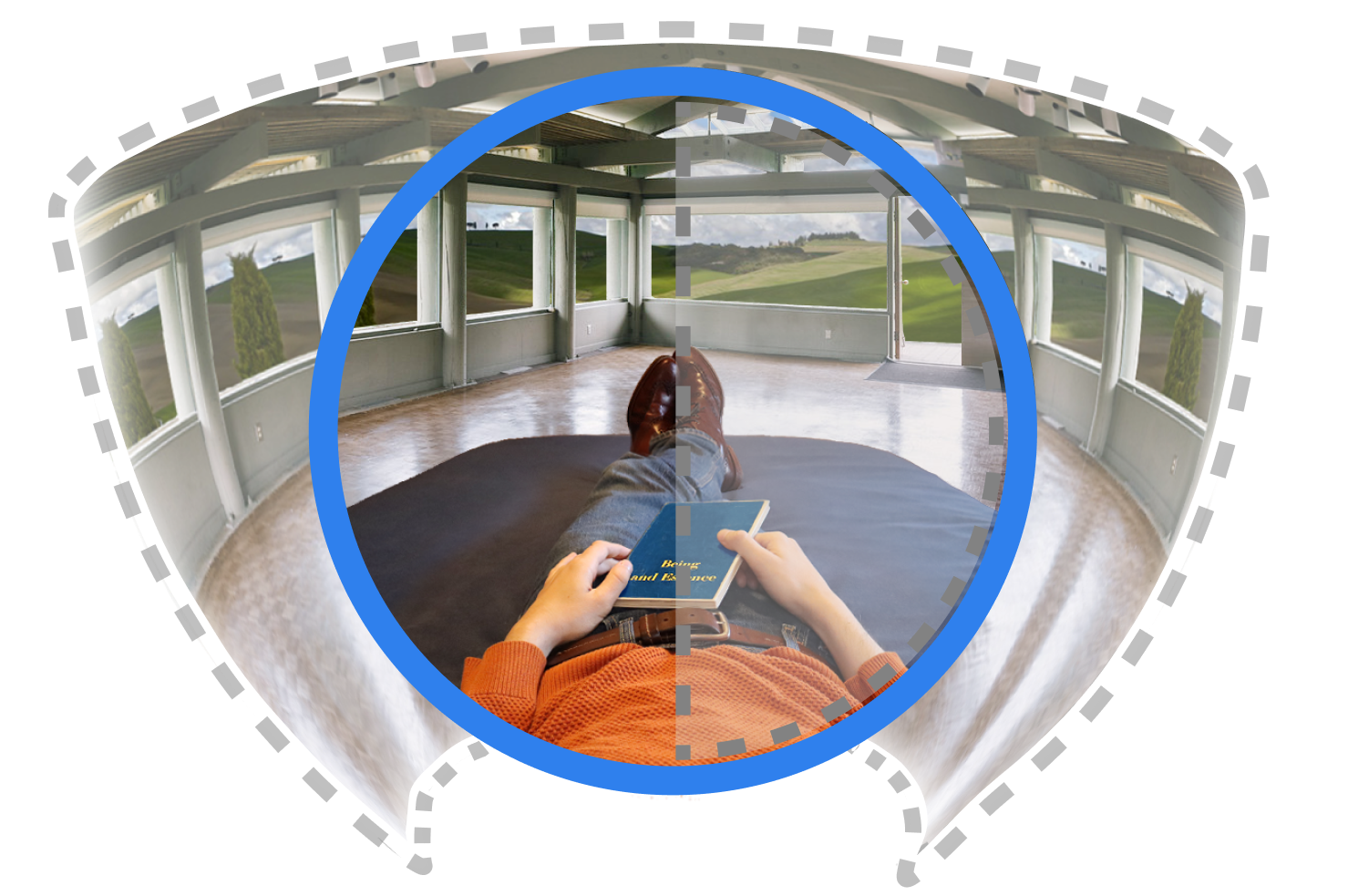
Exclusion is immediate, in the sense that I do not have to infer that experience includes what it includes rather than less or more. What it includes is right there, "in front of my eyes." Exclusion is irrefutable, in the sense that its negation is self-contradictory or absurd. I cannot meaningfully conceive of an indefinite experience—an experience that contained at once nothing, everything, and anything in between [2]. Furthermore, while I can conceive of an experience that contained less or more than my current experience—one that were not this whole, but a lesser or greater whole—it would remain true that when I experience it, it would contain exactly what it contains, neither less nor more. It would still be this whole, reaffirming the validity of the axiom. Finally, exclusion is true not just of the experience I am having, but it must be true of every conceivable experience, which means that it is an essential property of phenomenal existence.
Footnotes
[1] Note that what is axiomatic about exclusion is only that the experience I am having contains what it contains, neither less nor more. By contrast, the possibility that other experiences might exist that partially overlap with mine cannot be excluded axiomatically, because it is certainly conceivable that they might exist. Note also that if integration deals with the fact that experience is a whole above its parts, exclusion deals with the fact that the whole has a definite border. In other words, integration says that experience is "a whole," and exclusion says that it is "this whole."
[2] Indefinite should not be understood as vague (in the sense of hazy) or vast (extended as far as the eye can see).
Exclusion Postulate
The cause–effect power of the substrate of consciousness must be definite: it must specify its cause–effect state as this whole set of units.
[Excerpt from Tononi, G. (in prep.), On Being. Citation details at bottom of page.]
Phenomenally, exclusion means that experience is definite: every experience is not only a whole, but this whole—neither a lesser nor a greater one. How can this essential phenomenal property be formulated in physical terms? Clearly, exclusion requires that the substrate of consciousness, too, must be definite—it must be this irreducible set of units—neither a lesser nor a greater set. In other words, the substrate of my experience cannot at once shrink down to nothing, spread out indiscriminately over the universe, or anything in between. Instead, it must be constituted of a definite set of units, excluding lesser or greater sets.
But what establishes the "border" of a substrate of consciousness—which set of units constitutes it? Phenomenology only says that what exists intrinsically—the experience I am having—exists with the border it has, rather than with different borders. Can anything similar be said in terms of cause–effect power? IIT's formulation is based again on the principle of maximal existence [...]: among candidate substrates (characterized according to the previous postulates), the one that exists is the one that exists the most. By the integration postulate, a substrate's existence as one entity is quantified by integrated information φs. Therefore, the substrate of consciousness must be the set of units having maximal integrated information—a substrate that is maximally irreducible. Overlapping substrates with lower φs are excluded from existence. In IIT, a substrate that is maximally irreducible is called a maximal substrate or complex.
As an illustration, consider a set of units in a state—here, i, A, b, c, d, and o [figure below]. Many candidate substrates, all taken with the maximal state they specify, might be irreducible, including Ab, bc, Abc, bcd, Abcd, iAbcdo, and so on. Of these candidates, the "winning" one—the one with maximal integrated information (indicated by φs*)—turns out to be Abcd. As the maximally irreducible substrate, it excludes any overlapping substrates of lower φs, such as its subset Abc and its superset iAbcdo ([...] indicated by the dashed gray lines on the brain and on the TPM). It also excludes any parasets, meaning sets with some units internal to Abcd and some external to it (e.g., iAb).
Slideshow 1: Exclusion Postulate - 08/2023 — the deck embedded on the wiki page.
Slides: iit-wiki-slides-exclusion
Note that so far, we have considered a substrate as constituted of a set of units without defining their grain [...]. Should the units be micro-units—"atoms" of cause–effect power—or macro-units aggregating many micro-units, such as molecules, organelles, cells, and so on? Should they be considered over micro-updates or macro-updates (aggregating many micro-updates), such as milliseconds, seconds, minutes, and so on? Based on the exclusion postulate, the units that constitute the maximally irreducible substrate must also be definite in the sense of having a definite grain. Once again, the grain is defined by the principle of maximal existence: the "winning" grain is the one that ensures maximally irreducible existence to the substrate to which the units belong (marked in blue in the inset). On the other hand, units themselves must also be maximally irreducible, as measured by their φu value (u for units) [1]; otherwise, they would not be units but "disintegrate" into their constituents [2].
Footnotes
[1] This is expressed more precisely in Marshall et al. 2024: "a macro unit needs to be a maximally irreducible constituent of a complex ('maximally irreducible within'), rather than a complex itself ('maximally irreducible within and without')." In other words, "a macro unit need only have higher integrated information than any other system that could be constructed from its micro constituents."
[2] Extrinsically, of course, we can characterize the causal powers of any subset of units, whether or not they constitute a complex, as well as of any subset of micro-units (or -updates and -states), whether or not they constitute macro-units (or -updates and -states). As an illustration, consider the example of atoms, molecules, cells, and organs, with the caveat that the example is extrinsic (extrinsically, one can always consider multiple levels at once).
Frequently Asked Questions
What is meant by the term axiom in IIT?
If the axioms are "immediate" and "irrefutably true," shouldn't they also be self-evident?
Cite this page
Citation for the text:
Tononi, Giulio. "Exclusion." Excerpt from On Being (in preparation). In Integrated Information Theory Wiki. Center for Sleep and Consciousness, University of Wisconsin–Madison, 2024. Last modified 30 June 2024. DOI: 10.5281/zenodo.14160283. https://www.iit.wiki/axioms-and-postulates/exclusion.
BibTeX
@misc{tononi2024exclusion,
author = {Tononi, Giulio},
title = {Exclusion},
note = {Excerpt from {\em {On Being}} (in preparation)},
howpublished = {In {\em {Integrated Information Theory Wiki}}},
publisher = {Center for Sleep and Consciousness, University of Wisconsin--Madison},
year = {2024},
doi = {10.5281/zenodo.14160283},
url = {https://www.iit.wiki/axioms-and-postulates/exclusion}
}
Citation for the slides:
Hendren, Jeremiah, Matteo Grasso, Bjørn Erik Juel, and Giulio Tononi. "Exclusion slides." In Integrated Information Theory Wiki. Center for Sleep and Consciousness, University of Wisconsin–Madison, 2024. Last modified 30 June 2024. DOI: 10.5281/zenodo.14160283. https://www.iit.wiki/axioms-and-postulates/exclusion.
BibTeX
@misc{hendren2024exclusion,
author={Hendren, Jeremiah and Juel, Bj{\o}rn Erik and Grasso, Matteo and Tononi, Giulio},
title={Exclusion Slides},
howpublished={In {\em {Integrated Information Theory Wiki}}},
year={2024},
publisher={Center for Sleep and Consciousness, University of Wisconsin--Madison},
note={Last modified 30 June 2024. DOI: 10.5281/zenodo.14160283},
url = {https://www.iit.wiki/axioms-and-postulates/exclusion}
}
Composition
Source: https://www.iit.wiki/axioms-and-postulates/composition
5th axiom & postulate of IIT
Summary
Composition is an essential property of experience (an axiom) and, by inference, also an essential property of the substrate of consciousness (a postulate).
The axiom states that "experience is structured: it is composed of distinctions and relations that bind them together, yielding a phenomenal structure that feels the way it feels." Formulated in physical terms, the postulate states that the cause–effect power of the substrate of consciousness must be structured: subsets of its units must specify cause–effects over subsets of units (distinctions) that can overlap with one another (relations), yielding a cause–effect structure that is the way it is.
Contents
Composition Axiom
Experience is structured: it is composed of distinctions and the relations that bind them together, yielding a phenomenal structure that feels the way it feels.
[Excerpt from Tononi, G. (in prep.), On Being. Citation details at bottom of page.]
Within my experience I can distinguish many components, corresponding to phenomenal distinctions and relations. For example, looking at the image [here], I can pick out the bed, the body, the book, the color blue, and so on. But I can equally well pick out larger components, such as "the left side of space" or the room, as well as smaller components—for example, the corner of the bed, the leg of the body, and so on. Furthermore, the components of an experience are related to one another. The color blue is bound to the cover of the book, the book to the region of space it occupies in my experience, that region of space to neighboring and overlapping regions, and all regions of space to one another to compose the extended canvas in front of my eyes [1]. Together, the distinctions and relations that compose this particular experience are what make it feel the way it feels.
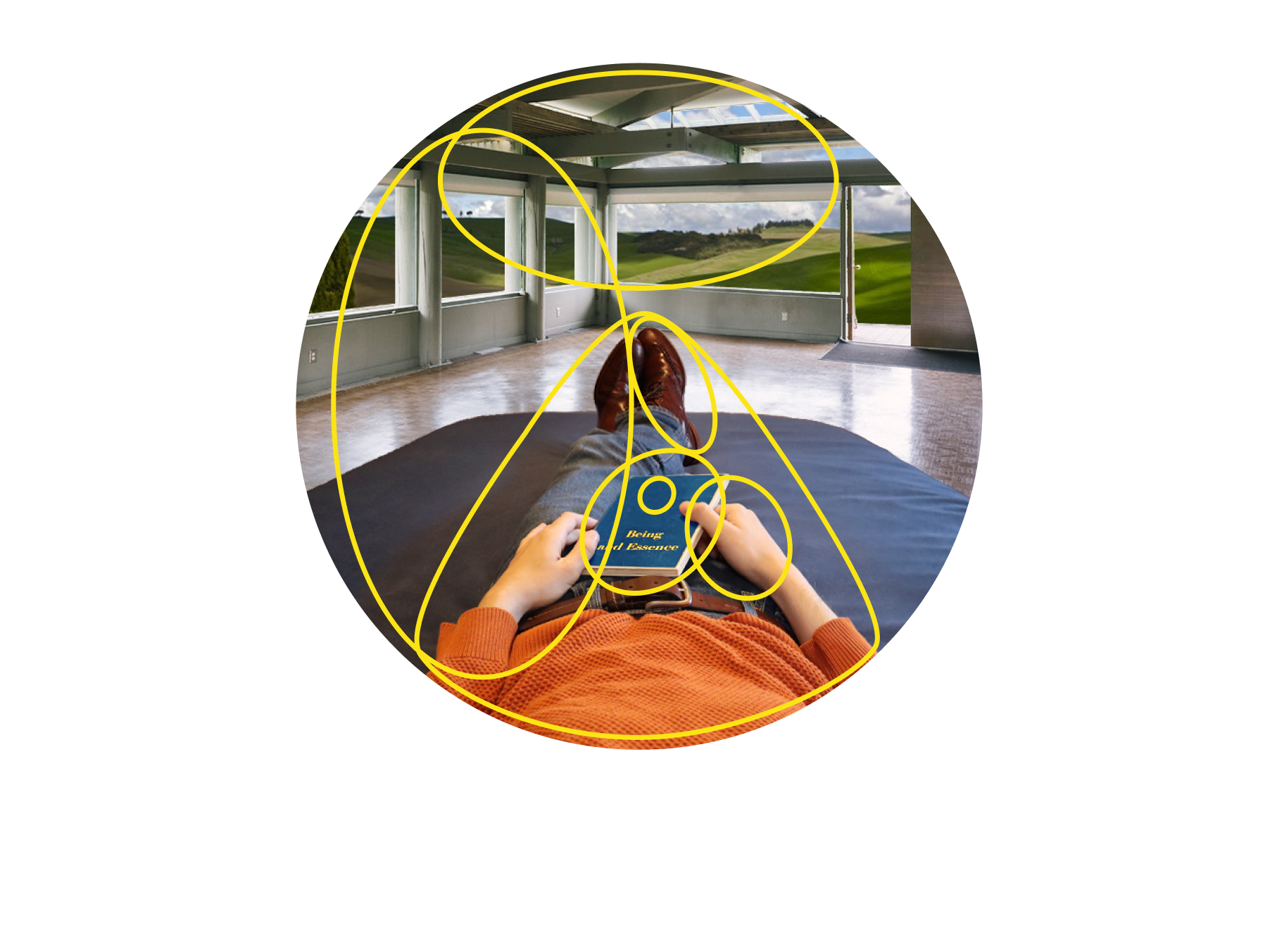
Introspection allows me to analyze the structure of an experience—its phenomenal structure—by dissecting it into coarse components, let's call them compound distinctions, and the way these distinctions are bound, corresponding to compound relations. However, introspection alone is hardly adequate to the task of dissecting an experience down to what I might consider to be elementary distinctions and relations. For example, I can distinguish the book and my left hand, and see they are related—the hand lies on the book. I can also distinguish the book's cover, its top and bottom edges, and its title, just as I can distinguish my thumb and index finger. I can also see that the two fingers are related to a different region of the book. But I cannot possibly hope to dissect my experience all the way down, or to count the innumerable ways in which the contents of my experience are related [2].
Composition is immediate because I do not need to infer the structure of experience, the way the experience feels. It is already there, the way it is, "in front of my eyes"—the book bound to its shape, color, and position in space; my body lying over my bed within the room; and so on. Composition is also irrefutable, in the sense that its negation is self-contradictory or absurd. Try to think of an experience that had no components at all, not even a single distinction. The structure of the experience would be composed of nothing, which is the same as saying that there would be no experience [3]. And while I can conceive of an experience structured in a different way, it would remain true that when I experience it, it would be structured in its particular way—it would feel the way it feels—reaffirming the validity of the axiom. Moreover, composition is true not just of the experience I am having now, but it must be true of every conceivable experience, which makes it an essential property of phenomenal existence.
Footnotes
[1] The section on space will illustrate how the structure of the "extended canvas of space" comes about.
[2] [An] introspectable, compound phenomenal distinction should ultimately correspond to a compound physical distinction (which includes a number of elementary distinctions), and a compound phenomenal relation to a compound physical relation (which includes many elementary relations). Nevertheless, the term distinction appropriately captures the idea that we "pick out" or "single out" (which is to say, "distinguish") some component of experience, and the term relation captures the idea that when we do so, we typically pick out other distinctions that are "bound" to it. More generally, any composition of distinctions and relations—a sub-structure within the phenomenal structure—can be considered a content of the experience.
[3] A truly "minimal experience" would be composed of just one distinction related to itself. It would correspond to the simplest possible structure but still be a structure and thus still an experience. In mereology, a whole can be considered as a part of itself, including the only part of itself (a so-called improper part). A self-consistent axiomatic system can be constructed assuming proper or improper parts.
Composition Postulate
The cause–effect power of the substrate of consciousness must be structured: subsets of its units must specify cause–effects over subsets of units (distinctions) that can overlap with one another (relations), yielding a cause–effect structure that is the way it is.
[Excerpt from Tononi, G. (in prep.), On Being. Citation details at bottom of page.]
How can we formulate the phenomenal property of composition in physical terms? Phenomenally, composition means that every experience is structured, being composed of phenomenal distinctions bound by phenomenal relations to form a phenomenal structure that is the way it is. Therefore, the substrate of consciousness must have cause–effect power that is structured in a particular way. We can reveal this internal structure by considering, first, whether and how subsets of units take and make a difference over subsets of units within a complex, specifying their own cause–effect states and yielding causal distinctions. Second, we must consider how these distinctions' causes and effects overlap over subsets of units, yielding causal relations. Altogether, causal distinctions and relations form a cause–effect structure, also called a Φ-structure.
Slideshow 1: Composition Postulate - 08/2023 — the deck embedded on the wiki page.
Slides: iit-wiki-slides-composition
Distinctions
We saw in the previous postulates that the complex as a whole must specify both a cause and an effect over itself. Likewise, a subset of its units can only exert cause–effect power within the complex if it specifies a cause–effect (a cause and an effect) within the complex, called a causal distinction. A distinction comprises a mechanism, a cause purview, and an effect purview: a mechanism is a subset of units within a complex that can take and make a difference within it, its cause purview is the subset of units from which the mechanism takes a difference, and its effect purview is the subset of units to which it makes a difference. The link between cause and effect provided by a mechanism can be roughly expressed as "given this cause, then this effect." [In the figures], distinctions are illustrated by orange lines connecting a mechanism and its cause and effect purviews.
As a simple analogy—albeit imperfect—think of a distinction as comprising a pulley (the mechanism) and two weights attached to the two ends of a cable (the cause and effect purviews). Alone, the mechanism is simply a wheel with a cable around it. To exert causal power, it must link weights at both ends of the cable.
The crucial feature of composition is that, in principle, any subset of units of a complex can constitute a mechanism or a purview. This is illustrated [in the slides above] by the powersets of mechanisms, causes, and effects, any of which may be combined to form a candidate distinction. Note that the mechanisms "inherit" their state (which units are ON and OFF) from the system's current state and the cause–effect purviews from the system's cause–effect state. Within each powerset, the mechanisms and purviews that make up distinctions that are maximally irreducible are highlighted in bold. Two distinctions, referred to by their respective mechanisms ("distinction b" and "distinction cd"), are singled out in the [slides above]: first-order distinction b specifying cause purview a and effect purview d, and second-order distinction cd specifying cause purview a and effect purview ad.
For a substrate constituted of n units, there are 2n–1 combinations of units (the powerset of the n units, excluding the empty set [1]), so the substrate could specify up to 2n–1 distinctions. In a given mechanism or purview, the term order refers to the number of units involved. In the example here, the mechanisms and effect purviews are both second order, while the cause purviews are first order.
As components of the cause–effect power of the complex, distinctions—like the complex as a whole—must be characterized in accordance with the postulates of physical existence (save for composition because, being components themselves, they do not have components). Recall that the complex as a whole must be able to take and make a difference (existence) and do so within itself (intrinsicality). It must also select a specific cause and effect state (information). Similarly, a distinction can only exist for the complex if it can make and take a difference. For this, it needs a mechanism that links a cause with an effect. Distinctions must also comply with the intrinsicality postulate: their cause–effect power must be exerted within a system, and from the intrinsic perspective of the mechanism. Likewise, they must comply with the information postulate: a mechanism in its specific current state must select a specific cause–effect state. As for the system, this is the state for which intrinsic information is maximal (indicated by the red and green squares on the TPM in [the slides above]) [2].
Finally, distinctions must comply with the integration and exclusion postulates. A distinction's integrated information is measured by φd ("phi" with subscript d for distinction), which quantifies "how much specific cause–effect power a mechanism has over its purviews as one mechanism." As with the system, and in line with the principle of minimal existence, we assess integration by considering the partition for which the difference is minimal, relative to the maximum possible integrated information for that partition. We also take the minimum between the cause and the effect sides [3]. To comply with the exclusion postulate, we follow the principle of maximal existence and establish the border of a distinction by determining the cause–effect purview over which a mechanism achieves maximal integrated information, excluding any purview with lower φd [4].
Note that when assessing integrated information of higher-order mechanisms, φd is not a measure of how much additional effects (or causes) a higher-order mechanism (say, Abcd) specifies over first-order mechanisms (say, A, b, c, d). Additional effects, say, due to non-linear interactions, may be relevant from an extrinsic perspective. Yet from the intrinsic perspective of an entity, what matters with respect to structure is whether the mechanism Abcd has an effect (and cause) in a way that is maximally irreducible. In other words, does the complex have at its disposal the integrated "pulley" or "handle" Abcd to specify a certain effect (and cause) within itself? [For more, see FAQ: Why do we assess the causal power of all orders of mechanisms? Why not simply assess the causal power of the individual units alone?]
Footnotes
[1] Subsets are any combination of units of the complex (its powerset). Because the subject is existence, the empty set is not considered as a legitimate subset.
[2] As for the system as a whole, the maximum operator ensures that the mechanism takes or makes a difference that, compared to chance, increases the probability of occurrence of the purview state it specifies. The reason is that the phenomenal distinctions that compose an experience are actual—they actually exist (intrinsically and in the specific way they do). Physically, the intrinsic cause or effect specified by a distinction must be not only specific but also such that their probability of occurrence—of being actual (existing)—is increased by a mechanism, not decreased (or left unchanged).
[3] The procedure is described in detail in Albantakis et al., 2022.
[4] Maximal irreducibility will typically be sensitive to the presence of minimum partitions that cut across a fault line of a purview, such as units connected to a mechanism with low strength. Moreover, φd is based on intrinsic information, which is sensitive to the tension between expansion and dilution. Therefore, φd will typically be higher for a smaller purview that can be specified with high selectivity than for a larger purview that can be specified with much lower selectivity.
Relations
Relations capture how a set of distinctions are bound together because they specify their cause and/or effect purviews over the same units in the same state—they have a congruent overlap. Just as a distinction links a cause and an effect purview by specifying their states, a relation binds a set of distinctions by specifying which units and states correspond to which across distinctions. Relations thus reflect how the cause–effect power of a set of distinctions is bound together irreducibly within a complex, as measured by the relation's φr ("phi" with subscript r for relation). As congruent overlaps among causes or effects of various distinctions, relations are just as important to the structure of the substrate's cause–effect power as the causes and effects of each distinction. [This can be] illustrated by the ropes from two pulleys converging on the same weight. Clearly, the fact that two pulleys are pulling on the same weight is just as important for a system as the fact that each pulley is pulling on its weight.
In principle, a complex constituted of n units can specify a very large number of relations, up to n*22^n. A relation is composed of one or more distinctions (the relation's degree) [1]. Each relation has one or more faces (the face's degree), each of which corresponds to a distinct combination of causes and/or effects of the participating distinctions. Each face has a corresponding face purview—the maximal congruent overlap shared by two or more causes and/or effects. For example, a relation between distinctions b and cd is indicated [in the slides above] by a dark line "binding" two labels in the mechanism powerset; the respective relation faces are shown as blue lines (for second degree) and a plane (for third degree) connecting the specified causes and effects in the cause and effect powersets.
The union of all face purviews is called the relation purview, or joint purview. [In the slides above], for example, the relation purview of distinctions b and cd comprises purview elements a and d. The particular combination of faces that constitute a relation characterize its type. For example, a self-relation is reflexive, a relation where all causes and effects are maximally congruent with one another is a complete relation (which is necessarily reflexive), a relation where the effects of one set of distinctions overlap congruently with the causes of the remaining distinctions (but not the other way around) is a directed relation, and so on. The type of relations will become important when accounting for the quality of experience [...].
Like distinctions, relations must be characterized according to the postulates of physical existence. Relations inherit existence from the cause–effect power of the distinctions that compose them. They inherit intrinsicality because the causes and effects that compose their faces are specified within the substrate. Moreover, relations are specific because their face purviews must be congruent for all causes and effects.
Relations satisfy integration because they capture the irreducibility of cause–effect power due to the overlap among distinctions [2]. The irreducibility of a relation (φr) is measured by "unbinding" distinctions from their joint purviews, one by one. By the principle of minimal existence, a relation can only be as irreducible as the minimal amount of irreducible information specified by any one distinction in the relation. Therefore, the relation integrated information (φr) is given by the minimum φd value scaled by the number of unique units over the face purviews of all faces in the relation [3].
Finally, a relation complies with exclusion in that its integrated information is naturally maximized over the maximally congruent overlap for each relation face (taking subsets of these overlaps could only reduce the integrated information of the relation).
In sum, for both distinctions and relations, φ is again a quantifier of integrated existence: a distinction or relation only exists as one distinction or relation to the extent that it is causally irreducible.
Relations also serve to "relate" the identity and state of the units of a complex from its intrinsic perspective. Needless to say, intrinsically, neither the units in a purview nor their states come with a label (such as unit A or B, state ON or OFF). It is relations that specify which purview units in one distinction correspond to which purview units in another, and which states correspond to which states. In this way, relations can uniquely specify (or "lock in") the identity of both the units and of the states from the intrinsic perspective of the complex [4].
Footnotes
[1] An individual distinction whose cause and effect overlap congruently specifies a first-degree "self-relation."
[2] Accordingly, in IIT, relations do add to being. [...]
[3] Details are in Albantakis et al., 2022.
[4] The way IIT characterizes relations—from an intrinsic, causal perspective—differs from the way the term is used in everyday language, in philosophy, and even in mathematics. Relations in everyday language, as well as in philosophy, are typically of this kind: Billy is taller than Susy, Billy is married to Susy, or Billy is near Susy. Relations are often subdivided into internal and external. An internal relation, say, Billy is taller than Susy, only depends on the intrinsic properties of the things that are related: if Billy and Susy exist, with their respective properties such as height, then the relation is supposed to follow necessarily. An external relation, say, Billy is near Susy, does not follow necessarily. But there is much disagreement on the definition of internal and external relations, even whether they should be thought to exist at all. Clearly, the causal relations defined by the postulates of IIT are meant to capture something else—namely, irreducible overlaps among causal distinctions. In this sense, IIT relations are not only causal but also always internal. However, they are always internal to an individual complex, not to the universe as a whole. So what does IIT have to say about the ontological status of the relations of everyday language and philosophy? Do they exist, and, if so, how? As we will briefly see in Part III (see Box: IIT and Platonic realism), relations such as "taller than," "married to," "near to," and many others should be thought of as high-level concepts. The same way that high-level concepts—such as "Billy," "Susy," "tall," "marriage," "near"—pick out disjunctions of conjunctions (see Objects), relations such as "taller than," "married to," and "near to" pick out conjunctions of other concepts. Like other concepts, they truly exist, but only as contents of experience—as intrinsic meanings. And, like other concepts, they may or may not correspond to objective properties of extrinsic entities, such as Billy and Susy.
Φ-structures and Φ
To make fully explicit the internal structure of the cause–effect power specified by a complex, we need to unfold all the distinctions it supports, of any order, and all the relations that bind them together, of any degree. However, in line with intrinsicality and information, from the intrinsic perspective of the complex, the only distinctions and relations that truly exists are those that are congruent with its own cause–effect state. A distinction's mechanism must be constituted by units of the complex, whose current state is a subset of the state of the complex as a whole. Likewise, the cause purview of any distinction must be in the same state as the cause state of the complex as a whole, and similarly for the effect purviews and the joint purviews of relations. This can be seen in [the slides above], where the three powersets [...] are always congruent with the cause–effect state of the complex. The complete set of distinctions and the associated relations specified by the complex compose a cause–effect structure—or, for brevity, a Φ-structure [1]. A Φ-structure thus captures the fully "unfolded" cause–effect power of a complex in its current state [2].
In the Φ-structure depicted [in the slides], mechanisms are represented by black letters, cause purviews by red letters, and effect purviews by green letters. The order of the mechanism or purview is the number of units that constitute it, which corresponds to the z-axis "level" in the figure. Distinctions are depicted by orange lines linking a cause purview (left side) and an effect purview (right side) through a mechanism (middle), and the thickness of the line reflects the φd value. Relation faces are depicted as lines (for second degree) and planes (for third degree), whose color intensity reflects the value of φr (the large number of relation faces higher than third degree cannot be visualized). Note that the Φ-structure is "planted" on the complex through its first-order mechanisms and, like the complex, it is depicted in a blue palette. This is to indicate that a Φ-structure is not a mathematical abstraction, disconnected from the substrate; it is rather the fully unfolded cause–effect power of that substrate.
Together, a complex and the Φ-structure unfolded from it comprise an intrinsic entity. The distinctions and relations that compose the Φ-structure characterize what exists, and the way they are organized characterize which way it exists—what it is like. The φd and φr values measure how much the distinctions and relations exist within the structure. The sum of their φd and φr values is the Φ value ("big phi") of the Φ-structure, which measures its total structure integrated information—how much the entity exists.
Footnotes
[1] In the context of composition, it is useful to clearly distinguish among constitution, combination, and superposition. Constitution. A component's mechanism and purviews are constituted of one or more units from a substrate. Combination. A component's mechanism and purviews can be constituted of any combination of units from a substrate. Given a substrate constituted of n units, the number of possible combinations or subsets of units (its powerset) is 2n-1 (-1 is due to the empty set, which cannot constitute a mechanism or purview). Superposition. The mechanisms and purviews of different components can overlap within the substrate. On the mechanism side, this means that a substrate constituted of n units can potentially support up to 2n-1 different mechanisms, as long as they exert cause–effect power within the system. These combinatorial mechanisms come for free, as it were. On the purview side, this means that the cause and effect purviews of different mechanisms will overlap over various subsets of units, composing candidate relations.
[2] An important consequence of the intrinsic perspective is that many causal powers that can be demonstrated extrinsically do not exist intrinsically. Based on the exclusion postulate, causal interactions across the border of a complex can be demonstrated extrinsically, but do not exist intrinsically. The same is true for causal interactions within a complex but across the borders of a purview, or across the border of a macro-unit. Similarly, extrinsically we may be able to demonstrate that the causal power of a mechanism in a state extends to many more units and states that those of its intrinsic cause and effect purviews, but those causes and effects do not exist intrinsically.
>>> The Fundamental Identity of IIT
Frequently Asked Questions
What is meant by the term axiom in IIT?
If the axioms are "immediate" and "irrefutably true," shouldn't they also be self-evident?
Does a Φ-structure "emerge" from a complex?
Does an experience "emerge" from its corresponding Φ-structure?
Cite this page
Citation for the text:
Tononi, Giulio. "Composition." Excerpt from On Being (in preparation). In Integrated Information Theory Wiki. Center for Sleep and Consciousness, University of Wisconsin–Madison, 2024. Last modified 30 June 2024. DOI: 10.5281/zenodo.14160283. https://www.iit.wiki/axioms-and-postulates/composition.
BibTeX
@misc{tononi2024composition,
author = {Tononi, Giulio},
title = {Composition},
note = {Excerpt from {\em {On Being}} (in preparation)},
howpublished = {In {\em {Integrated Information Theory Wiki}}},
publisher = {Center for Sleep and Consciousness, University of Wisconsin--Madison},
year = {2024},
doi = {10.5281/zenodo.14160283},
url = {https://www.iit.wiki/axioms-and-postulates/composition}
}
Citation for the slides:
Hendren, Jeremiah, Matteo Grasso, Bjørn Erik Juel, and Giulio Tononi. "Composition slides." In Integrated Information Theory Wiki. Center for Sleep and Consciousness, University of Wisconsin–Madison, 2024. Last modified 30 June 2024. DOI: 10.5281/zenodo.14160283. https://www.iit.wiki/axioms-and-postulates/composition.
BibTeX
@misc{hendren2024composition,
author={Hendren, Jeremiah and Juel, Bj{\o}rn Erik and Grasso, Matteo and Tononi, Giulio},
title={Composition Slides},
howpublished={In {\em {Integrated Information Theory Wiki}}},
year={2024},
publisher={Center for Sleep and Consciousness, University of Wisconsin--Madison},
note={Last modified 30 June 2024. DOI: 10.5281/zenodo.14160283},
url={https://www.iit.wiki/axioms-and-postulates/composition}
}
Φ-structure Visualization
Source: https://www.iit.wiki/axioms-and-postulates/composition/phi-structure
Below is an interactive visualization of system Abcd, used throughout the postulates pages of this Wiki.
Click on legend elements to show or hide them. Click and drag Φ-structure to change angles.
If you're using a phone, please view it here.
Plotted using plotly (Plotly Technologies Inc. Collaborative data science. Montréal, QC, 2015. https://plot.ly) as coded in pyphi.
The Fundamental Identity of IIT
Source: https://www.iit.wiki/identity
Phenomenal Structures & Φ-structures
Summary
The fundamental identity of integrated information theory (IIT) can be seen as the theory's answer to the riddle of consciousness—it is how IIT accounts for both the quality and quantity of consciousness in physical terms (see FAQ: What does it mean to explain consciousness scientifically?).
Most succinctly, the fundamental identity states that an experience is identical to the Φ-structure unfolded from a complex: every property of the experience should be accounted for by a corresponding property of the Φ-structure.
This definition, and the concepts on this page, build heavily on the previous pages. It will be hard to follow without first reviewing IIT's foundations and methodological assumptions, and the theory's axioms and postulates.
As you learn about the identity, keep in mind that it aims to be explanatory rather than ontologically reductive. In other words, IIT never claims that an experience is "nothing but" a Φ-structure. Experience is always primary in IIT, but the identity allows us to make sense of it in objective, physical terms—that is, in terms of a substrate we can manipulate and observe.
Contents
- The Fundamental Identity of IIT
- Identity as a complete, naturalistic account of consciousness
- Identity as explanatory
- Identity as a good explanation
- Cite this page
The Fundamental Identity of IIT
[Excerpt from Tononi, G. (in prep.), On Being. Citation details at bottom of page.]
The fundamental identity of IIT states that an experience is identical to the Φ-structure unfolded from a complex: every property of the experience should be accounted for by a corresponding property of the Φ-structure.
[The figure below] shows a schematic depiction of the identity. The left side shows a snapshot of the experience that served to illustrate the essential properties of every experience—namely, that every experience is intrinsic, specific, unitary, definite, and structured. Of course, this representative experience also has its particular, accidental properties, which give it its specific content and make it different from countless other experiences: the room, the bed, my body, a blue book in the middle, and so on. The right side of the figure shows the intrinsic entity that corresponds to the experience—a Φ-structure unfolded from a complex constituted of active and inactive neurons in the back of the cerebral cortex (blue outline). By definition, a complex is a substrate whose cause–effect power is characterized in physical terms in accordance with the essential properties of phenomenal existence. Furthermore, according to the fundamental identity, the Φ-structure specified by a complex must also account for all accidental properties: my particular experience of the bed, my body, the blue book, and so on should correspond to the particular properties of the Φ-structure specified by my substrate in the brain.
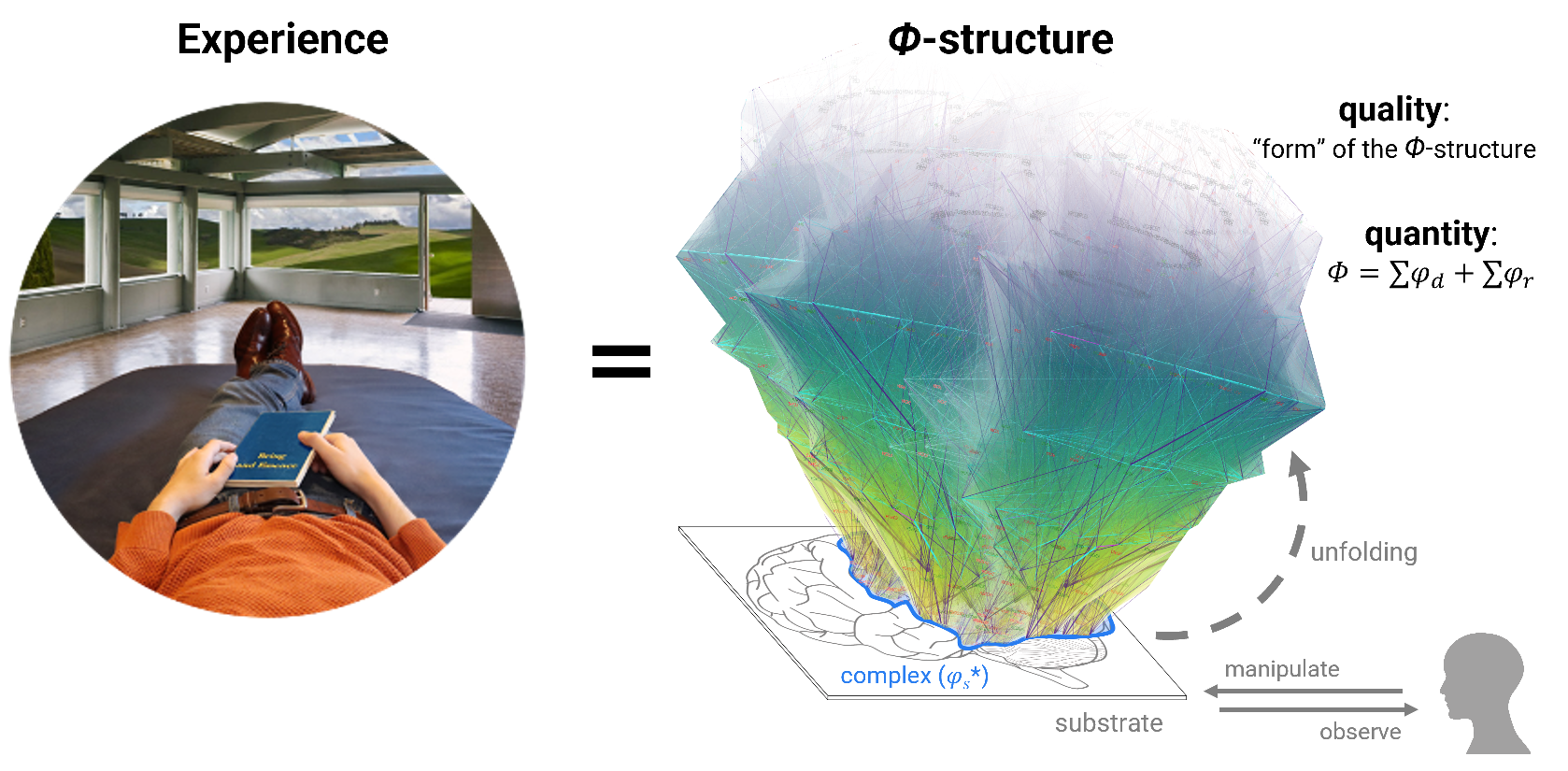
Identity as a complete, naturalistic account of consciousness
The goal of the identity proposal is to put forth a complete account of consciousness in terms of natural science. Complete means that the account must ultimately explain all aspects of consciousness: under what conditions it is present, to what degree it is present (its quantity), and the particular ways it is present (its quality). In terms of natural science means that the explanation must be based on properties of a universe that exists independently of individual experience and can be investigated in physical terms—that is, operationally [...].
According to the fundamental identity, consciousness should be present if a substrate is a maximum of irreducible, intrinsic cause–effect power and absent otherwise. The degree to which consciousness is present—its quantity—is given by the Φ value of the Φ-structure specified by the substrate. It follows that every time consciousness vanishes and returns, its substrate and associated Φ-structure should disintegrate and reintegrate, as reflected by its Φ value. Similarly, the degree to which phenomenal components exist within an experience is given by the φ values of the corresponding distinctions and relations within the Φ-structure.
The particular way an experience feels—its quality—must also be accounted for by the properties of the corresponding Φ-structure. The essential properties of experience are accounted for explicitly through the requirements that the postulates of IIT impose on the substrate of consciousness. But the fundamental identity of IIT requires that all the accidental properties that make an experience that specific experience can be accounted for by the substrate's Φ-structure, with no additional ingredients. In other words, all qualitative properties of an experience that make it feel the way it does must be accounted for by corresponding properties of the Φ-structure. In short, quality is structure.
The identity also implies that the degree to which a content exists within an experience should be accounted for by the degree to which a sub-structure exists within the Φ-structure. For example, when I see a face and then the face vanishes from experience, a corresponding, highly interrelated Φ-fold should do the same (as measured by ΦR). Similarly, the phenomenal grain of the experience should be accounted for by the causal grain of the Φ-structure.
Properties summarizing overall features of the experience—such as its richness, its vividness, the number of distinct contents, modalities, sub-modalities, and so on—should also be accounted for by corresponding features of the Φ-structure. Finally, the similarity and dissimilarity of contents within an experience should be accounted for by the similarity or dissimilarity of their respective Φ-folds. The same holds for similarities and dissimilarities between experiences, which should be accounted for by similarities and dissimilarities between the corresponding Φ-structures.
In short, a Φ-structure should account for the corresponding experience in both quantity and quality—an identity that, in principle, should leave nothing unexplained [1].
The explanatory completeness of the identity becomes especially clear in accounting for why specific experiences feel the way they do—that is, in substantiating the claim that "quality is structure." Hence, [the Contents of Experience section presents] a first attempt at accounting for some paradigmatic qualitative properties of experience in terms of structural properties of Φ-structures. For example, the "extendedness" that characterizes spatial aspects of an experience can be accounted for by extendedness of Φ-folds; the "flowing" that characterizes temporal aspects of an experience can be accounted for by the directed flowing of corresponding Φ-folds; and the "object-like" nature of certain contents of experience, such as an apple, can be accounted for by the hierarchical arrangement of corresponding Φ-folds.
The specific experiences of space, time, and objects were chosen as natural starting points because the structure of these experiences can be at least partially decomposed through introspection.
If this approach is successful, however, it may then be justifiable to probe the identity in the reverse direction as well—from the properties of Φ-structures to those of experiences. In other words, we may then use "inference from a good explanation" to reason about accidental properties of experience that are difficult or impossible to decompose through introspection. By reasoning in both directions in this way, the completeness of the identity can be progressively established.
Footnotes
[1] Note that the identity of IIT means that quantity of being (existence) and its quality (essence) are inextricably linked. In this light, [...] it is intriguing to consider Aquinas’s “real distinction” between existence and essence.
Identity as explanatory
Identity is a fraught notion [1], so it is important to clarify what is meant here by explanatory identity [2]. By Leibniz's law, an identity requires that each property of one object is a property of the other and vice versa. Strictly speaking, then, something can only be identical to itself, which is utterly uninformative. In the present case, this would amount to stating that the current experience is identical to itself. An identity statement can become explanatory when its terms differ in sense [3].
Classic identity explanations in science are of this sort, such as the identity between temperature and mean kinetic energy or between water and H2O. Typically, the domain that does the explaining is more general than the one being explained. Moreover, a satisfactory scientific explanation is often reductive, in that coarser properties in one domain are decomposed into finer properties in another domain. For example, in the domain of things that can be observed by the eyes and manipulated by the hands, "water" is characterized as a transparent liquid that boils and freezes at certain temperatures. Science can explain the properties of water through those of H2O, characterized in the broader domain of physics and chemistry as properties of fine-grained molecules, their interactions, and their susceptibility to phase transitions. In this case, it is reasonable to conclude that water and H2O refer to the same "thing," while using different kinds of observations and manipulations to characterize it.
In the case of IIT, the identity is explanatory in a similar way because it tries to account for one sense of existence—phenomenal existence, understood as experience—through another sense of existence—physical existence, understood as cause–effect power. If experiences turn out to be identical to Φ-structures, they would be accounted for through a principle that is not private but publicly available—namely, cause–effect power (the principle of being). This principle is fully general and potentially capable of accounting for all of nature. Furthermore, the properties of Φ-structures offer the prospect of decomposing the properties of experience in a way that is as fine-grained as possible and much finer than what can be done by introspection alone. This is because, at least in principle, we could characterize cause–effect power down to the atomic level, unfolding the powers of a substrate with an objective, shared methodology based on public observations and manipulations.
Thus, the explanatory identity proposed by IIT is similar to other identities in science in accounting for one domain through another that is accessible in a more general and fine-grained way. It is unique, however, because the identity of IIT is between a subjective and an objective domain, whereas explanatory identities elsewhere in science are between two objective domains. Most importantly, in IIT the physical domain is not primary (in fact, not even co-primary), but an explanatory inference made from within the phenomenal domain. As we saw in [the 0th axiom], IIT takes the existence of experience as primary: it is immediate and irrefutable, rather than being inferred through observations and manipulations [...]. By contrast, the existence of an independent, atomic world of cause–effect power—the physical world—is explicitly treated as an inference from within experience to explain its regularities.
Two further remarks about the explanatory identity of IIT are in order. First, identity must be distinguished from isomorphism [4]. Isomorphism typically implies a one-to-one correspondence between two different things. Unlike an isomorphism, IIT's identity does not need to explain why there should be such a "lovely" correspondence between two different things: Φ-structures are meant as an explanation of phenomenal properties in terms of physical properties, not as something that happens to be correlated with them.
Second, an explanatory identity must be distinguished from a causal explanation. The identity of IIT does not claim that the phenomenal is caused by the physical, but rather that the phenomenal can be explained in physical terms. If the identity holds, the question of how a substrate would "cause," "generate," or "give rise to" experience is ill-posed, as is the question of how phenomenal, subjective properties would mysteriously "emerge" out of physical, objective properties [see FAQ: Is IIT an emergentist theory of consciousness?].
[If] we take the existence of the physical world as primary, explaining how it would be correlated with phenomenal experience, or even cause it, becomes not just hard but impossibly hard.
Footnotes
[2] Ruben DH. 2003. Explaining Explanation: Taylor & Francis.
[3] Frege G. 1892. Über Sinn und Bedeutung. Zeitschrift für Philosophie und Philosophische Kritik. 100/1: S. 25–50.
[4] Category theory also distinguishes between mere isomorphism and equality (here, "identity"). The identity postulated by IIT means that there is a unique, natural mapping between properties of experience and of the corresponding cause-effect structure.
Identity as a good explanation
To qualify as an explanation of experience, the explanatory identity of IIT should satisfy the criteria of inferences to a good explanation [...]: scope, synthesis, specificity, self-consistency, system consistency, simplicity, and scientific validation. By analogy, consider again the classic example of the identity between water and H20 proposed by contemporary physics and chemistry. The explanation covers a full scope in that every feature of water can be accounted for in terms of properties of H20; it would not be enough, for example, to account for its liquidity but not for the fact that it can freeze. It is synthetic by providing a unifying explanation for its behavior in its solid, liquid, and gaseous phase. It is specific in that it predicts, for example, the exact temperature of freezing. It is also reasonably simple, self-consistent, systematically consistent with the rest of science, and empirically testable. In a similar vein, IIT proposes that the properties of Φ-structures can provide a good explanation for all the properties of experience.
To do so, the identity proposed by IIT should be validated with wide scope, in many different situations. For example, it should explain and predict the presence or absence of consciousness and, more generally, its quantity, not only during wakefulness and sleep but also in cases of anesthesia, brain damage, or epileptic seizures. Moreover, it should explain and predict many of the qualitative features of consciousness—how space feels extended, time flowing, objects at once general and particular, local qualities colored or pitched, and so on [see Contents of Experience].
It should do so in a synthetic manner, by providing a "deep" explanation that unifies these various, seemingly disparate manifestations using the same set of principles. In principle, IIT's identity lets us account for every conceivable property of experience—essential and accidental—through the single, parsimonious principle of cause–effect power, with no further ingredients or ad hoc explanations. This is especially demonstrated in [the Contents of Experience section], where we will see how the identity can account for accidental properties of various kinds of experiences without invoking any domain-specific "bridging principles." Moreover, [...] the identity might offer a unifying foundation for ontology and metaphysics—for defining macro-units; characterizing different types of entities; and providing an account of meaning, reference, and knowledge, as well as causation and free will.
The scope of the explanation should be not just broad and deep, but also highly specific. This means it must encompass the minutest components of experience, so that nothing is left unaccounted for. The identity of IIT is highly specific in demanding that every phenomenal distinction and relation correspond one-to-one with their physical counterpart. The identity should further satisfy specificity by making detailed predictions. In practice, of course, broader predictions come before highly specific ones. But, like in other areas of science, a theory should offer increasingly specific predictions as the evidence accumulates, and ideally some counterintuitive ones [...].
The identity already satisfies simplicity. This would certainly be the case if one were indeed able to characterize the properties of all that exists based on just five axioms introspected from phenomenology, and on their translation into five operational postulates, all based on the notion of cause–effect power, and complemented by four basic principles (of being, becoming, and maximal and minimal existence), and a few auxiliary assumptions.
Self-consistency is evident in the way the explanatory identity accounts for every aspect of consciousness in a systematic, internally coherent way. There is not one set of principles to explain the quantity of consciousness and another for explaining its content, one for explaining the experience of time and another for that of color. Rather, the identity between experience and the structure of cause–effect power permits a self-consistent account of everything that needs to be explained. This consistency is rooted in how the axioms are formulated as postulates, which can in turn be formalized as mathematical expressions [2]. It is also evident in the way the postulates build upon one another—existence, intrinsicality, specificity, integration, exclusion, and composition—to yield such expressions in a transparent manner. Finally, it is reflected in the mathematical symmetry between the expressions for identifying the substrate of entities () and those for identifying the distinctions and relations that compose them ( and ).
The explanatory identity also satisfies system consistency because it does not require mysterious new physical "forces" or "laws" but fits within the natural sciences. In fact, it emphasizes the unity of science by claiming that experience is part of nature, unified by the notion of cause–effect power as the definition of the physical. Though the identity fits with the way science attempts to characterize nature objectively, through observations and manipulations, it also reveals, within a unitary, natural explanation of all that exists, a great divide of being—the divide between existence that is intrinsic and existence that is merely extrinsic [...] [3].
Finally, the criteria for assessing the identity are objective: [...] IIT can be scientifically validated against the necessary and sufficient conditions for our own consciousness. Of course, validation is not possible in one fell swoop but only through the accumulation of evidence of many kinds. As evidence mounts, however, the identity may provide a good enough explanation from which to extrapolate to difficult cases (inference from a good explanation), such as establishing the quantity and quality of consciousness in newborns, animals, and machines.
[...]
Footnotes
[1] Lipton P. 2004. Inference to the Best Explanation: Routledge/Taylor and Francis Group. Mackonis A. 2013. Inference to the best explanation, coherence and other explanatory virtues. Synthese. 190:975-995.
[2] Coherence would be even stronger if it could be proven that the translation of the essential properties of experience (axioms) into physical properties (postulates) is unique, without any residual arbitrariness.
[3] [The] principle of inference to/from a good explanation further suggests a parsimonious hypothesis about the physical world: that all its atoms are either monads—they exist intrinsically—or they are subsumed into macro-units that exist as constituents of a complex, which also exists intrinsically. In this scenario, there is no substrate that does not partake of intrinsic existence: all that truly exists exists intrinsically, and extrinsic existence is grounded in intrinsic existence. This hypothesis may seem compromised by extrinsic interactions among distinct complexes (as well as within a complex or within macro-units), whose causal powers have no phenomenal correspondence. What is the ontological status of such extrinsic interactions? Are they "hanging" in limbo? The answer is that extrinsic interactions are a prerequisite for intrinsic existence because everything that can be shown to exist physically must have ports-out that allow for observation and ports-in that allow for manipulation. In this sense, extrinsic interactions can be considered properties of intrinsic existence, where entities serve as background conditions for one another.
Cite this page
Tononi, Giulio. "The Fundamental Identity of IIT." Excerpt from On Being (in preparation). In Integrated Information Theory Wiki. Center for Sleep and Consciousness, University of Wisconsin–Madison, 2024. Last modified 30 June 2024. DOI: 10.5281/zenodo.14160283. https://www.iit.wiki/identity.
BibTeX
@misc{tononi2024identity,
author = {Tononi, Giulio},
title = {The Fundamental Identity of IIT},
note = {Excerpt from {\em {On Being}} (in preparation)},
howpublished = {In {\em {Integrated Information Theory Wiki}}},
publisher = {Center for Sleep and Consciousness, University of Wisconsin--Madison},
year = {2024},
doi = {10.5281/zenodo.14160283},
url = {https://www.iit.wiki/identity}
}
Computing Φ
Source: https://www.iit.wiki/unfolding
Identifying a Complex & Unfolding its Φ-structure
Summary
This page provides a tutorial on how integrated information theory (IIT) can be applied to a substrate to allow us to make a principled inference about whether it is conscious and in what way (i.e., about whether "it is like something" to be that substrate and exactly "what it is like").
The procedure can be understood as six sequential steps, each checking whether a candidate substrate satisfies each of the postulates (0th plus five). In technical terms, we describe these steps as identifying a complex and unfolding its Φ-structure—though we often refer to the whole sequence as "unfolding" for short.
This page presents the six steps as building on the respective postulate pages. It also aims to be a more pedagogically oriented companion to the complete mathematical formalism of IIT (4.0).
Finally, these same six steps are presented as a pre-run interactive notebook here, showing how they are executed in PyPhi (the software associated with IIT).
Documentation for PyPhi is available here.
Computing Φ in Six Steps:
- Existence: Define a substrate model
- Intrinsicality: Select a candidate complex
- Information: Compute intrinsic information
- Integration: Compute integrated information (φs)
- Exclusion: Identify the main complex
- Composition: Unfold the Φ-structure of the main complex
Technical Summary (click to view)
The tools of IIT can be used to assess any substrate in a state—first, to figure out which of its units—if any—form a complex (or a substrate of consciousness), and second, to unfold the Φ-structure of that complex.
First, to identify a complex (steps 1 through 5), we sequentially apply the postulates of existence, intrinsicality, information, integration, and exclusion. If a system "passes the test" of these postulates, we infer that it is indeed a complex—that it is conscious. However, to account for the quality of consciousness, we then unfold its Φ-structure (step 6); this means applying the composition postulate to determine the specific way in which the distinctions and relations specified by the complex are structured. This final step involves applying postulates of existence through exclusion again, but at the mechanism level rather than system level.
1. Existence: Define a substrate model
The 0th postulate states that the constituent units of any substrate of consciousness must have the capacity to take and make a difference (it must have cause–effect power). Our first step, therefore, is to choose the substrate to analyze and model it in a way that can be characterized operationally by cause–effect power. That is, we obtain an explicit substrate model coded as a transition probability matrix (TPM).
When we model a substrate, we have to explicitly define its constituent units. This means defining their constituent grain, update grain, and unit TPMs. For example, taking a brain as a substrate to model, we might consider how a neuron (its constituent grain) takes and makes a difference over 100ms (its update grain) by modeling it with a typical sigmoidal activation function (to obtain its unit TPM). Finally, although IIT usually assumes binary units (i.e., states are ON and OFF), we also have to define what it means to be ON or OFF. For example, we might consider any burst of action potentials within the 100ms update grain as ON, and OFF otherwise. We can combine all the unit TPMs into a single substrate TPM, which uniquely describes the possible state transitions of the substrate. (For more, see FAQ: How do we get a TPM?)
In theory, the exclusion postulate requires that we try out every possible operational characterization of the substrate. However, this is clearly not feasible in practice, so this first step of defining a substrate is critical: our operational choices here will determine what complexes and Φ-structures we will find. When making our model, therefore, it is essential to carefully consider our best scientific knowledge about substrates and their constituents (brains, neurons, etc.).
For the explanations on this page, we will work with the substrate ABCDIO, illustrated below—the same system we used throughout the postulates pages. This simple system is not meant to model any specific substrate in the world; it is rather designed to help explain IIT. This means it is as simple as possible yet sophisticated enough to precisely articulate how the postulates of IIT are operationalized. The units have a basic sigmoidal activation function, and they interact through a mix of strong, weak, and intermediate connections—in particular, the four-unit core (ABCD) is tightly interconnected all-to-all, each one sending and receiving exactly one connection of each type (in addition to having self-loops). All units are (at least weakly) connected to all others, and the strength of causal connections is indicated by the thickness of the respective arrows. The units are shown in an indeterminate state on the substrate graph (roman uppercase), and the substrate TPM presents the potential state transitions (italics, lowercase = OFF, uppercase = ON).
With our substrate model in hand, we could assess whether it fulfills the 0th, existence postulate—whether its units "can take and make a difference" (have cause–effect power)—by computing the informativeness of its possible transitions. However, this is typically not done here explicitly; rather, informativeness is assessed in the information step (step 3 below) when computing intrinsic information.
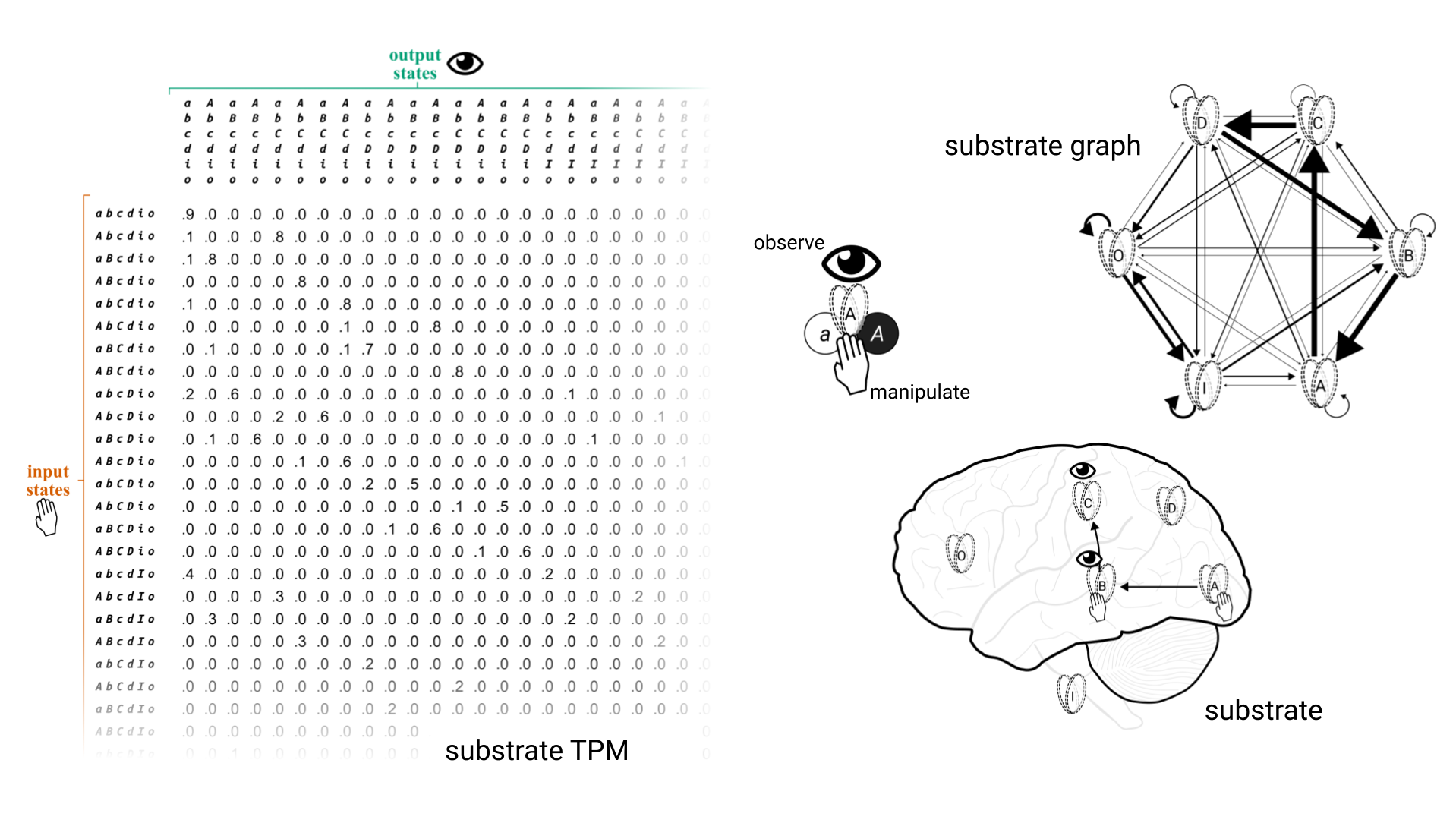
2. Intrinsicality: Select a candidate complex
As described in the postulate, intrinsicality requires that the cause–effect power of the substrate of consciousness be intrinsic—it must take and make a difference within itself. Therefore, when we apply intrinsicality operationally, we start by explicitly selecting a candidate substrate of consciousness (or complex) within the overall substrate we are studying. To do so, we treat all units outside the candidate as background conditions, leaving them causally inert (visualized by "pinning" them).
Mathematically, this is done by causally marginalizing out the background units from the input side of the TPM, conditional on their current state. This operation results in two distinct TPMs for the candidate complex:
- a cause TPM, containing the probabilities of the candidate complex being in all possible current states conditional on each of its possible input states
- an effect TPM, containing the probabilities of the candidate complex transitioning to each of its possible output states conditional on being in any of its possible current states
The reason we get two distinct TPMs in this step is that the consequences of "pinning" the background units are different whether the current state is considered as an input or an output state for a given transition. For the effect TPM, when the current substrate state is considered as an input state, the background units are marginalized out conditional on a distribution over their states where the current state has a 100% chance (it is certain) and all counterfactual states have 0% chance. In contrast, for the cause TPM, when the current state is considered as an output, the conditional distribution used when marginalizing out background units is not as straightforward. It is found by "backpropagating" the knowledge that the current substrate state occurred (as an output), resulting in a distribution over the possible input states of the background units. This distribution is then used to marginalize out the background units.
Now, with these two TPMs, we are in a position to assess whether the candidate complex "takes and makes a difference within itself"—as the postulate requires.
Slideshow 1: Unfolding - Apply intrinsicality - post Oct. 2023 — the deck embedded on the wiki page.
Slides: iit-wiki-slides-unfolding
Unfolding - Apply intrinsicality - post Oct. 2023
3. Information: Compute intrinsic information
[This excerpt is taken from Tononi, G. (forthcoming). On Being. Ch. 3: The postulates of physical existence I.]
As described in the [information postulate], the cause–effect state of the system is determined operationally by measuring intrinsic information ( and ) and picking the cause and the effect for which its value is maximal. Intrinsic information captures the specific cause–effect power of a system in its current state and uniquely combines the requirements not only of the information postulate but also of the existence and intrinsicality postulates [1]. Intrinsic information is the product of two factors, informativeness and selectivity, which are calculated through operations on the [cause and effect TPMs], as described below [2].
Slideshow 2: Unfolding - information — the deck embedded on the wiki page.
Slides: iit-wiki-slides-unfolding
Unfolding - information
Informativeness measures the "raw power" of the system in its current state over a specific effect state, or of a specific cause state over the system's current state. On the effect side, it is given by the logarithm of the ratio between the constrained and unconstrained probabilities ([...] dark green and gray bars). "Constrained" refers to the probability of a specific effect state given that the system is set to its specific current state, while "unconstrained" refers to the average probability of that effect state if the system is initialized in all possible states. Thus, informativeness is positive if and only if the system's current state raises the probability of a specific effect state above chance, and zero otherwise. The same calculation is done to determine informativeness on the cause side ([...] dark red and gray bars), but here, the power is of the cause state over the current state. Cause informativeness is thus positive if and only if a specific cause state raises the probability of the current system state above chance.
Informativeness can grow with the number of system units due to the increased repertoire of possible states, which reduces their unconstrained probability. More precisely, informativeness grows maximally, by 1 ibit, if we add a fully constrained unit to the system, while it will never decrease when adding a unit—even when adding a fully unconstrained one. Informativeness captures the postulate of existence—to exist, something must have cause–effect power, in the sense of taking a difference (being caused) and making a difference (producing an effect). It also fits with the postulate of intrinsicality because cause–effect power is exerted by the system over itself.
Selectivity measures how much the system's cause–effect power is concentrated over a specific cause or effect state ([...] light red and green bars)—that is, how close the probability of that specific state is to certainty (). Thus, effect selectivity is maximal () if the effect state is determined with certainty and uniquely by the current system state (likewise for cause selectivity, if the current state fully constrains the cause state) [3]. Selectivity reflects the intrinsicality postulate because, from the intrinsic perspective of the system, any uncertainty () about the potential cause–effect states it selects dilutes its specific cause–effect power.
Intrinsic information () is calculated as the product of informativeness and selectivity for every possible cause and effect state. Following the principle of maximal existence [...], the specific cause and effect states selected by the system in its current state are the ones with the highest value.
[...]
For a metaphorical illustration of intrinsic information and the role of informativeness and selectivity, imagine a rider on a chariot shafted to a number of horses [...]. The rider with the reins stands for the system in its current state and the behavior of the horses shafted to the chariot corresponds to the system's intrinsic effect. In the first case, the chariot is shafted to one horse. The rider has one "horsepower" at his disposal (corresponding to informativeness) and through the reins he can determine the chariot's course perfectly (corresponding to perfect selectivity). In the second case, the chariot is shafted to two horses. If the second horse is constrained by the reins just as well as the first, the rider has twice as much horsepower (higher informativeness) under his control (and still perfect selectivity). Given the choice, the rider should definitely prefer the two-horse chariot. In the third case, a third horse is shafted to the chariot, but the reins are extremely slack, so the horse is only minimally constrained by the rider's pull. Now, despite the increase in horsepower, and a small amount of influence over the third horse, the rider's control over the chariot's course has diminished: the chariot will hardly ever go where pointed, swerving around according to the whims of the third horse. Clearly, the rider should now prefer the two-horse chariot to stay on course. In other words, what matters from the intrinsic perspective is neither horsepower alone nor control alone, but the product of the two, corresponding to the product between informativeness and selectivity.
Footnotes
[1] Barbosa et al. 2020.
[2] For an exposition of the mathematical formalism, see Albantakis et al. 2022.
[3] As explained in Marshall et al. 2023, and Albantakis et al. 2022, selectivity on the cause side requires applying Bayes' rule to obtain the probability of a cause state given the current state. [See FAQ: How do we obtain the "backward" probabilities needed for cause selectivity?]
Video presentations about calculating intrinsic information
4. Integration: Compute integrated information (φs)
[This excerpt is taken from Tononi, G. (forthcoming). On Being. Ch. 3: The postulates of physical existence I.]
The integrated information of a system () quantifies the intrinsic information specified by a candidate substrate over its minimum partition for its maximal cause or effect state. It is determined by calculating and and taking the minimum between the two.
The calculation of and is similar to that of and , as presented in [the previous step]. The key difference is that the informativeness factor now becomes integrated informativeness, since we aim to assess the degree to which the cause–effect power of the system as a whole cannot be accounted for by the cause–effect power of its subsets. The values of and are calculated as the product of integrated informativeness and selectivity.
The probabilities required for calculating and are shown [below]. The same selectivity values from the calculations are used (light red and green bars). For integrated informativeness, the "constrained" probabilities from carry over as the "unpartitioned" probabilities (dark red and green bars). But now, instead of the "unconstrained" probabilities from , we use the "partitioned" probabilities (gray bars)—obtained, in this example, from the minimum partition. Integrated informativeness on the cause or effect side is then calculated as the logarithm of the ratio between the unpartitioned and partitioned probabilities. In other words, integrated informativeness measures the cause or effect power of the system with its internal connections intact compared to the power it would have if its internal connections were severed along the minimum partition.
Slideshow 3: Unfolding - integration — the deck embedded on the wiki page.
Slides: iit-wiki-slides-unfolding
Unfolding - integration
The value of and is obtained by taking the product of integrated informativeness and selectivity for the unidirectional partition that yields the minimal value (the "minimum partition"), following the principle of minimal existence [1]. Following the same principle, we then choose the minimal value between the cause and effect sides. Accordingly, the irreducibility () of substrate Abcd is 1.21, corresponding to the for the minimum partition. If the were zero (or set to zero if its value is negative), then the candidate system would be reducible—that is, it would not have unitary cause–effect power.
Of note, the minimum partition is defined as the partition that minimizes the integrated information relative to the maximum possible integrated information for a given partition [2]. Using the relative integrated information quantifies the strength of the interactions between parts in a way that does not depend on the number of parts and their size. Once the minimum partition has been identified, the integrated information across it is an absolute quantity.
Footnotes
[1] As noted in the [previous step, Compute intrinsic information], the selectivity factor is different in the cause direction because it takes Bayes' rule into account. [See FAQ: How do we obtain the "backward" probabilities needed for cause selectivity?]
[2] For a given partition, the maximum possible value of is equal to the number of potential connections cut by the partition, as demonstrated in Marshall et al. 2023.
5. Exclusion: Identify the main complex
As described in the postulate, exclusion requires that the substrate of consciousness be definite: it must specify its cause–effect state as this whole set of units. Our goal in this step, therefore, is to identify the main complex (or "first complex")—the well-defined set of units whose intrinsic cause–effect state is maximally irreducible among all candidate substrates that overlap with it.
This amounts to applying the previous steps to every subset (e.g., Abc), superset (e.g., Abcdo), and paraset (e.g., bdi) of our candidate Abcd. We aim to see whether any of these candidates has a higher than Abcd. It turns out that Abcd indeed has the maximum , indicated by .
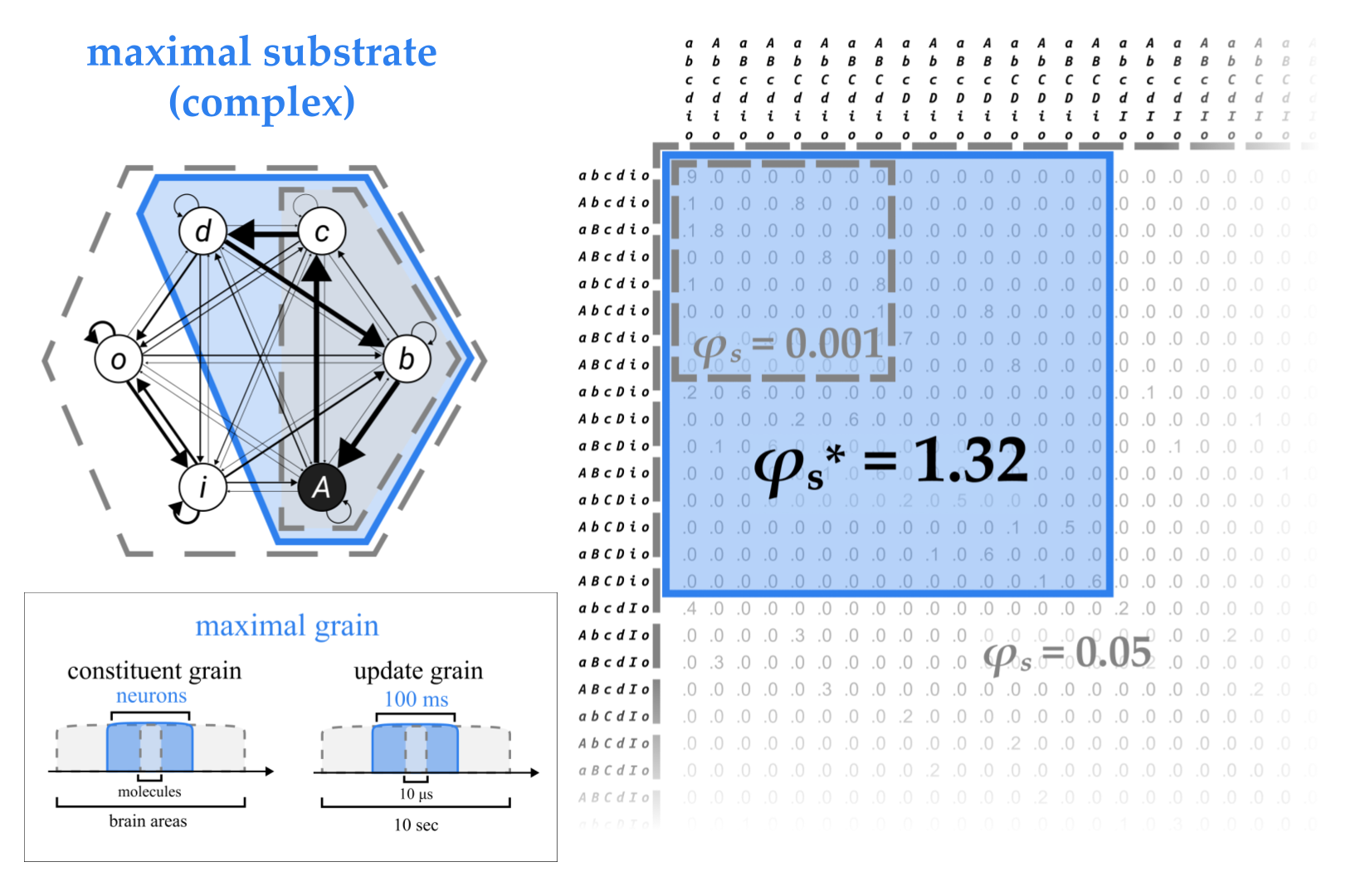
We can also identify any minor complexes. This amounts to applying the previous four steps to all remaining candidates of the original substrate (in this case, all subsets of units i and o).
Finally, note that these results are only valid for the specific constituent and update grains that we chose at the start. A different choice of grains means using a different substrate TPM. In theory, we would also have to apply the previous steps to all possible constituent and update grains to determine whether another choice yields the main complex (one with an even higher value than what we found with Abcd). (For more, see How do we determine the causal grain at which integrated information (φs) is maximal?)
6. Composition: Unfold the Φ-structure of the main complex
As described in the postulate, composition requires that the cause–effect power of the substrate of consciousness be structured: subsets of its units must specify cause–effects over subsets of units (distinctions) that can overlap with one another (relations), yielding a cause–effect structure that is the way it is. Hence, now that we have identified our main complex, we unfold its cause–effect power in full by evaluating the cause–effect power of each distinction (measured by ) and each relation (i.e., the cause–effect power that distinctions exert jointly, measured by ). Unfolding can be understood in the four steps below, which reapply the postulates (save composition itself), but now at the level of mechanisms rather than the system as a whole.
- Determine all irreducible distinctions by calculating the intrinsic information () and integrated information () of each candidate.
- Enforce the congruence of each irreducible distinction with the cause–effect state of the system.
- Calculate the value for each candidate relation, thus measuring the irreducibility of each distinction overlap.
- Calculate Φ ("big Phi") as the sum of all and values.
In explaining each step, we will focus mainly on the distinctions (and their relations) used elsewhere in the Wiki—namely, first-order distinction c and third-order distinction bcd.
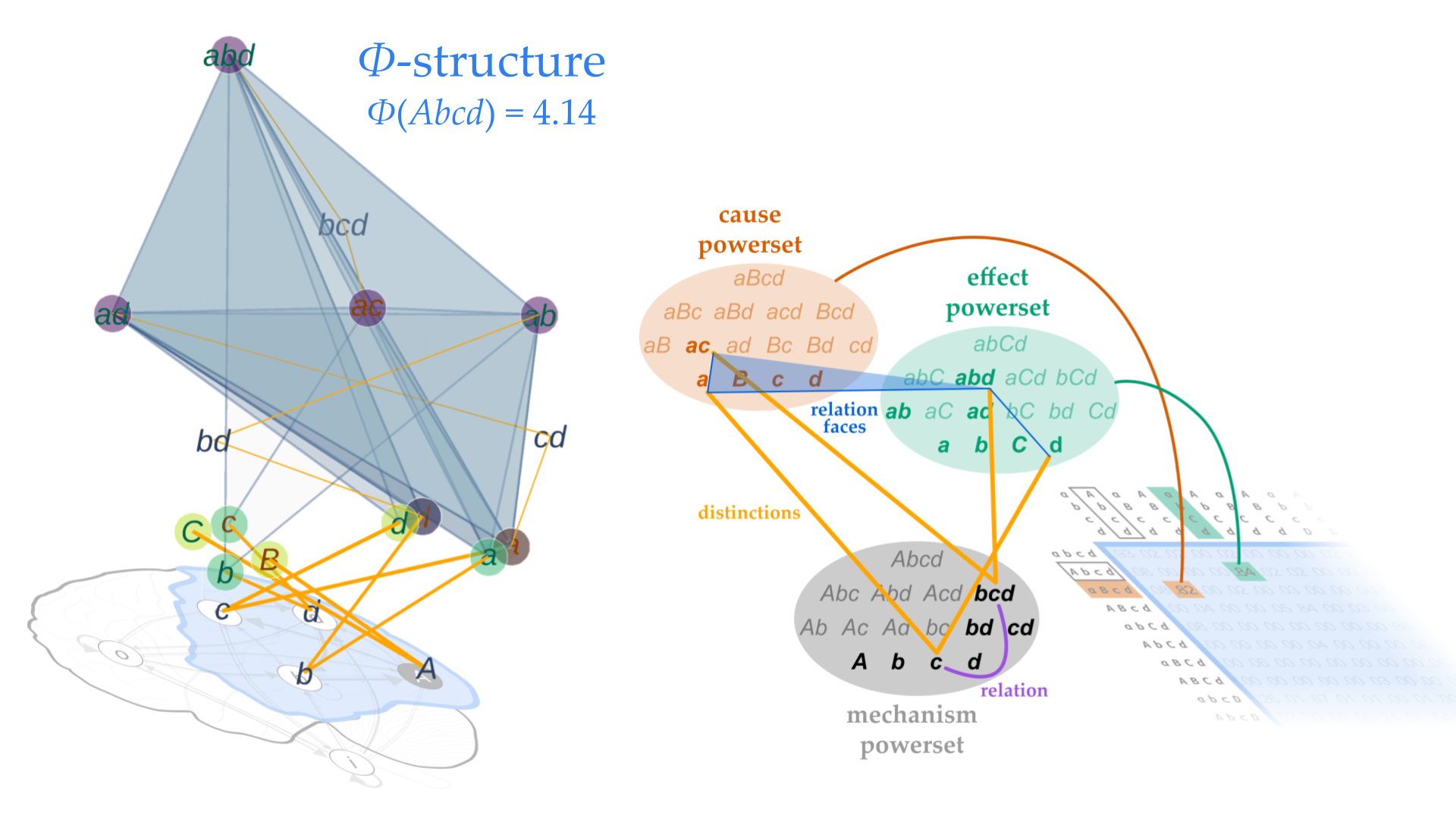
6.1. Determine all irreducible distinctions
We start by considering every possible subset of system units as a candidate mechanism. This means that we take the set of system units in their state (A, b, c, and d) and consider all possible subsets (the mechanism powerset), in this case: A, b, c, d, Ab, Ac, Ad, bc, bd, cd, Abc, Abd, Acd, bcd, and Abcd. (For more, see FAQ: Why do we assess the causal power of all orders of mechanisms?)
For each candidate mechanism, we aim to evaluate whether it specifies a distinction—whether it has an intrinsic and irreducible cause and effect. Hence we also assess the whole powerset of units as candidate causes and effects (called purviews). While the states of candidate mechanisms are "inherited" from the system state, the cause and effect purviews will have to be evaluated over every possible state (thus they are depicted in roman uppercase).
First, we compute intrinsic information () for each candidate mechanism over each purview state. This step can be understood as applying the existence, intrinsicality, and information postulates at the mechanism level. Starting on the cause side, take the example of candidate mechanism bcd. We will compute for every 1st-order candidate cause purview in every state (e.g., a, A), 2nd-order one (e.g., ac, Ac, aC, AC), and so on for all candidate causes of all orders. For each candidate cause, we find the state with the highest . For bcd over AC, for example, the state with highest is ac, while for bcd over A, the state with highest is a (details in the slides below).
After finding the state of the candidate cause of our candidate mechanism, we then measure the irreducibility of the mechanism–purview pair. The candidate cause (in its maximal state) with the highest is the maximally irreducible cause. This step can be understood as applying the integration and exclusion postulates. In our example, mechanism bcd has a of 0.035 over cause purview ac, and of 0.017 over a. The value of purview ac is higher than that of a—and of any other candidate cause as well. We therefore conclude that ac is the maximally irreducible cause of bcd, thereby excluding all other candidate causes.
After following these steps for every candidate mechanism on the cause side, we do the same on the effect side (calculating and ). We find, for example, that for candidate mechanism bcd, its maximally irreducible effect is abd, with . Thus, candidate mechanism bcd is irreducible and specifies a distinction over ac and abd with (the minimum between and for that distinction, according to the principle of minimal existence).
We repeat the process for every candidate mechanism and end up with a set of irreducible distinctions. For our example system, we find eight distinctions out of a possible fifteen given by the mechanism powerset (shown in the slides).
Slideshow 4: Unfolding - composition - distinctions — the deck embedded on the wiki page.
Slides: iit-wiki-slides-unfolding
Unfolding - composition - distinctions
6.2. Enforce congruence with the cause–effect state of the system
It is not enough to discover each irreducible distinction. Each must also be congruent with the system's cause–effect state (which we computed in the information step). Since the cause–effect state of system Abcd is aBcd–abCd, only the candidate purviews that are congruent with this state will be kept.
Our example distinction bcd is indeed congruent since its cause is ac and effect abd (the state of each purview unit is the same as the corresponding unit state specified by the system as a whole). However, one of the eight distinctions from the previous step is incongruent—namely, distinction bc (because its cause is over b and not B). We thus discard it and end up with only seven irreducible, congruent distinctions.
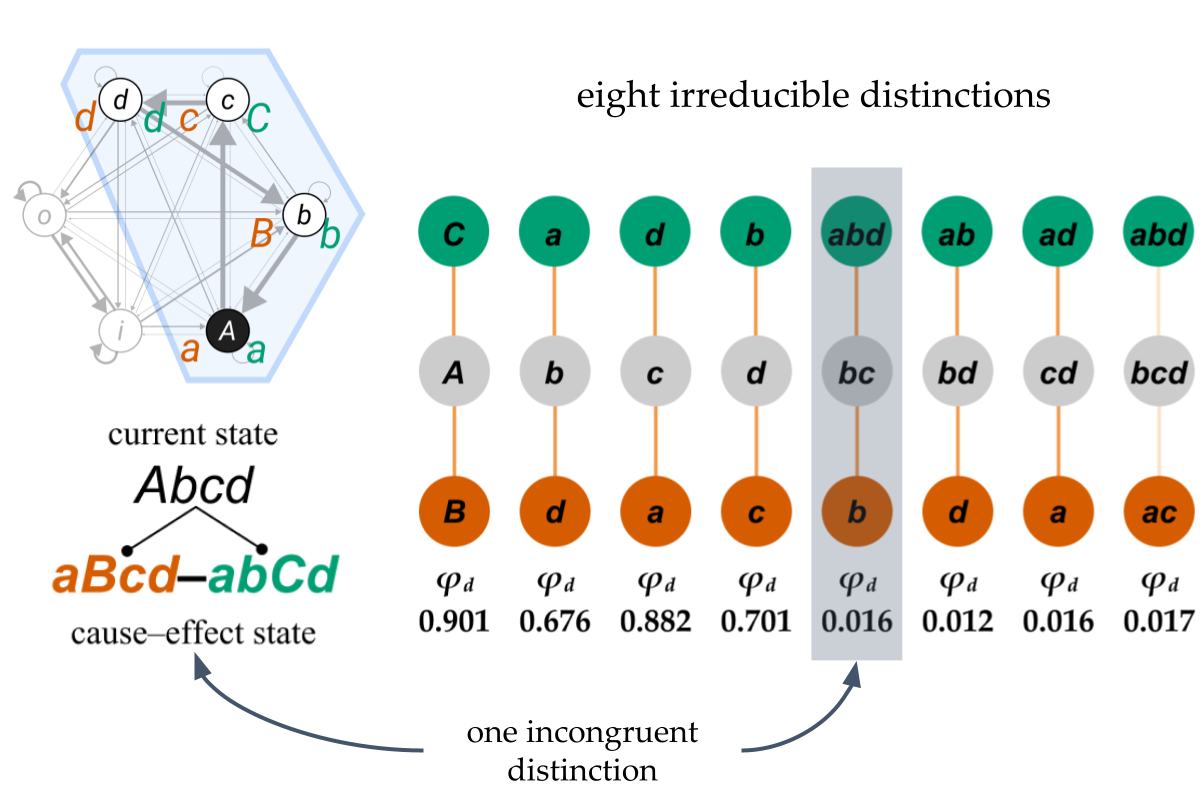
6.3. Calculate φr for all distinction overlaps
A causal relation obtains whenever distinctions overlap congruently over cause or effect purviews. Hence, we first identify all relations by simply looking at the overlaps in purview units, but we then need to quantify their irreducibility (how much they exist).
To assess the irreducibility of a relation, we partition or "unbind" the distinctions that constitute it one at a time, and identify the distinction that contributed least to the overlap (the relation MIP). As an example, consider the two distinctions in the figure: a–c–d and ac–bcd–abd. These distinctions are bound by a 2nd-degree relation (in purple), with relation purview ad, composed of three 2nd-degree faces (blue edges) with face purviews over a and d, and one 3rd-degree face (blue area), with a face purview over a.
To compute the of the relation, we unbind one distinction at a time and see which one makes the least difference. We calculate this by multiplying the average per distinct purview unit by the size of the overlap across all faces.
Here, bcd's , its cause is over ac, its effect is over bcd, and together, these purviews contain four unique units (c is repeated). Thus the size of the union is four, and the average per distinct purview unit is . Since the relation in question has an overlap over two units (relation purview ad), .
If instead we unbind distinction c, we get a of 0.882.
Since the from unbinding bcd is less than that from unbinding c, we conclude that the relation MIP is bcd and the of the relation is 0.008.
Slideshow 5: Unfolding - composition - relations — the deck embedded on the wiki page.
Slides: iit-wiki-slides-unfolding
Unfolding - composition - relations
6.4. Calculate Φ
We now have all the elements to assemble the complete Φ-structure (or cause–effect structure)—the union of all distinctions and relations specified by a substrate.
First we see all 7 distinctions, depicted with the first-order mechanisms "planted" on their respective substrate units. Each links a cause and an effect. The values are indicated by the thickness of the links and by the color of the bubbles (cool to warm tracks low to high ).
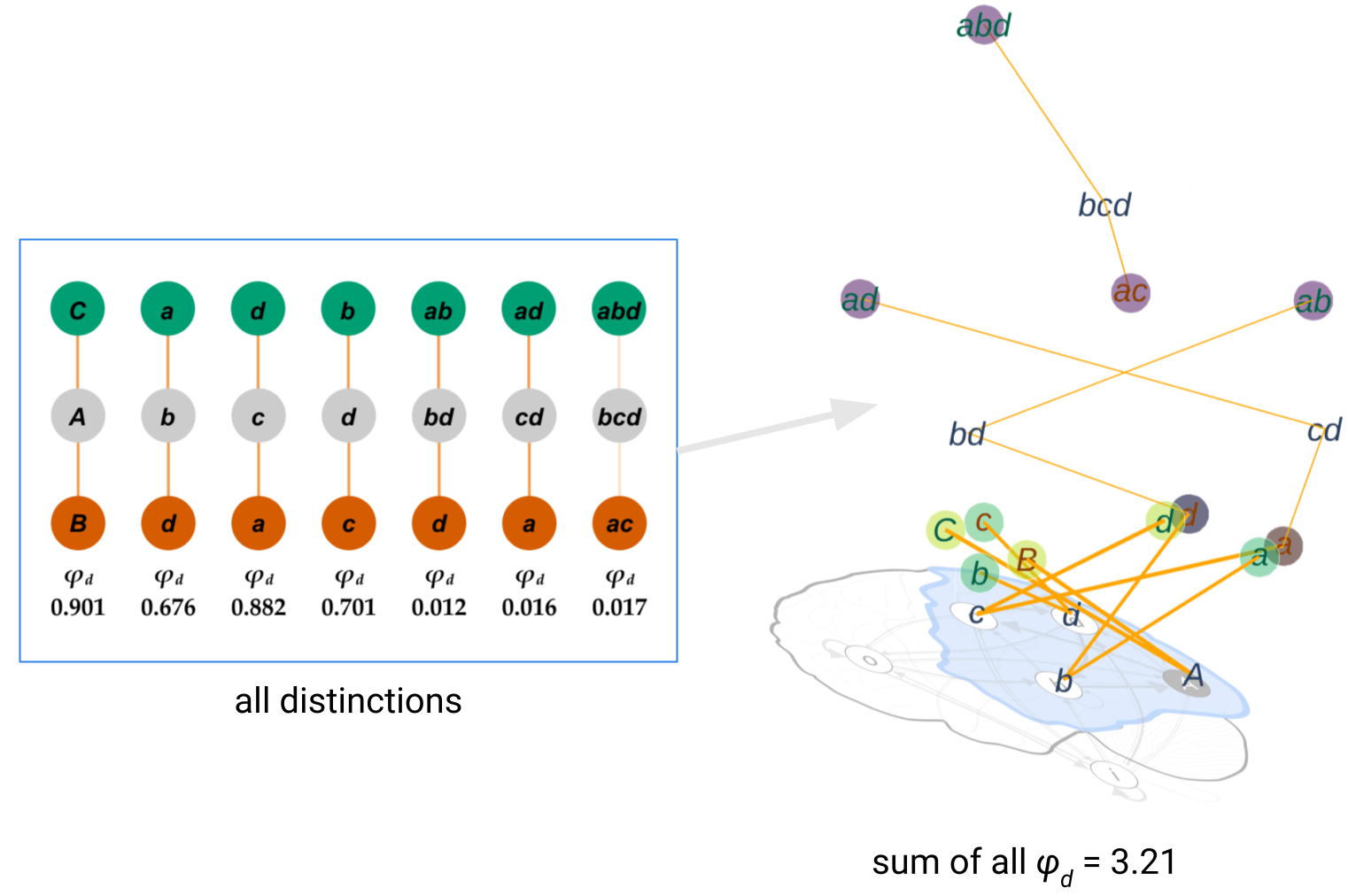
And all the relations are depicted as faces connecting the purviews. Second-degree faces are edges, and third-degree faces are surfaces. (We cannot show higher-degree faces, though there are many.) The values are indicated by the thickness and opacity of the edges and surfaces.
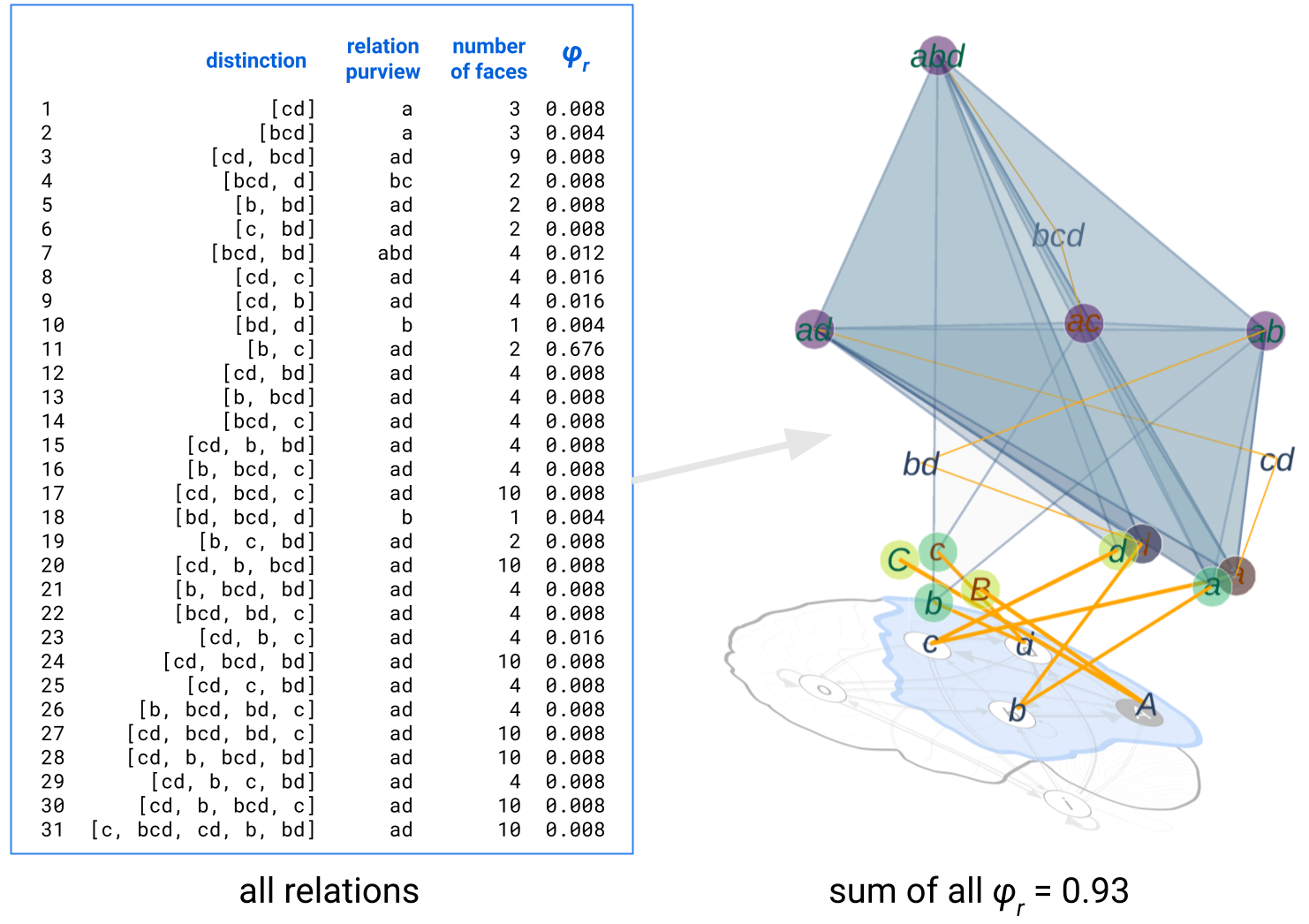
Now that we have unfolded the Φ-structure in full (with all its distinctions and relations), we can calculate its Φ value, which is simply the sum of and = 3.21 + 0.93 = 4.14. The Φ value (called "big Phi" or "structure Phi") quantifies the structure integrated information—the total irreducible cause–effect power specified by a complex.
Note that this is just one way to depict a Φ-structure, in which the powersets of mechanisms and purviews are arranged by order in layers of regular polygons. Though this depiction may appear chaotic at times, it allows you to see which subsets in the powerset are absent (and thus reducible) and to pick out key differences when comparing Φ-structures. We will use other depictions in, for example, the sections on space and time.
https://bjorneju.github.io/CES_html_hosting/figure1/
Frequently Asked Questions
- How do we get a TPM?
- How do we obtain the "backward" probabilities needed for cause selectivity?
- What is a valid (or "legal") partition?
- How do we determine the causal grain at which integrated information (φs) is maximal?
Cite this page
Juel, Bjørn Erik, Jeremiah Hendren, Matteo Grasso, and Giulio Tononi. "Computing Φ: Identifying a complex & unfolding its Φ-structure." In Integrated Information Theory Wiki. Center for Sleep and Consciousness, University of Wisconsin–Madison. Last modified 30 June 2024. DOI: 10.5281/zenodo.14160283. http://www.iit.wiki/unfolding.
BibTeX
@misc{Juel2024unfolding,
  author={Juel, Bjørn Erik and Hendren, Jeremiah and Grasso, Matteo and Tononi, Giulio},
  title={Computing \emph{$\Phi$}: Identifying a complex \& unfolding its \emph{$\Phi$}-structure},
  howpublished={In {\emph{Integrated Information Theory Wiki}}},
  year={2024},
  publisher={Center for Sleep and Consciousness, University of Wisconsin--Madison},
  note={Last modified 30 June 2024. DOI: 10.5281/zenodo.14160283},
  url={http://www.iit.wiki/unfolding}
}
How IIT Accounts for Contents of Experience
Source: https://www.iit.wiki/contents
Summary
To provide a complete explanation of consciousness, integrated information theory (IIT) aims to account not only for its quantity but also its quality—its contents. For instance, we think thoughts, feel emotions, see colors and shapes, hear sounds, sense the flow of time, and so on. According to IIT, the "feel" of all these contents of experience must be accounted for in full by the corresponding properties of Φ-structures and sub-structures (Φ-folds). In short, all quality is structure.
Thus far, the IIT research program has focused on accounting for the feeling of extendedness that characterizes spatial experience and the feeling of flow that characterizes temporal experience. These modes of experience have been the focus for two reasons: they are especially pervasive, and it is possible to introspect various aspects of the phenomenal structure (unlike, say, the "color red," which seems impenetrable to introspection). The IIT account of the extendedness of space has been developed in Haun & Tononi (2019) and of time in Comolatti et al. (2025). The accounts of objects and local qualities will come next in the IIT research program.
Contents
- Why does space feel the way it does?
- Video tutorial for space
- Plasticity in the structure of visual space
- Of maps and grids
- The unfathomable richness of seeing
- Why does time feel the way it does?
- Why do objects feel the way they do?
- Frequently Asked Questions
Why does space feel the way it does?
"There must be a reason why an experience feels the way it does. A good place to begin addressing this question is spatial experience, because it may be more penetrable by introspection than other qualities of consciousness such as color or pain. Moreover, much of experience is spatial, from that of our body to the visual world, which appears as if painted on an extended canvas in front of our eyes. Because it is 'right there', we usually take space for granted and overlook its qualitative properties. However, we should realize that a great number of phenomenal distinctions and relations are required for the canvas of space to feel 'extended'. Here we argue that, to be experienced as extended, the canvas of space must be composed of countless spots, here and there, small and large, and these spots must be related to each other in a characteristic manner through connection, fusion, and inclusion. Other aspects of the structure of spatial experience follow from extendedness: every spot can be experienced as enclosing a particular region, with its particular location, size, boundary, and distance from other spots. We then propose an account of the phenomenal properties of spatial experiences based on integrated information theory (IIT). The theory provides a principled approach for characterizing both the quantity and quality of experience by unfolding the cause–effect structure of a physical substrate. Specifically, we show that a simple simulated substrate of units connected in a grid-like manner yields a cause–effect structure whose properties can account for the main properties of spatial experience. These results uphold the hypothesis that our experience of space is supported by brain areas whose units are linked by a grid-like connectivity. They also predict that changes in connectivity, even in the absence of changes in activity, should lead to a warping of experienced space. To the extent that this approach provides an initial account of phenomenal space, it may also serve as a starting point for investigating other aspects of the quality of experience and their physical correspondents."
Video tutorial for space
Video 1: Video tutorial for space — source deck in this folder: space-tutorial-wiki-June 2025.pptx
Slides: iit-wiki-slides-contents
To cite the content of this presentation, please cite Haun, A., & Tononi, G. (2019). Why does space feel the way it does? Towards a principled account of spatial experience. Entropy, 21(12), 1160.
Plasticity in the structure of visual space
Abstract from Song, C., Haun, A. M., & Tononi, G. (2017). Plasticity in the structure of visual space. Eneuro, 4(3):
"Visual space embodies all visual experiences, yet what determines the topographical structure of visual space remains unclear. Here we test a novel theoretical framework that proposes intrinsic lateral connections in the visual cortex as the mechanism underlying the structure of visual space. The framework suggests that the strength of lateral connections between neurons in the visual cortex shapes the experience of spatial relatedness between locations in the visual field. As such, an increase in lateral connection strength shall lead to an increase in perceived relatedness and a contraction in perceived distance. To test this framework through human psychophysics experiments, we used a Hebbian training protocol in which two-point stimuli were flashed in synchrony at separate locations in the visual field, to strengthen the lateral connections between two separate groups of neurons in the visual cortex. After training, participants experienced a contraction in perceived distance. Intriguingly, the perceptual contraction occurred not only between the two training locations that were linked directly by the changed connections, but also between the outward untrained locations that were linked indirectly through the changed connections. Moreover, the effect of training greatly decreased if the two training locations were too close together or too far apart and went beyond the extent of lateral connections. These findings suggest that a local change in the strength of lateral connections is sufficient to alter the topographical structure of visual space."
Of maps and grids
Abstract from Grasso, M., Haun, A. M., & Tononi, G. (2021). Of maps and grids. Neuroscience of Consciousness, 2021(2), niab022:
"Neuroscience has made remarkable advances in accounting for how the brain performs its various functions. Consciousness, too, is usually approached in functional terms: the goal is to understand how the brain represents information, accesses that information, and acts on it. While useful for prediction, this functional, information-processing approach leaves out the subjective structure of experience: it does not account for how experience feels. Here, we consider a simple model of how a "grid-like" network meant to resemble posterior cortical areas can represent spatial information and act on it to perform a simple "fixation" function. Using standard neuroscience tools, we show how the model represents topographically the retinal position of a stimulus and triggers eye muscles to fixate or follow it. Encoding, decoding, and tuning functions of model units illustrate the working of the model in a way that fully explains what the model does. However, these functional properties have nothing to say about the fact that a human fixating a stimulus would also "see" it—experience it at a location in space. Using the tools of Integrated Information Theory, we then show how the subjective properties of experienced space—its extendedness—can be accounted for in objective, neuroscientific terms by the "cause-effect structure" specified by the grid-like cortical area. By contrast, a "map-like" network without lateral connections, meant to resemble a pretectal circuit, is functionally equivalent to the grid-like system with respect to representation, action, and fixation but cannot account for the phenomenal properties of space."
The unfathomable richness of seeing
Abstract from Haun, A. M., & Tononi, G. (2025). The unfathomable richness of seeing. Trends in Cognitive Science, 29(10), 892–902:
Many hold that visual experience is sparse and its richness illusory, relying on high-level summaries rather than detailed content. However, we argue here that seeing is more than this—it is unfathomably rich. We distinguish three levels of visual phenomenology: high level object and scene categorizations; mid-level feature groupings; and a fundamental spatial field composed of spots and their spatial relations. Crucially, we argue that seeing objects requires seeing the groupings that compose them, and that seeing groupings requires seeing the spatial field that grounds them. Even the most basic feeling of spatial extendedness implies rich phenomenal structure. It follows that much of what we see cannot be used, reported, or remembered. And yet we see it.
Why does time feel the way it does?
Time flows—or at least the time of our experience does. Can we provide an objective account of why the conscious present encompasses a succession of moments that slip from now to then—an account of why time feels flowing? Integrated Information Theory (IIT) aims to account for both the presence and quality of consciousness in objective, physical terms. Given a substrate's architecture and current state, IIT's formalism yields a cause-effect structure that fully accounts for experience. Here, we show that unfolding the cause-effect structure of directed grids can explain why time feels flowing. We argue that the conscious present feels flowing because it is composed of phenomenal distinctions (moments) that are directed and related via inclusion, connection, and fusion. Time, on this view, is not a process in clock time but a structure specified by the system's current state. We conclude by outlining implications for the psychophysics, philosophy, and neuroscience of time.
Video 2 — source deck in this folder: time-tutorial-wiki-Jul 10 2025.pptx
Why do objects feel the way they do?
Preview of abstract from Grasso & Tononi. (In preparation). Why do objects feel the way they do?
When we look at the world, we don't only perceive specs of color, we see objects we have names for: we see three segments and recognize a letter "A"; we see two dots and a curved line and recognize a smiley face. Visual experience is typically characterized by sets of low-level features that are bound together to form objects we recognize—anything from geometric shapes to natural forms, animal shapes, letters, numbers, faces, tools, and so on. Previous work has applied the formalism of IIT to account for the extendedness of visual space (Haun & Tononi 2019) and the feeling of the flow of time (Comolatti, Grasso & Tononi Forthcoming). Here we develop an initial explanation of why objects feel the way they do: how phenomenal objects bind general concepts with particular features (conceptual invariance).
First we characterize the phenomenology of objects, in which a particular configuration of low-level features (e.g., colors and edges) is experienced as an instance of a general concept (e.g., "face"), which is invariant for many possible configurations. We then apply the formalism of IIT to analyze a plausible neural substrate for conceptual invariance: pyramids of grids, similar to the ones found across levels of the visual cortex. We show how the binding of particular configurations to general concepts can be accounted for in physical terms by the cause–effect structure specified by pyramids of grids: by the causal distinctions (specified by conjunction and disjunction mechanisms) and relations they form to compose a conceptual hierarchy.