Corpus
Slides: How IIT Accounts for Contents of Experience
The lab's transcriptions of the decks embedded on https://www.iit.wiki/contents: each slide's text as the deck shows it, and in square brackets a description of each diagram, which is the transcriber's and not the deck's.
Video 1: Video tutorial for space
Source page: Why does space feel the way it does? Source deck: space-tutorial-wiki-June 2025.pptx (56 slides, with narration in the presenter's notes) Based on: Haun, A., & Tononi, G. (2019). Why does space feel the way it does? Towards a principled account of spatial experience. Entropy, 21(12), 1160.
Introduction (slide 1)
This slideshow will outline how IIT accounts for the experience of space. We will focus on visual space, but this account applies to spatial experience in other modalities as well.
If any of the terms we use are confusing, we encourage you to pause the video and consult the glossary of the IIT Wiki.
[The title slide reads "Why does space feel the way it does?" with a button labelled "iit.wiki/glossary."]
The IIT method (slides 2–5)
Following the IIT method, recall that we aim to establish a one-to-one correspondence between an experience—a phenomenal structure—and the Φ-structure unfolded from the substrate of consciousness.
Earlier in the Wiki, we saw how IIT establishes the explanatory identity by accounting for the essential properties of every conceivable experience in terms of cause-effect power.
Now, we will see how IIT demonstrates the identity by accounting for the accidental properties of experience—that is, properties that are present in some experiences but absent in others.
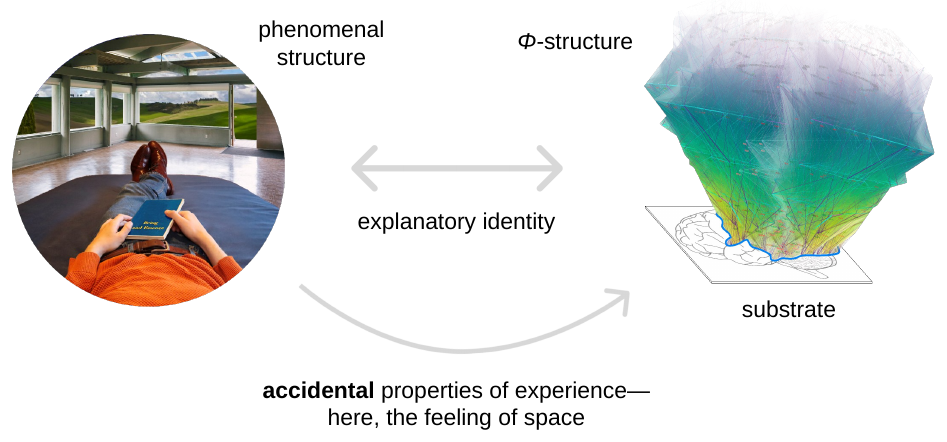
[Under the title "The IIT method," the wiki's sample experience, a round first-person photograph of lying on a bed with a book in a bright room with wide windows, is labelled "phenomenal structure." At right, a colourful, many-faceted "Φ-structure" rises from a flat "substrate" in which a brain outline is drawn. A double arrow labelled "explanatory identity" joins them, and a curved arrow runs from the experience to the substrate, captioned "accidental properties of experience—here, the feeling of space." On slide 2 only the photograph, the Φ-structure and a plain double arrow are shown, with a button labelled "iit.wiki/overview"; on slide 3 the caption reads "essential properties of experience."]
This account of why space feels the way it does was first developed in Haun and Tononi 2019. Here we will provide a simplified version of this account, slightly updated to IIT 4.0 and without any mathematical details.
[Slide 5, titled "The IIT method to account for space," shows photographs of the two authors beside the reference: Haun, A., & Tononi, G. (2019). Why does space feel the way it does? Entropy, 21(12), 1160.]
The method applied to space (slides 6–11)
Following the IIT method, we will first characterize in more detail what space feels like—its phenomenal structure.
We will then aim to formulate these phenomenal properties in physical terms—that is, in terms of the cause–effect power of a substrate.
We will work with a simple substrate inspired by the lattice-like architecture of visual cortex. This part of the brain comprises 2D grids of neurons connected via lateral near-neighbor connections and stacked on one another.
If we unfold the cause-effect power of a substrate of this kind, it corresponds to a Φ-fold—in this case, a part of the Φ-structure specified by visual cortex.
In this demonstration, we will work with a highly simplified substrate—namely, a 1D grid of 7 units, A through G. These units all connect to their nearest neighbors and have self-loops.
This 7-unit, 1D grid unfolds into the Φ-fold depicted here. While a 1D grid would technically correspond to a 1D phenomenal space, the results generalize to 2D as well, as demonstrated in the Haun and Tononi paper.
Based on the explanatory identity of IIT, the properties of this Φ-fold should correspond one-to-one with the properties of the phenomenal structure of visual space. As we will show, this phenomenal–physical identity is how IIT explains why space feels extended.
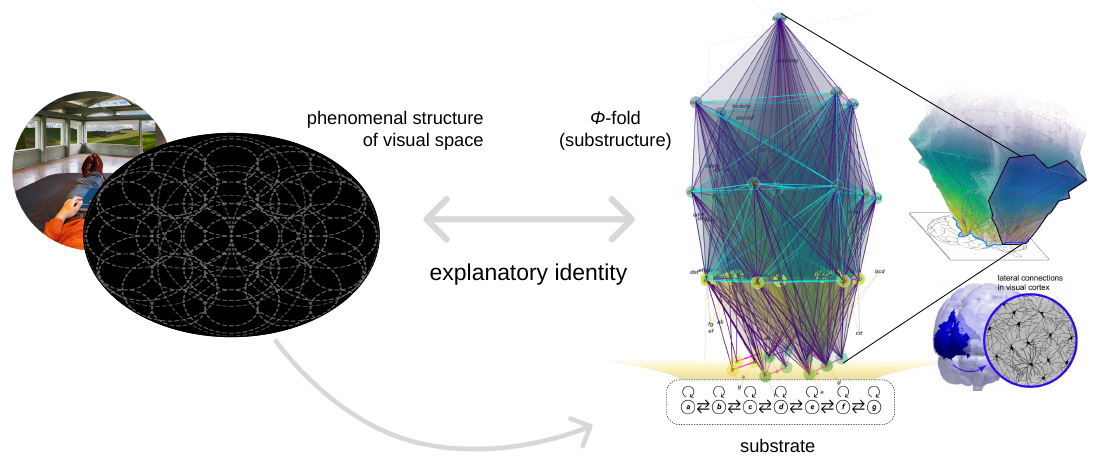
[At left, a black ellipse filled with many overlapping dashed circles, standing for the countless spots of visual space, lies over the sample-experience photograph and is labelled "phenomenal structure of visual space." At right, labelled "Φ-fold (substructure)," a tall lattice of purple, blue and yellow connections rises above the "substrate," a row of seven units a to g, each with a self-loop and linked to its neighbours by double arrows. A line from the Φ-fold leads to a small copy of the whole Φ-structure, in which the Φ-fold is outlined as one part; below it, a brain with its visual area in blue is shown beside an enlarged grid-like network labelled "lateral connections in visual cortex." The double arrow "explanatory identity" joins the two sides, and a curved arrow from the ellipse to the substrate is captioned "Formulate phenomenal properties in terms of cause–effect power of a substrate." Slides 6–10 build this picture step by step: the ellipse (slide 6), the visual cortex (slide 7), the Φ-fold as part of the Φ-structure (slide 8), the 7-unit substrate (slide 9) and its Φ-fold (slide 10).]
Characterizing the phenomenal structure of visual space (slides 12–15)
Let us begin by characterizing the phenomenal structure of visual space. This may seem strange at first, even trivial—for example, it's like starting to explain gravity by demonstrating that things fall. But this is because our experience of space is so all-pervasive that we may not even notice that it needs to be accounted for. The exercises here aim demonstrate that visual space indeed has structure, and one that we can characterize—at least to some extent.
What do we mean by the experience of visual space? A typical visual experience has various shapes and colors on the canvas of our visual field. For instance, now you see a screen that is all black.
But it can be red…it can be green…it can be blue…or black again. Notice that despite all these changes in color, the screen was there all the time, like an extended canvas.
[On slide 13 the whole screen turns black, red, green, blue and black again.]
Besides colors, you might also see shapes and objects occupying portions of your visual space.
For instance, here's a face…or a house…and now those objects are gone. But you still see the space: the canvas on which those objects appeared is still there, just dark.
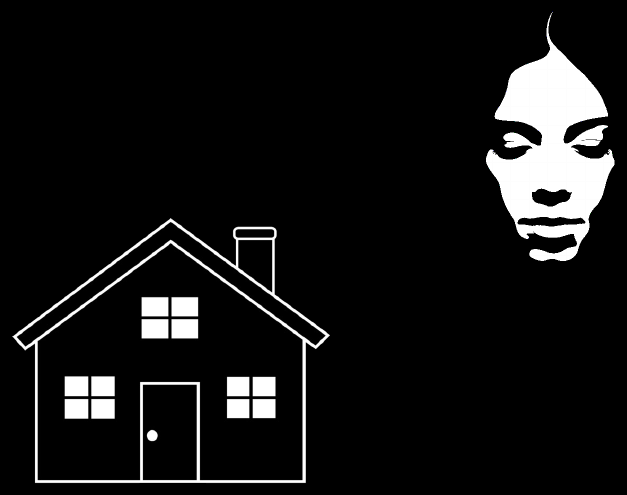
[White line drawings on a black screen: a woman's face at upper right and a house at lower left. They appear one after the other and then vanish, leaving the black screen.]
How can we characterize the feeling of space? Not the feeling of the colors or the objects you saw, but of space itself—the feeling of the canvas on which those colors and objects appeared?
Spots: the components of space (slides 16–21)
First, it must have components—and a lot of them. The most basic of these components we will call "spots."
For example, here is a bright spot roughly where you saw the face before. In order to see this spot as bright, you must be seeing a spot in the first place.
To see what we mean, keep watching this spot as it fades out. You can't see the spot as bright anymore, but the spot is still there—it simply has the same color as its surroundings.
In fact, the spot was always there—also before you saw it as bright.
[On slide 16 a single white oval appears on the black screen, where the face was, and fades out.]
We can generalize and show that this is true for many more spots, big and small, all over the canvas. We can think of spots as distinctions in the sense that they are the basic component that we can distinguish when we introspect phenomenal space.
And now they've gone dark, but the spots are still there because the entire space is still there—it's just dark. The point is that for space to feel extended, all its countless spots must be there all the time.
[On slide 17 white ovals of many sizes appear all over the black screen and then go dark.]
What if space were not composed of all its spots? Here, for example, you see two bright spots with a region of space separating them. What would happen if the spots composing this central region were not there?
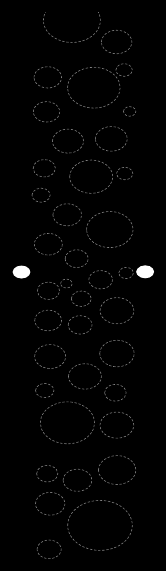
[A vertical band down the middle of the black screen is filled with dashed circles of many sizes, the spots of the central region; a small white spot sits at each side of the band.]
If the spots of this region were not there, there would be no space to separate the two bright spots; as a consequence, they would not feel to be at a distance anymore. The feeling of space would "shrink." Of course, this depiction is merely an intuition pump. But something akin to this happens in, for example, hemianopia, where patients cease to experience portions of visual space altogether.
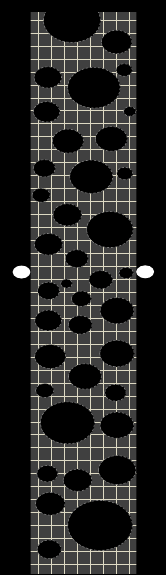
[The same band, now drawn as a white grid in which the spots appear as black holes, standing for spots that are missing; the slide animates the "shrinking" the narration describes.]
So, for this central region of space to feel the way it does—for it to feel extended—all the spots that compose it must be there.
But it's not enough to have spots—they must also be structured. Some spots overlap, some include others, each is at a distance from the others, and so on. So the distinctions—the spots—must also be related to one another in particular ways.
[On slide 20 the band is shown densely packed with overlapping dashed circles.]
What would it mean if the spots were all there but there were no relations among them? Again, it's not really possible to show this, but here's another graphical intuition pump.
All the spots are still there, but they've been scattered and lost the relations that had made them form a region of space before.
[On slide 21 an animation scatters the spots of the band.]
Four fundamental properties of extendedness (slides 22–31)
We have seen that to form a space, spots must relate to one another. But how exactly do they relate? IIT proposes that phenomenal space feels extended owing to four fundamental properties. These are reflexivity, inclusion, connection, and fusion. Let's look at each in turn.
[Slide 22 lists the "Four Fundamental Properties of Extendedness": reflexivity, inclusion, connection, fusion.]
Reflexivity (slide 23)
The first property is reflexivity: spots are stable or fixed—figuratively speaking, we might say that spot "points to" itself.
What would it mean if spots didn't "point to" themselves?
Consider the contrast with the feeling of time, in which a moment feels fleeting—it "points away" from itself, toward other moments.
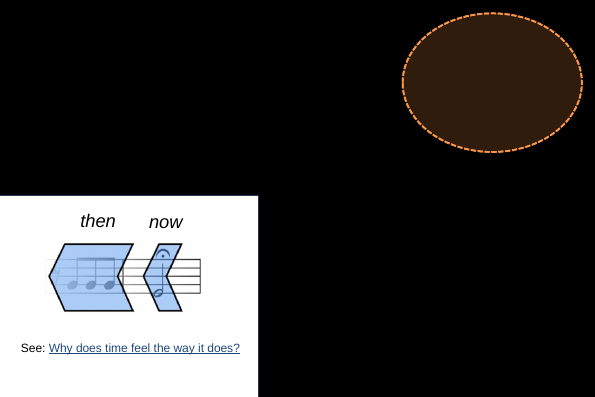
[Under the heading "reflexivity," a single spot is drawn as a brown ellipse with a dashed orange outline on the black screen. In the lower-left corner, a white inset shows two arrow-shaped blue blocks over a musical stave, labelled "then" and "now," pointing away from themselves, with the caption "See: Why does time feel the way it does?"]
Inclusion (slides 24–26)
The second property is inclusion: for every spot there are other spots that include it—for example, S2 includes S1.
If there were not a bigger spot that included S1, then S1 would simply be the full space.
Sort of like this.
Similarly, for any spot, such as S1, there's always a spot that is included by it—for example, S3. Could S1 look the way it does if it didn't include any smaller spot?
No, because it would mean that we could not introspect that S1 has, say, a left half and a right half.
If S1 didn't include a smaller spot, it would shrink to a point—which has no extension—sort of like this.
So, S1 must be included by at least one bigger spot—S2—and include at least one smaller spot—S3.
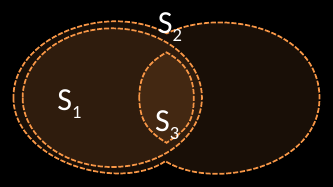
[Three spots with dashed orange outlines: a larger ellipse S2, and inside its left part a smaller ellipse S1, which in turn contains a still smaller spot S3 on its right side. On slide 24 only S1 and S2 are shown, and an animation ("sort of like this") shows S1 as the full space. On slide 25 S1 is shown with a dashed line dividing it into left and right halves and S3 inside it, and an animation shows S1 shrinking to a point.]
Connection (slides 27–29)
The third property is connection: for every spot, there is always another spot that partially overlaps with it, such that their overlap is also a spot (or, in the limit, just a point). Here, S1 partially overlaps with S4, such that their overlap is S3.
If the spots were not connected, at best, they might feel to be next to each other—like this. But note that for these to feel next to each other, connection is again at work: there must be another spot that they both overlap with.
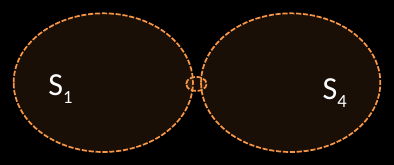
[S1 and S4 are drawn side by side without overlapping; between them, where they meet, a tiny dashed spot overlaps both.]
Connection is what makes space feel ordered—for instance, it's what makes S1 feel "close" to S4 and "far" from S5.
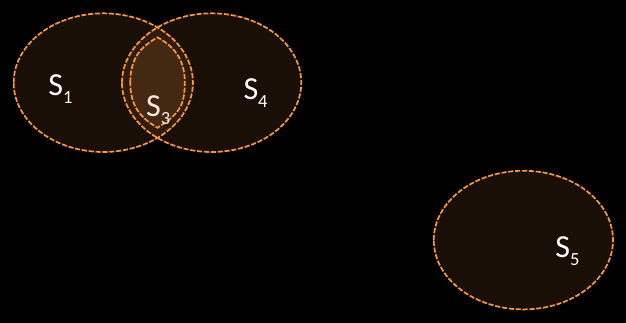
[S1 and S4 overlap, and their overlap is the smaller spot S3. A separate spot, S5, lies far away at lower right. Slide 27 shows the overlapping S1, S3 and S4 alone.]
Fusion (slides 30–31)
The fourth property is fusion: for every spot, we can find another spot that partially overlaps it such that their union is also a spot. Here, the union of S1 and S4 is S2, which includes both of them and nothing else. If fusion didn't hold, our experience of space would be fragmented—meaning that S1 and S4 would not feel to be part of the same space.
For example, imagine that S1 were the left half of the full visual field and S4 the right half. For S1 and S4 to feel like the left and right half of something, we must also be experiencing the whole—in other words, they must fuse into S2.
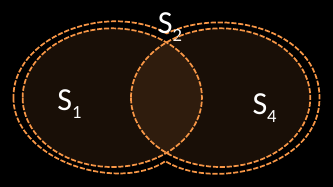
[S1 and S4 overlap, and a larger spot S2 surrounds exactly the two of them. On slide 31 the same spots are shown over a grainy grey background, with S1 and S4 as the two halves of the whole field.]
Summary of the phenomenological analysis (slides 32–33)
To sum up this phenomenological analysis, space needs to be explained because there is something it is like to have a spatial experience, irrespective of colors, objects, or any sensory stimuli.
To experience space, we must be experiencing countless spots…which must be related in four fundamental ways: reflexivity, inclusion, connection, and fusion.
Note that we presented these properties as being satisfied by S1—our original spot. But they must be satisfied by every spot—every distinction that composes space.
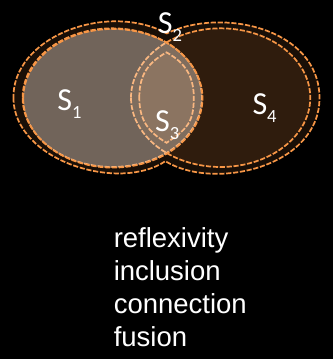
[The four spots together: S1 (highlighted) and S4 overlap in S3, and S2 surrounds both. Beneath them are the words reflexivity, inclusion, connection, fusion. Above the figure, the slide lists three points: "1) There is something it is like to have a spatial experience, irrespective of colors, objects, or any sensory stimuli. 2) To experience space, we must be experiencing countless spots… 3) …which must be related in four fundamental ways:"]
Before we continue, a clarification is in order.
Some may be tempted to ask, isn't this phenomenological analysis just set theory applied to space? There are connections indeed, also to mereology and topology.
But the reason, we argue, is because space feels the way it does. Since visual space has the phenomenological structure it has, these mathematical fields have been formalized the way the are—not the other way around.
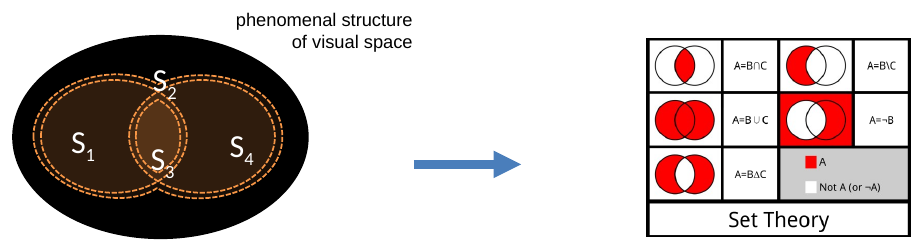
[At left, the four spots S1–S4 inside the black ellipse, labelled "phenomenal structure of visual space." At right, a table labelled "Set Theory" shows Venn diagrams of pairs of circles with regions shaded red for operations such as intersection, union and difference. A blue arrow points from the phenomenal structure to the set-theory table, in line with the narration: the mathematics takes the form it has because space feels the way it does. The table is credited to Wikimedia Commons.]

The four properties in terms of cause–effect power (slides 34–42)
We will now apply the IIT method to account for the phenomenal structure of visual space in physical terms.
As already mentioned, we will work with the Φ-fold unfolded from this model substrate of a 1-dimensional lattice of seven units—A through G.
You can learn about the unfolding procedure elsewhere in the Wiki.
[Slide 34 repeats the method diagram of slide 11, with the four spots S1–S4 in the ellipse, and a button labelled "iit.wiki/unfolding."]
To help us interpret the Φ-fold here, we will illustrate the distinctions in this simplified way: each cluster is a distinction, with the mechanism in black, the cause in red, and the effect in green.
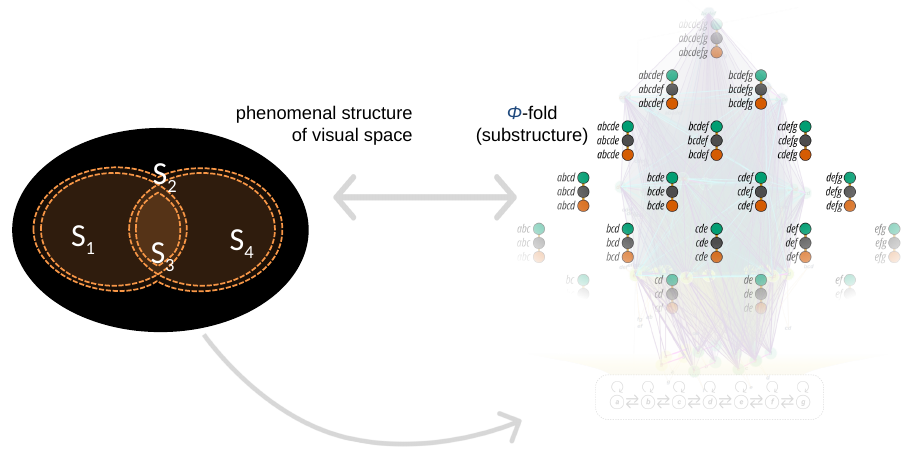
[At left, the four spots S1–S4 in the black ellipse, labelled "phenomenal structure of visual space." At right, labelled "Φ-fold (substructure)," the Φ-fold is redrawn as a pyramid of small clusters, one per distinction, each a stack of three labels (cause in orange-red, mechanism in black, effect in green) with coloured dots, from the single units at the bottom up to abcdefg at the top.]
To simplify even further, let us zoom in on four distinctions. We will see how the four properties among our four spots can be formulated in terms of cause-effect power—that is, as types of relations among these four distinctions on the right.
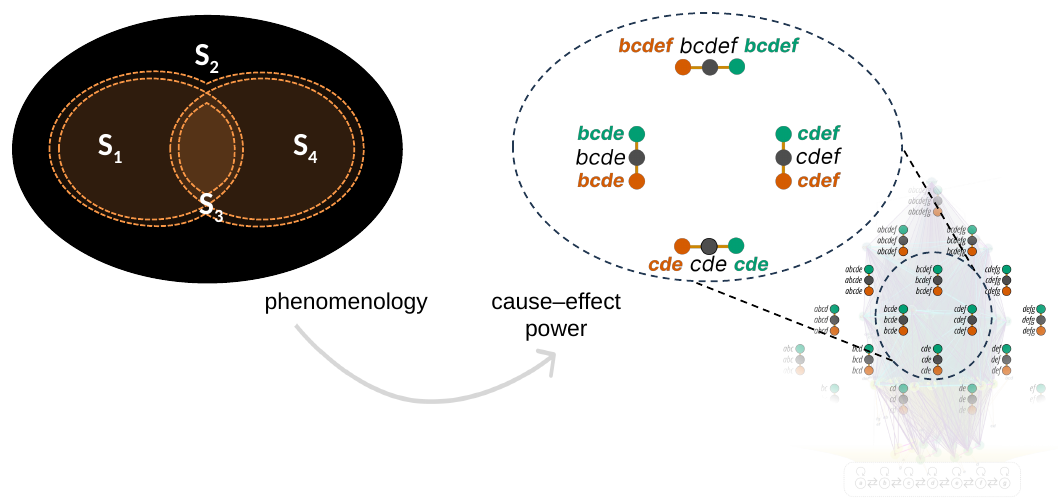
[At left, the four spots S1–S4, labelled "phenomenology." At right, a dashed oval enlarged from the middle of the Φ-fold, labelled "cause–effect power," contains four distinctions, each drawn as a cause, a mechanism and an effect over the same units: bcdef at the top, bcde at left, cdef at right and cde at the bottom. A curved arrow runs from the phenomenology to the cause–effect power.]
Let's go through each property in turn, starting with reflexivity.
Each spot is reflexive.
In terms of cause-effect power, notice how the distinctions here follow a pattern: the mechanism, cause, and effect are over the same units. For instance, distinction cde has a cause and an effect over cde.
The cause and effect of each distinction fully overlap—figuratively, the distinctions "point to" themselves.
The second property is inclusion.
Spot S1 is included by spot S2.
Similarly, we see that distinction bcde is included by distinction bcdef. This is because the cause and effect of bcde are both a subset of the cause and effect of bcdef. In technical terms, we say that these two distinctions are related by a 2nd-degree relation, and the relation purview is over bcde (in yellow).
Similarly, just as S1 includes S3, distinction bcde includes distinction cde. This is because the cause and effect of bcde are both over a superset of the cause and effect of cde. We describe this as a 2nd-degree relation over relation purview cde.
The third property is connection:
S1 partially overlaps with S4, and their overlap is also a spot (S3).
Similarly, for distinction bcde, there is a distinction that overlaps it partially (cdef) over relation purview cde, and their overlap is also a distinction (cde). This is a 3rd-degree relation because there are three distinctions involved.
The fourth property is fusion:
We saw that S1 and S4 fuse into S2, which includes both and nothing else.
In terms of cause-effect power, for example, distinction bcde fuses with distinction cdef into distinction bcdef. The cause and effect purviews of bcdef are the union of the purviews of the other two distinctions.
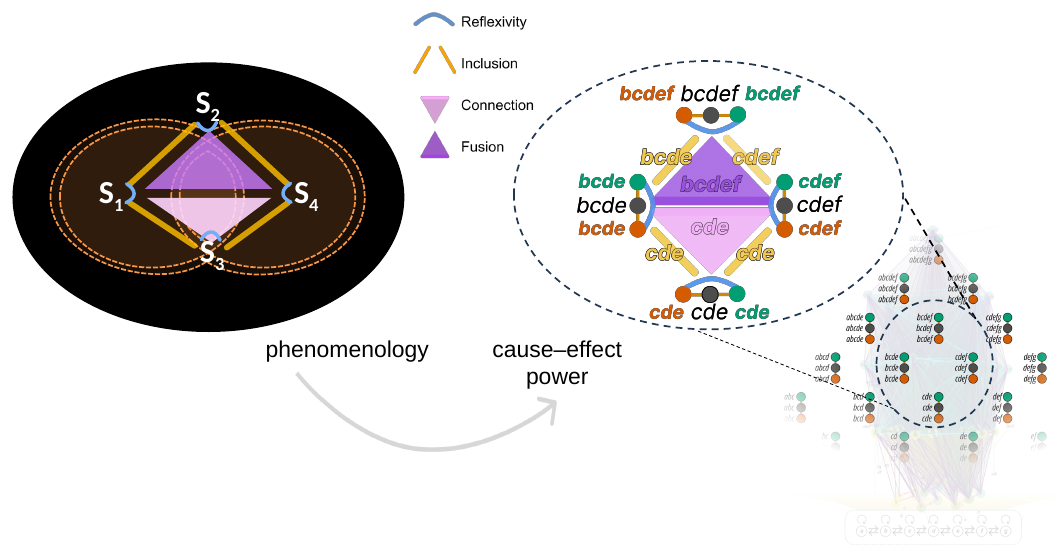
[The spots and the four distinctions of slide 36, now with the four properties marked on both sides and explained in a legend: reflexivity as a blue arc on each spot and each distinction; inclusion as yellow lines (S1 to S2 and S1 to S3; bcde to bcdef and bcde to cde, with relation purviews labelled bcde and cde); connection as a pale purple downward triangle (S1, S4 and their overlap S3; bcde, cdef and cde); and fusion as a darker purple upward triangle (S1, S4 and their union S2; bcde, cdef and bcdef). Slides 37–40 add these marks one property at a time, with the pairs discussed circled.]
We have now found a one-to-one correspondence between the four types of phenomenal relations among spots and the four types of causal relations among distinctions in the cause-effect structure.
According to the explanatory identity of IIT, these four types of relations are all we need to account for the feeling of space, with no additional ingredients.
[On slide 42, titled "The four properties formulated in terms of cause–effect power," the curved arrow is replaced by the double arrow "explanatory identity."]
The pattern across the whole Φ-fold (slides 43–44)
To illustrate this, let's first show the four causal properties in a simplified form. The distinctions are labeled by their mechanism units, and the four key properties are indicated schematically.
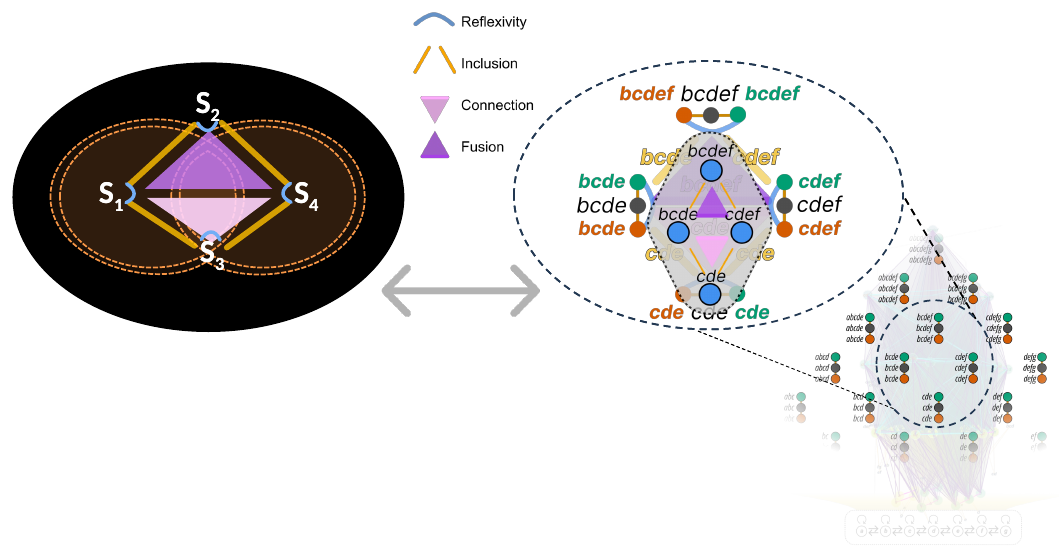
[The same figure as slide 41, with a grey diamond overlaid on the four distinctions: each distinction is now a single blue circle labelled by its mechanism (bcdef at top, bcde and cdef at the sides, cde at bottom), with the inclusion lines and the connection and fusion triangles drawn between them.]
In an idealized system, we would see that this basic pattern of relations applies at all orders of distinctions unfolded from the 1D grid of units a through g.
There are only two exceptions: First-order distinctions are simply points—they are not extended. They don't include anything and don't connect, and therefore they don't fuse either. The highest-order distinction is that spot which is the whole space, and therefore it isn't included by other spots and doesn't overlap with other spots.
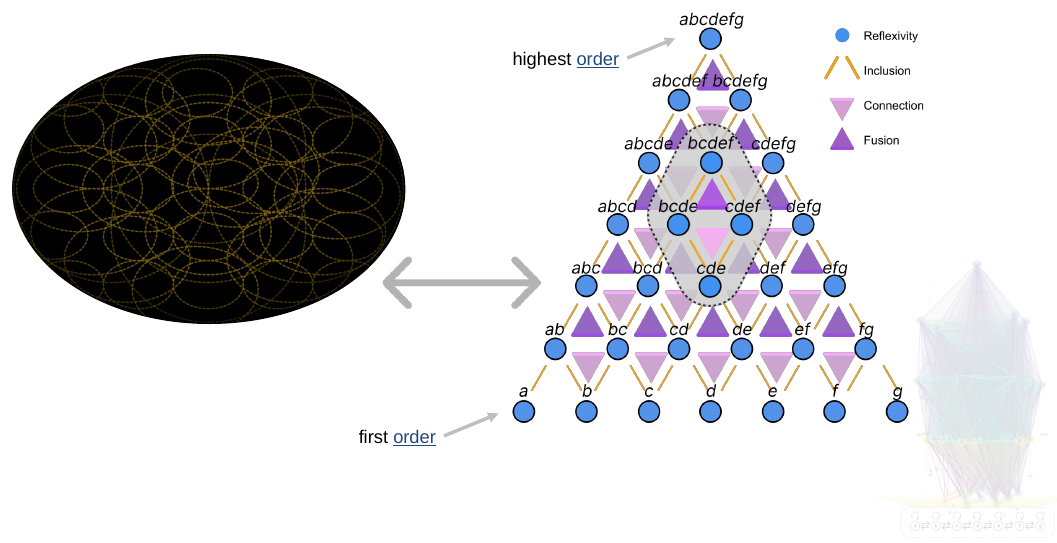
[At left, the black ellipse filled with many overlapping yellow-outlined spots. At right, joined by a double arrow, a triangular lattice of blue circles, one per distinction, labelled by mechanism: the seven first-order units a to g along the bottom ("first order"), then ab to fg, abc to efg, and so on up to abcdefg at the apex ("highest order"). Between neighbouring circles, yellow inclusion lines and purple connection and fusion triangles repeat the pattern of slide 43 everywhere; the diamond of slide 43 is outlined in the middle. A legend explains the four symbols.]
Accounting for derived properties of space (slides 45–55)
According to the explanatory identity of IIT, we should be able to account for any derived property of space using only the four fundamental properties of reflexivity, inclusion, connection, and fusion.
To demonstrate how this can be done, let us see how we can account for the region occupied by a spot, the distance between two spots, and the location of a spot.
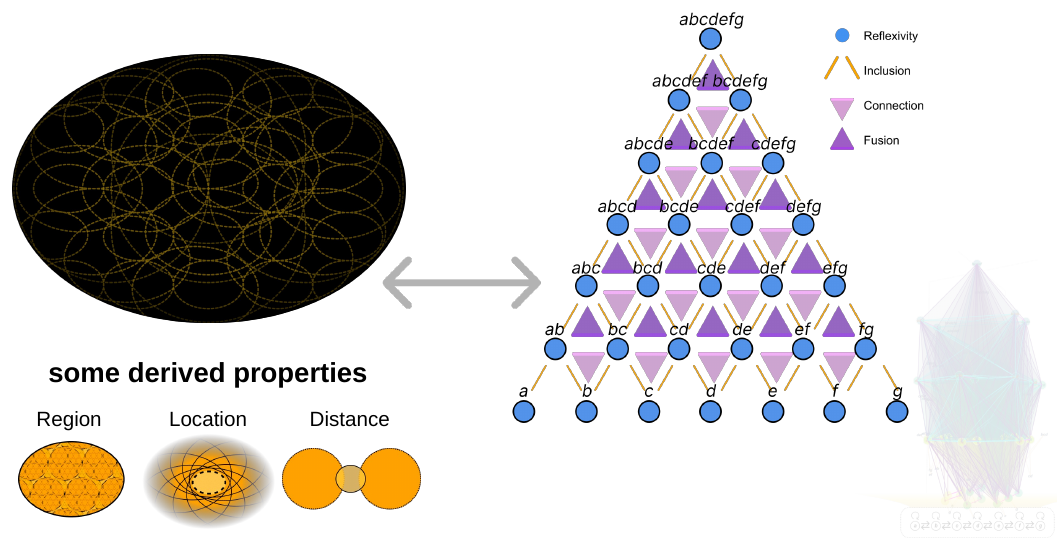
[Titled "Accounting for derived properties of space," the ellipse of spots and the lattice of distinctions from slide 44, joined by a double arrow. Beneath the ellipse, under "some derived properties," three orange icons: "Region" (a spot filled with smaller spots), "Location" (a spot surrounded by nested rings) and "Distance" (two spots joined by a smaller one).]
Region (slides 46–49)
Phenomenally, the region covered by a spot can be thought of as all the spots that are included by it.
For instance, spot S1 is a rather small region—it includes the yellow spots indicated (and many, many more).
Let us suppose that spot S1 corresponds to distinction bcd in the cause-effect structure. The region occupied by S1 would correspond to all the distinctions that are included by a particular distinction—called its subtext.
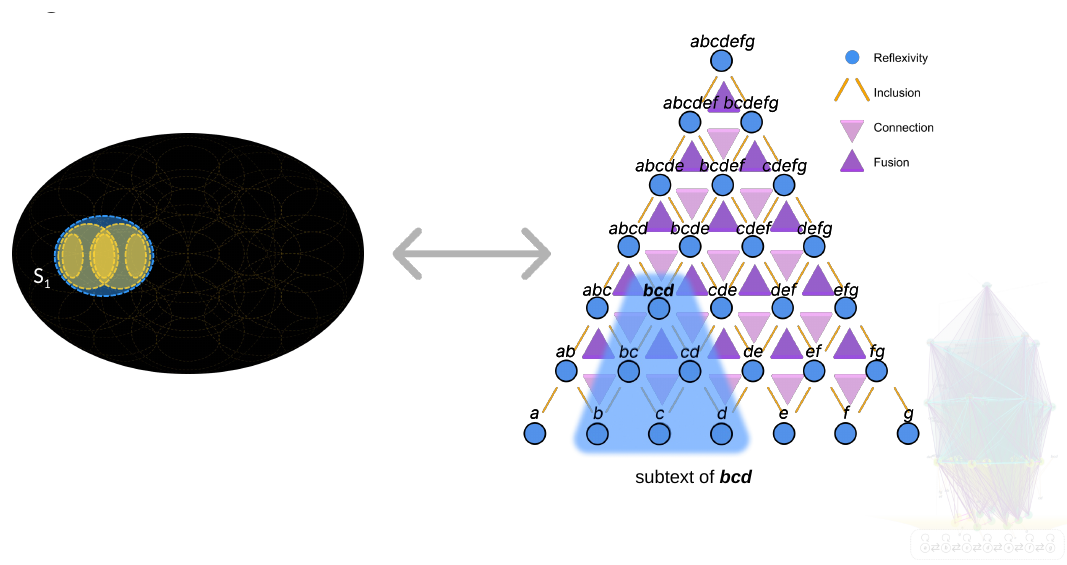
[At left, a small spot S1 near the left edge of the ellipse, filled with smaller yellow spots. At right, in the lattice of distinctions, a blue triangle covers bcd (in bold) and everything below it (bc, cd, b, c, d), captioned "subtext of bcd."]
If we consider another spot occupying a larger region, such as S2, phenomenally, it will include more spots.
Similarly, this would correspond to a distinction that includes more distinctions in its subtext—for example, distinction bcde.
Finally, we can consider an even larger spot, such as S3, which would correspond to an even higher-order distinction, such as bcdef.
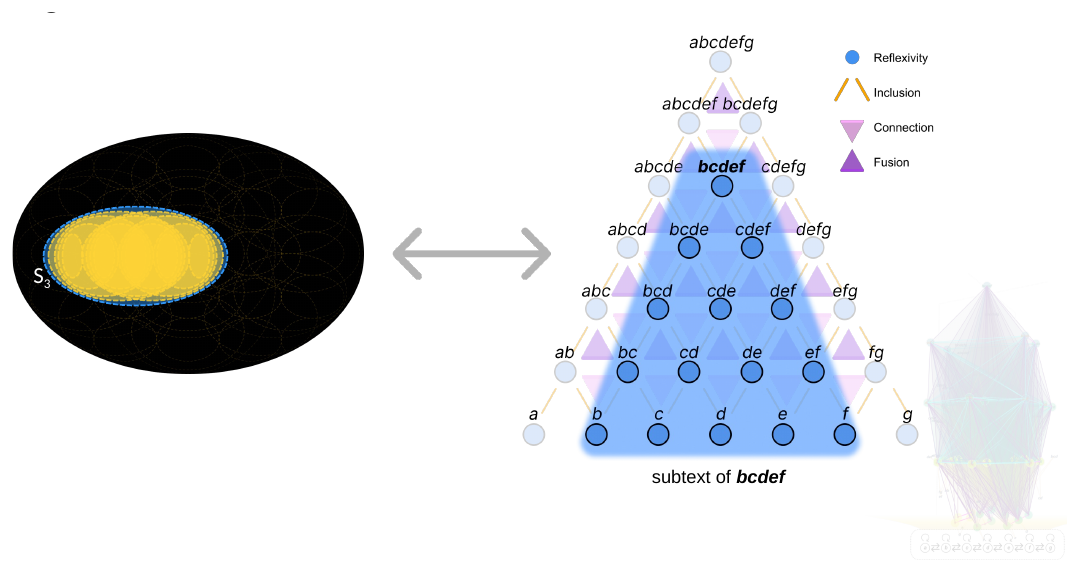
[At left, a large spot S3 covering most of the left of the ellipse, filled with yellow. At right, the blue triangle now covers bcdef and all the distinctions below it, from b to f, captioned "subtext of bcdef." On slide 47 the intermediate case is shown: a spot S2 and the "subtext of bcde."]
Now that we have defined a region, you may have noticed that every spot we can introspect always has a region (otherwise it would be impossible to see it—it would not be extended). We had to bootstrap to get started, and we thus crudely equated phenomenal spots to individual distinctions in the Φ-structure.
Even though we cannot pick out a so-called "pure" spot through introspection, it is useful to think about spots as being elementary distinctions—the most basic component of spatial experience.
[Slide 49, headed "Clarification: region vs. spot?", states that "spots are elementary distinctions," beside a faded version of the region figure.]
Location (slides 50–51)
Phenomenally, the location of a spot can be thought of as the set of all spots that fully overlap it, identifying its place within the total space. As an analogy, we describe a geographical location by a set of larger places that include it: a street number, a city, a state, and so on. For spot S1, to locate it, we could say it is in the left half of the total space, in its middle third, etc.
In the cause-effect structure, the location of a distinction is given by its supertext—its relations to all the distinctions that include it. For example, the location of distinction bcd is the set of distinctions highlighted in yellow, which (recursively) include it.
We can see that bcd is on the left side because it is included by abcde (a bigger distinction covering a region on the left) and not by cdefg (which covers a region on the right).
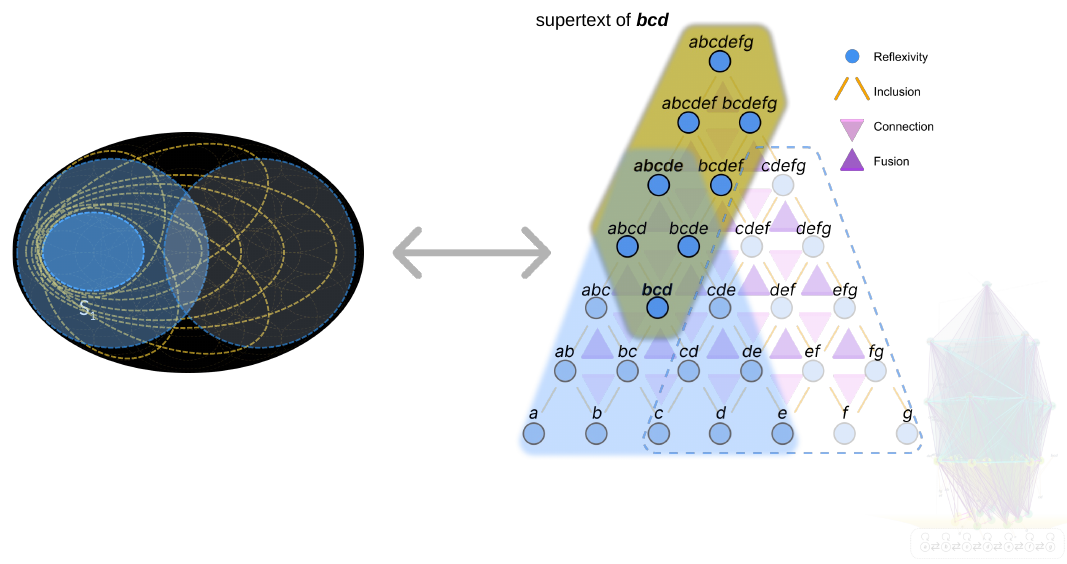
[At left, a blue spot S1 on the left of the ellipse, surrounded by the larger spots that include it, drawn as nested dashed yellow outlines. At right, captioned "supertext of bcd," a yellow band runs from bcd up through the distinctions that include it (abcd, bcde, abcde, bcdef and so on) to abcdefg; the distinctions on the right side, such as cdefg, lie outside it within a dashed outline.]
If we considered another spot (S2) with a different location, this would correspond to another distinction, say, def, with a different supertext.
Def is at a different location because it is included by cdefg (the rightmost third of the space) and not by abcde—as bcd was.
We already saw that every time we experience a phenomenal spot, we also experience its region—that is, we experience all its relations to spots that it includes. Similarly, we cannot experience a spot without simultaneously experiencing its location—that is, we immediately experience all the relations to the spots that include it.
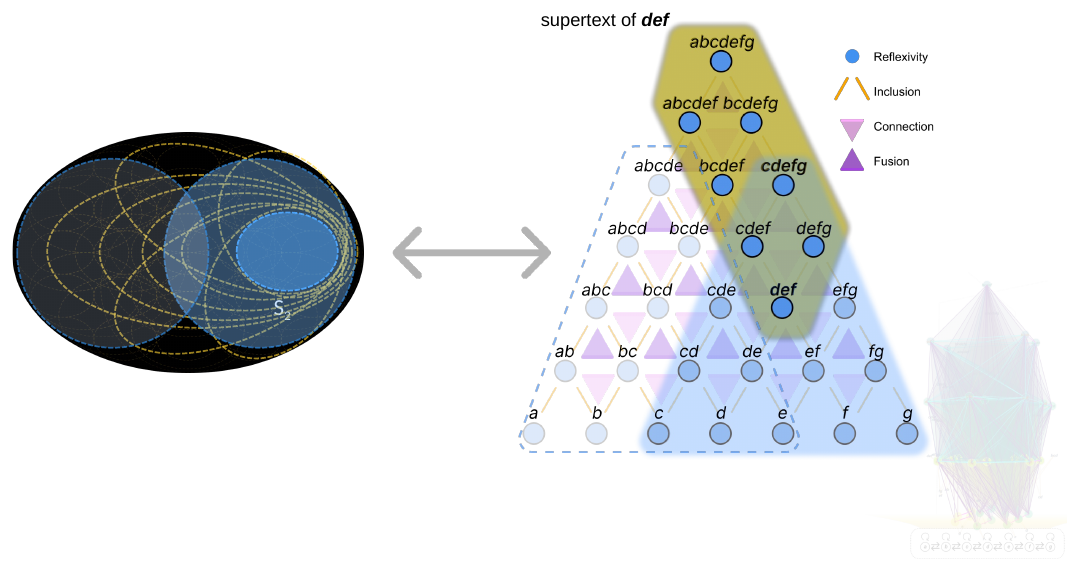
[The mirror image of slide 50: a blue spot S2 on the right of the ellipse with its enclosing spots, and a yellow band captioned "supertext of def" running from def up through cdef, cdefg, bcdefg and so on to abcdefg.]
Distance (slides 52–55)
Phenomenally, the distance between any two spots can be thought of as the smallest spot they both overlap with, their smallest connection. For example, the distance between S1 and S2 is S3, the smallest spot they both connect to.
In the cause-effect structure, the distance between two distinctions corresponds to the subtext of the smallest distinction that they both connect to. In this case, cde is the smallest distinction that both abc and efg connect to.
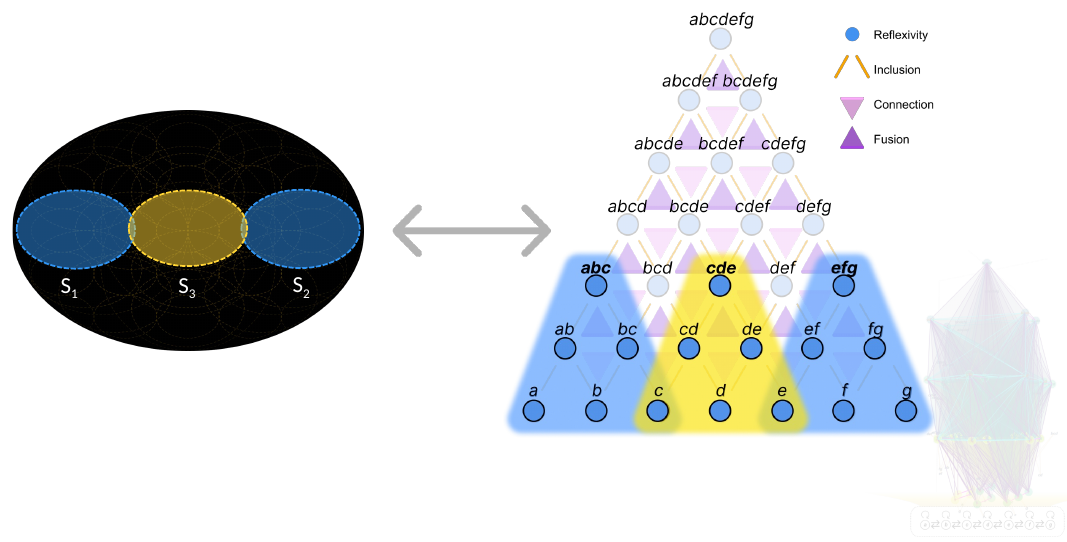
[At left, two blue spots S1 and S2 at the two ends of the ellipse, with a yellow spot S3 between them, overlapping both. At right, the subtexts of abc and efg are shaded blue, and the subtext of cde, which overlaps both, is shaded yellow.]
Consider what would happen if S1 were closer to S2, as shown here.
In the Φ-structure, this means that S2 would correspond to a distinction that is "closer" to abc—for example, def—and the distance between the two distinctions would be smaller—here, distinction cd.
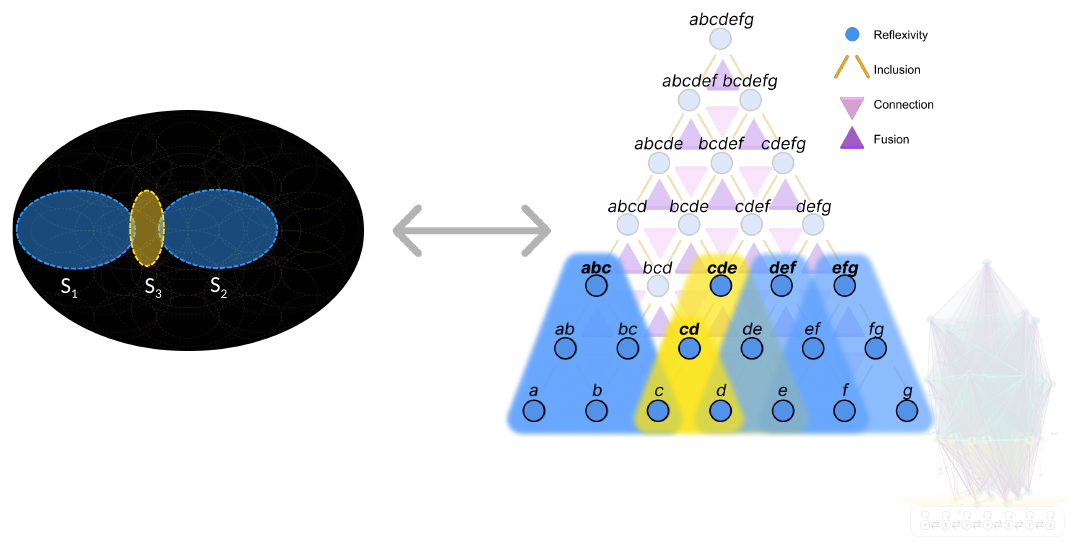
[The spots S1 and S2 are now closer, with a narrow yellow spot S3 between them. At right, the subtexts of abc and def are shaded blue, and the small subtext of cd between them is shaded yellow.]
Finally, two spots are not separated by any distance if there is no spot in between—in other words, they already connect to one another. In terms of cause-effect power, this corresponds to two distinctions that connect—for example, abc and cde, which connect over c.
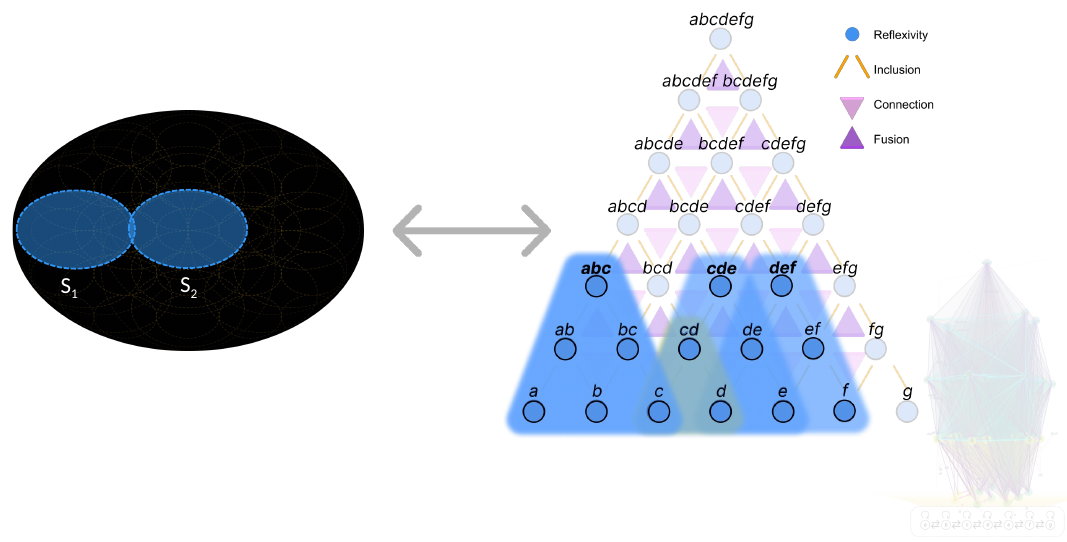
[S1 and S2 now touch, with no spot between them. At right, the subtexts of abc and cde are shaded blue and overlap at c.]
Spots are related to all the other spots through distance relations: for every pair of non-overlapping spots, there is always another spot that is their distance. This means that when we see various spots, we immediately experience them as closer or farther from every other spot. This experience is immediate in the sense that we don't need to calculate or measure these distances—they are simply there, in front of our eyes.
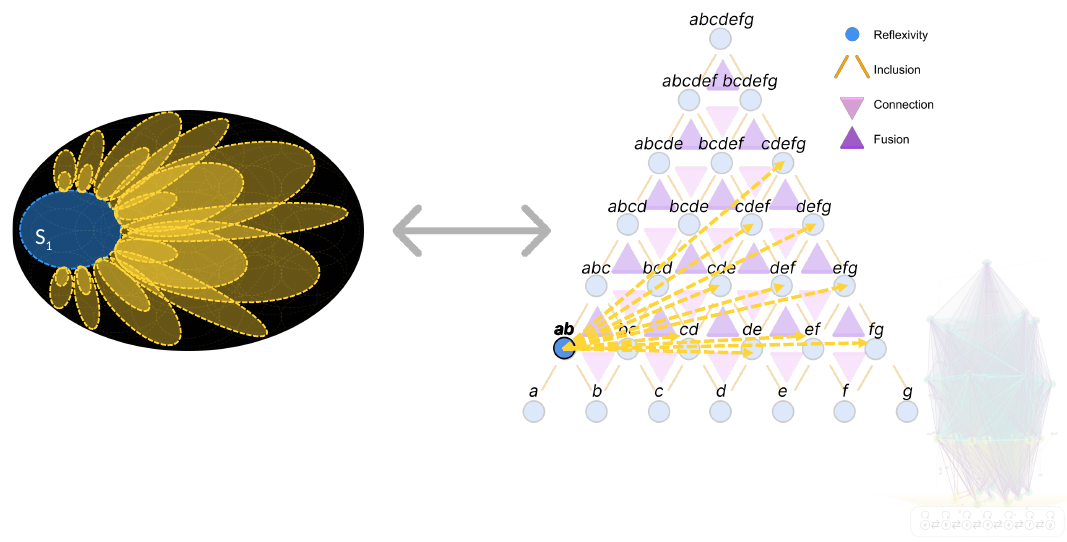
[At left, a blue spot S1 at the left edge of the ellipse, with many yellow petal-shaped spots fanning out from it across the space, one for each distance to another spot. At right, dashed yellow lines fan out from distinction ab to the distinctions across the lattice.]
Summary (slide 56)
This has been an overview of IIT's explanation for why space feels the way it does. Please consult Haun & Tononi 2019 for further details and accounts of additional spatial properties.
[The closing slide, titled "Why space feels the way it does" and labelled "summary," brings the pieces together: the sample experience with the four spots and the four properties marked, joined by the explanatory identity to the Φ-fold lattice over the 7-unit substrate, the three derived properties (region, location, distance), and the reference Haun, A., & Tononi, G. (2019). Why does space feel the way it does? Towards a principled account of spatial experience. Entropy, 21(12), 1160.]