Corpus
Slides: Integrated Information Theory as a Theory of Consciousness
The lab's transcriptions of the decks embedded on https://www.iit.wiki/overview: each slide's text as the deck shows it, and in square brackets a description of each diagram, which is the transcriber's and not the deck's.
Slideshow 1: IIT Method
Source page: Overview Source deck: IIT Method Slides (9 slides)
The diagram of the method (slides 1–2)
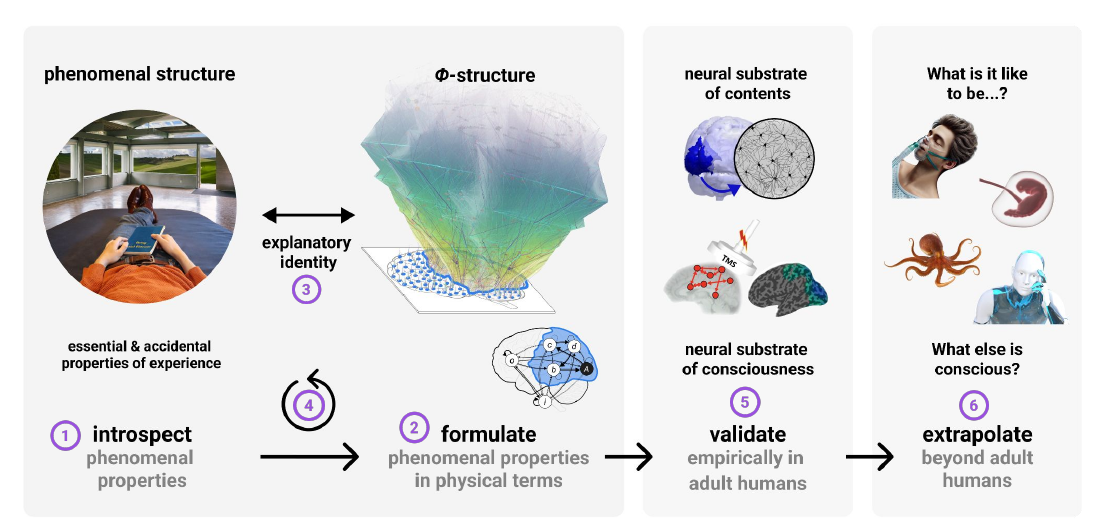
[The diagram is laid out left to right in three grey panels, linked by arrows.
The first and widest panel pairs experience with its physical counterpart. At left, under the heading "phenomenal structure," is the wiki's sample experience: a round first-person photograph of lying on a bed with a book in a bright room with wide windows. Beneath it is the caption "essential & accidental properties of experience" and step 1, "introspect phenomenal properties." At right, under the heading "Φ-structure," a colourful, many-faceted structure rises out of a flat grid of units; beside it is a small brain containing the six-unit substrate outlined in blue. Beneath is step 2, "formulate phenomenal properties in physical terms." A straight arrow leads from step 1 to step 2. Between the two halves, a double-headed arrow labelled "explanatory identity" is marked step 3, and a circular arrow between steps 1 and 2 is marked step 4, standing for the repeated passage through steps 1–3 for particular contents.
The second panel, step 5, "validate empirically in adult humans," shows two kinds of evidence: at top, "neural substrate of contents," a brain with its posterior (visual) region in blue, beside an enlarged grid-like network; below, "neural substrate of consciousness," a brain being stimulated with TMS, with a red network, beside a brain map.
The third panel, step 6, "extrapolate beyond adult humans," is headed "What is it like to be…?" and "What else is conscious?" and shows four cases: a patient wearing an oxygen mask, a fetus, an octopus and a humanoid robot.
On slide 1, a prompt reads "Click a step or advance the slide": each step in the diagram links to the slide that explains it.]
Step 1: Introspect (slide 3)
A typical experience comprises sights, sounds, thoughts, emotions, etc.—which are also related in a particular way.
We use the term phenomenal structure to describe any such moment of experience. This structure is what we aim to account for in physical terms.
To characterize a phenomenal structure, we must first identify its essential phenomenal properties—those that are common to every possible experience one could have.
Using introspection, IIT identifies five such properties, which form the axioms of the theory.
[The "phenomenal structure" half of the first panel is highlighted; small photographs of other experiences surround the sample experience.]
Step 2: Formulate (slide 4)
We then formulate the five essential properties of experience in physical terms—that is, in terms of causal properties of a substrate of units (e.g., Abcdio). This gives us the five postulates of IIT.
These postulates guide us in identifying the substrate of consciousness (blue contour) and the structure of causes and effects among all sets of units, called a Φ-structure.
In the brain, the Φ-structure would be unfathomably rich, illustrated schematically here as "popping out" of its substrate—which IIT suggests is to be found empirically in the posterior parts of the brain.
[The "Φ-structure" half of the first panel is highlighted.]
Step 3: The explanatory identity (slide 5)
IIT then makes a conjecture:
A phenomenal structure is identical to a Φ-structure:
The quality of an experience corresponds to the specific "shape" of the Φ-structure: the phenomenal components (the distinctions and relations) correspond one-to-one with their causal counterparts.
The quantity of experience corresponds to the amount of integrated information of the structure (its Φ value).
[The whole first panel is highlighted. Yellow outlines drawn over the sample experience are labelled "distinctions" and "relations," and matching labels point into the Φ-structure.]
Step 4: Accounting for contents (slides 6–7)
The identity has explanatory power: it allows us to account for why contents of experience feel the way they do—for example, why space feels extended, time feels flowing, etc.
We can think of this step as iterating through the previous steps, but now for the accidental—rather than the essential—properties of experience.
Take the example of space…
For example, when you look at a starry sky, the feeling of visual space is a substructure of the experience with certain phenomenal properties that we can characterize using introspection.
These phenomenal properties can be accounted for by the cause–effect substructure of a grid-like substrate (such as that found in the visual cortex.)
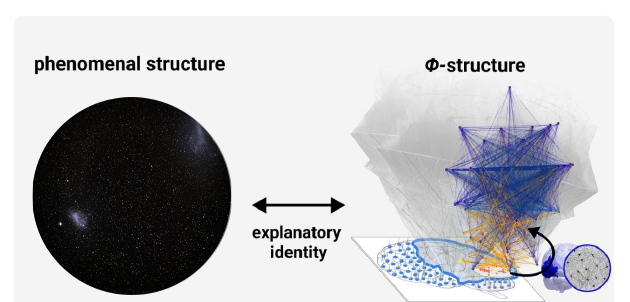
[On slide 6, the first panel is highlighted with the circular arrow of step 4, and small images around the sample experience stand for accidental properties: a starry sky overlaid with a grid, a line of musical notation, a grid of colourful repeated portraits, and a colour wheel. On slide 7, the sample experience is replaced by a round photograph of a starry night sky under "phenomenal structure." Under "Φ-structure," a dense network of blue and orange connections rises from the grid of units, drawn over the faded Φ-structure, with an arrow pointing to an enlarged grid-like network, standing for the substructure specified by a grid-like substrate such as visual cortex. The two are joined by the double arrow "explanatory identity."]
Step 5: Validate (slide 8)
To validate the theory, we turn to humans who can introspect and report their experiences.
To validate the theory against the neural substrate of consciousness as a whole, we can show, for example, that crude proxies of integrated information correlate with reported presence vs. absence of consciousness (e.g., using TMS-EEG).
To validate the theory against the neural substrate of particular contents, we can show that the theory can account for why a given neural circuit contributes that content—for example, the architecture of visual cortex can account for why the visual field feels extended.
[The second panel of the diagram is highlighted.]
Step 6: Extrapolate (slide 9)
Finally, IIT offers a principled basis to infer the presence or absence of consciousness for any physical system—whether non-responsive human patients, fetuses, living creatures quite unlike ourselves (e.g., octopuses), or even artificial systems.
Moreover, by studying the Φ-structures of such systems, we can also attempt to characterize what—if anything—it "is like to be" them.
The theory also opens the way for principled positions on millennia-old questions about, for example, the place of consciousness in nature, meaning, causation, free will, and ethics.
[The third panel of the diagram is highlighted.]