Corpus
Slides: Intrinsicality
The lab's transcriptions of the decks embedded on https://www.iit.wiki/axioms-and-postulates/intrinsicality: each slide's text as the deck shows it, and in square brackets a description of each diagram, which is the transcriber's and not the deck's.
Slideshow 1: Intrinsicality Postulate - 08/2023
Source page: Intrinsicality Source deck: Intrinsicality Postulate (17 slides)
Title slide (slide 1)
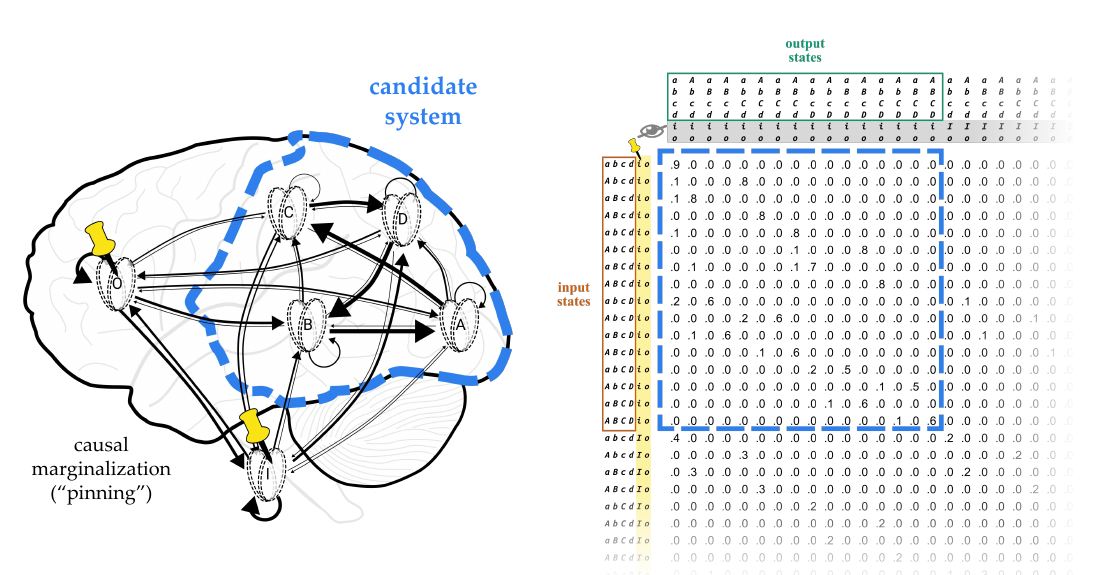
[On the left, the brain outline carries the six units (A, B, C, D, I, O) with arrows among them. A thick dashed blue line, labelled "candidate system," encloses units A, B, C and D. Units O and I lie outside it, each with a yellow pushpin, and the label "causal marginalization ('pinning')" points to them. On the right is the substrate TPM, with input states down the side and output states across the top. The block of rows and columns belonging to the candidate system is enclosed by the same dashed blue line; the columns for I and O are shaded yellow and marked with a small pushpin on the input side, and their rows are greyed out and marked with a crossed-out eye on the output side. A red "(click)" prompt invites the reader to advance.]
From axiom to postulate (slides 2–4)
Axiom: Experience is intrinsic: it exists for itself.
How can we formulate this phenomenal property in physical terms—that is, in terms of cause–effect power?
Postulate: The cause–effect power of the substrate of consciousness must be intrinsic: it must take and make a difference within itself.
Note that these slides give a conceptual overview of the postulate without going into the mathematics. Use the links to learn more about key concepts, and visit the Computing Φ page for technical details.

[Beneath the axiom sits a round photograph seen from the viewer's own eyes: one's legs and crossed feet stretch out on a large bed, one's hands hold a closed blue book resting on the stomach, and beyond the bed is a bright room with wide windows onto green hills. A blue arrow leads from the axiom to the postulate, which is set above the question.]
Assessing cause–effect power within a candidate system (slides 5–7)
In the existence postulate, we saw how to assess the cause–effect power of some units over some other units.
Intrinsicality now asks us to assess whether a candidate substrate of consciousness has cause–effect power within itself. This involves isolating a candidate system and assessing its powers over itself from its intrinsic perspective.
Note that IIT uses the terms candidate substrate, candidate system, and candidate complex more or less interchangeably.
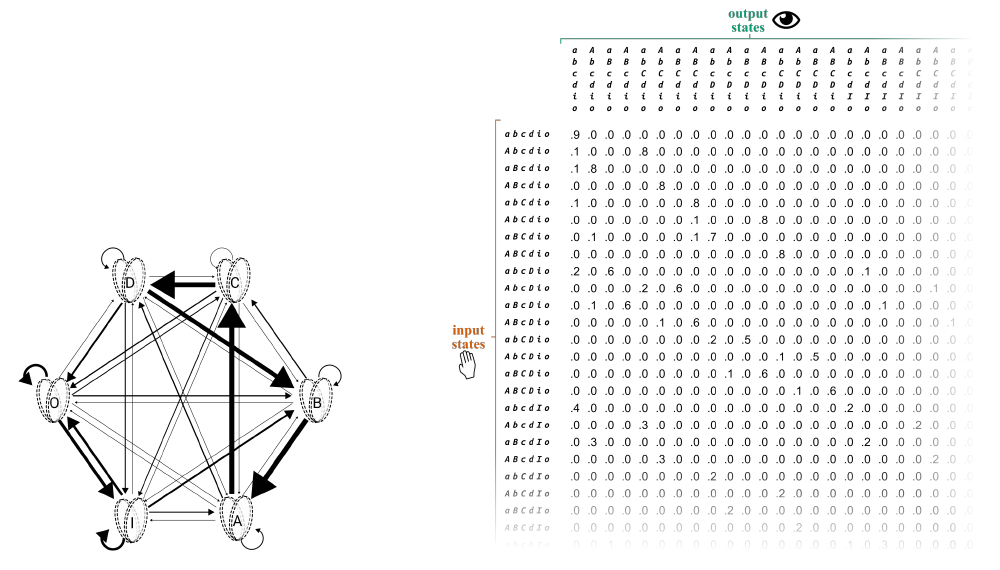
[On the left is the substrate graph from the Existence slides: six units arranged in a hexagon (D top left, C top right, B right, A bottom right, I bottom left, O left), every unit connected to every other by arrows of varying thickness, each with a self-loop. On the right is the full substrate TPM, with all 64 input states down the side (marked "input states" with a hand icon) and all 64 output states across the top (marked "output states" with an eye icon); the lower rows and right-hand columns fade out to suggest that the table continues.]
Isolating the candidate by causal marginalization (slides 8–12)
We first isolate a candidate within our full substrate (IABCDO). In this case, we pick ABCD, and we causally marginalize over units I and O, which means making them causally inert. We illustrate this by "pinning" the background units.
Causal marginalization is a mathematical operation performed on the TPM, which lets us focus on the causal powers of the units in our candidate system (ABCD).
In coarse terms, the pin indicates that we render these background units causally inert as an input…
…and the crossed-out eye indicates that we ignore these units on the output side.
Note that this illustration is a visual shorthand to suggest that we're "zooming in" on a part of the TPM.
In practice, however, it doesn't quite work like this. When we apply intrinsicality operationally, we will get two TPMs with distinct probability distributions: a cause TPM and an effect TPM. (Technical details are in Computing Φ: Step 2—Intrinsicality.)
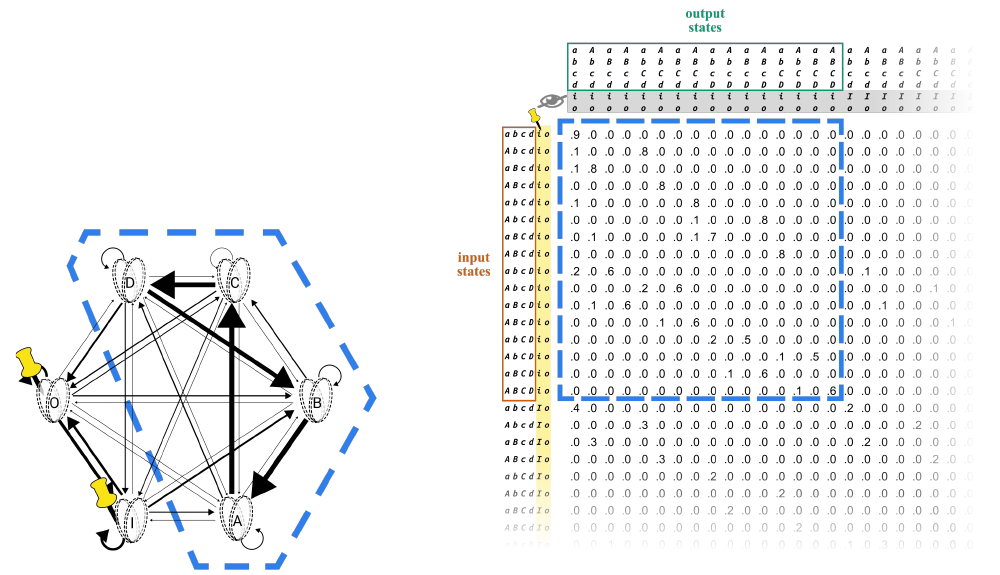
[On the substrate graph, a dashed blue hexagon encloses units A, B, C and D, and yellow pushpins sit on the two background units, O and I. In the substrate TPM on the right, a dashed blue box encloses the block of entries for the candidate system; the columns for I and O in the input-state labels are shaded yellow and marked with a pushpin, and the corresponding row of output-state labels is shaded grey and marked with a crossed-out eye. On slides 10 and 11, speech bubbles point to the pushpin and to the crossed-out eye with the two sentences given above.]
Any combination of units can be a candidate (slides 13–15)
In theory, we could take any combination of units as our candidate system, and assess its causal power over itself.
For example, we could also choose ICDO as our candidate system…
…or BCD, or even unit D alone.
In fact, as we will see in the exclusion postulate, we'll have to check every possible candidate within the full substrate (64 candidates in this case). And each time, we isolate only the cause–effect power of the candidate system by causally marginalizing over all units outside its borders.
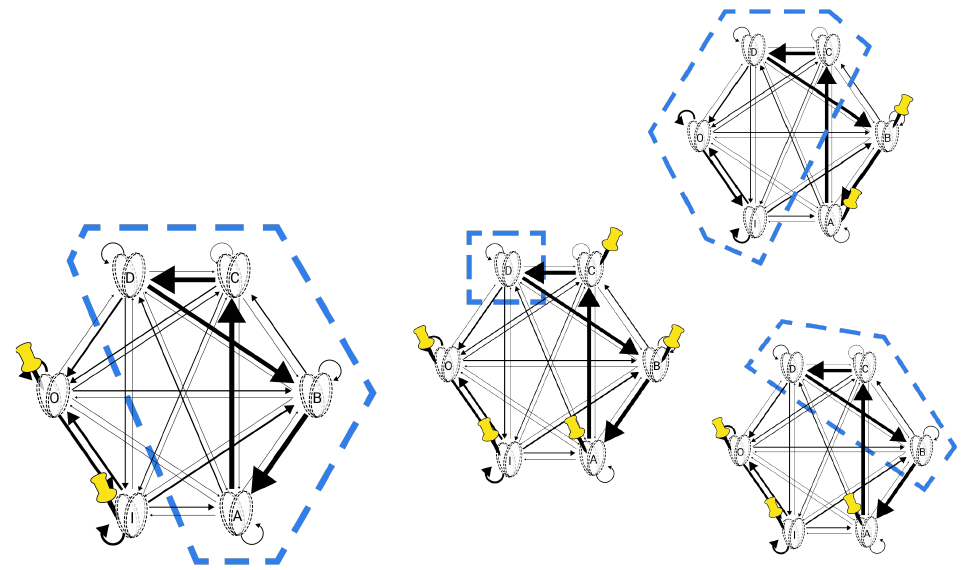
[Four copies of the six-unit substrate graph are shown. In each, a dashed blue line encloses the candidate system and yellow pushpins mark every unit outside it. The largest, at left, is the candidate ABCD from before, with O and I pinned. At top right, the dashed line encloses I, C, D and O, with B and A pinned. At bottom right, it encloses B, C and D, with O, I and A pinned. In the middle, a small dashed square encloses unit D alone, and all five other units are pinned.]
Further repercussions of the postulate (slide 16)
Thus far, we have seen how intrinsicality guides us in isolating a candidate system. This is the most basic sense of the postulate.
Yet the postulate has repercussions in the subsequent postulates as well. It requires that we characterize the powers the system has over itself from its intrinsic perspective. This point will be further elaborated in the way we calculate intrinsic information (in the Information Postulate).
Summary slide (slide 17)
[The closing slide, labelled "summary," combines the axiom and postulate from slide 4 (with the round photograph of the sample experience) and the diagram from slide 1: the brain with the candidate enclosed by a dashed blue line, here labelled "candidate substrate," units O and I pinned under the label "causal marginalization ('pinning')," and the substrate TPM with the candidate's block enclosed, the I and O inputs pinned and their outputs marked with a crossed-out eye.]