Corpus
A reply to “the unfolding argument”: Beyond functionalism/behaviorism and towards a science of causal structure theories of consciousness
Naotsugu Tsuchiya, Thomas Andrillon, and Andrew Haun
Correspondence: naotsugu.tsuchiya@monash.edu
“ Every theory makes untestable predictions, but theories should be judged on the basis of the testable ones.” – Carroll (2006)
In their recent article, “ The unfolding argument.. ”, Doerig et al argue that a theory of consciousness cannot be based on the characterization of the physical structure of the brain. They argue that such theories must be “either false or outside the realm of science”, concluding that “consciousness must be described in terms of what it does”. Judging from their premises and statements in the paper, Doerig et al seem to be advocating for a new mode of methodological behaviorism. We take issue with their view and describe an alternate approach to consciousness science. We clarify some ambiguities in Doerig et al’s argument, critiquing three of their four premises, leading to different conclusions. We then explain what makes causal structure theories of consciousness empirical and falsifiable. Specifically, we propose that consciousness science must work on ways to consider phenomenal structures to search for an isomorphism between physical and phenomenal structures. To improve our understanding of phenomenal structures, we need to enrich our investigation in consciousness science: for example, by extending standard report paradigms or by inventing no-report paradigms (Tsuchiya, Wilke, Frässle, & Lamme, 2015) together with simultaneous neuronal measures and neuronal stimulation. In essence, we argue that to really take consciousness seriously as an object of study, it is unavoidable that both the phenomenal structure and the causal structure of a system must be central to any theory of consciousness (Fig. 1).
We divide our response into two parts: a critique of the unfolding argument as it is presented in syllogistic form by Doerig et al; and a discussion of how structural theories of consciousness permit the search for isomorphism between physical and phenomenal domains. Overall, we argue that the internal structure of a conscious observer provides empirical insights into the material basis of conscious experience.
1. Critiquing the ‘unfolding argument’ of Doerig et al:
Doerig et al endorse functionalist theories of consciousness, but we find that their argument is clarified by viewing it through the lens of classical methodological behaviorism.1 Broadly, this stance effectively focuses only on the publicly observable data, such as reports about consciousness. As one example of such a stance, Dennett, who counts himself as a behaviorist (1993a,b), has argued that the study of consciousness should be purely of third-person data, claiming that private mental events are incompatible with empirical science (also see Dennett, 2003 for further clarification). From this perspective, a psychological science of any sort – including consciousness science – must rely strictly on observation of behaviors by a subject (and their relation to stimuli), without imputing any further non-observable properties to the subject.2 Of course, a consciousness researcher must be imputing some non-observable properties to their subjects – Doerig, Schurger, Hess, and Herzog (2019) hope to study consciousness, after all – but a behaviorist consciousness researcher would consider such qualities to be empirically irrelevant, and perhaps even theoretically invalid.3 With this idea of behaviorism in mind, we find that Doerig et al’s premises can be clarified substantially:
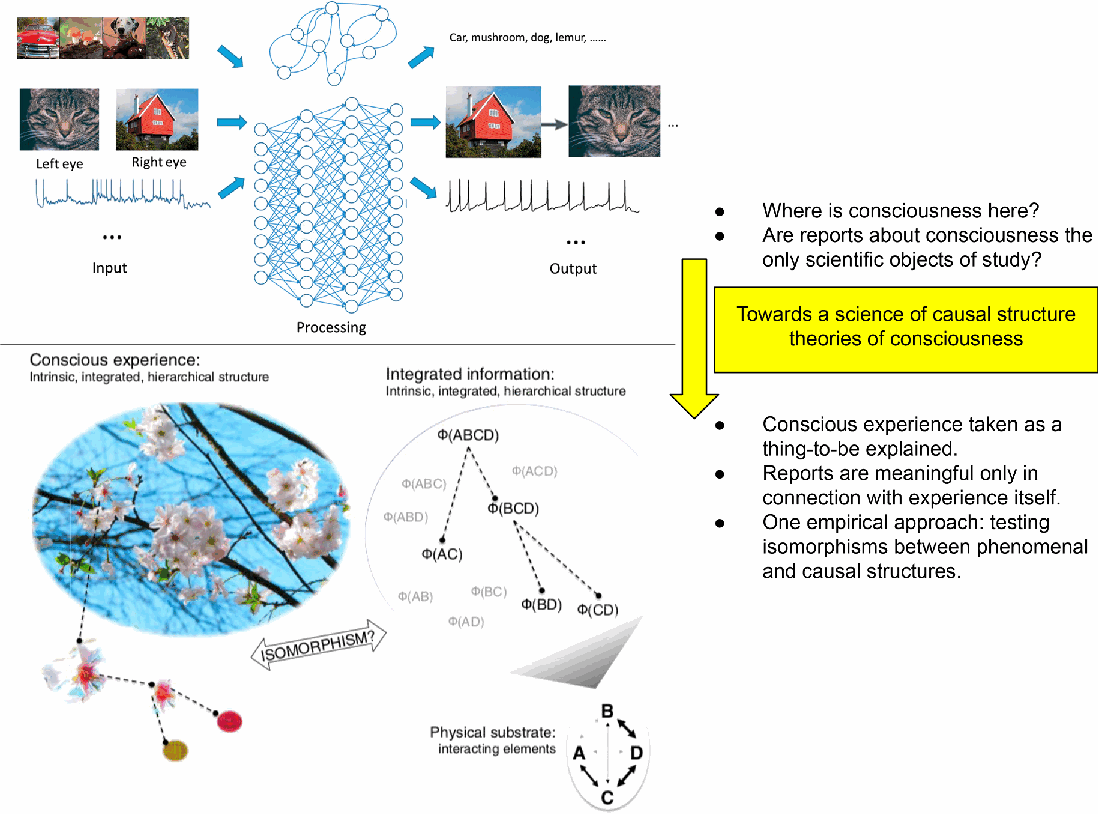
Figure 1. Contrasting view between function/behaviorism and causal structure theories of consciousness.
“(P1): In science we rely on physical measurements (based on subjective reports about consciousness).”
We agree with P1 in a limited way: in science, hypotheses are motivated by physical evidence. However, their parenthetical statement is ambiguous and needs clarification. When we consider a “subjective report about consciousness”, are we taking consciousness itself as evidence, or not? While a behaviorist would not trust their own conscious experience in developing a theory, she trusts others’ reports about their conscious experience. In contrast, we maintain that the ‘ground truth’ data in consciousness science are one’s own conscious experiences. Thus, this premise diverges for behaviorist and non-behaviorist versions of consciousness science. A clearly behaviorist version of P1 (BP1) would read:
(BP1): In science we rely on physical measurements including behavioral reports that may describe conscious phenomena. Only such physical evidence may motivate a theory of consciousness.
A non-behaviorist version of P1 (CP1) would read:
(CP1): In consciousness science we rely on the link – known to each of us by first-hand experience – between conscious experience and behavioral reports. This link motivates our collection of physical measurements including behavioral reports and motivates theories about consciousness.
We find the authors’ P1 to more closely resemble BP1 than CP1 (the latter resembling more closely our own stance). An example may make the divergence between the two approaches clearer. Suppose we have two systems that make identical responses, even prosaic ‘free’ responses, about face stimuli under a wide array of experimental conditions. One of the systems is an ordinary human being, while the other is a “black box” whose internal causal structure is completely unknown. A scientist operating under CP1 would start from her knowledge that human beings are conscious, that the subject’s reports are about face experiences, and that face experiences have a certain compositional structure that may be extracted from the subject’s reports (e.g. that a face is a spatial configuration of features including eyes, nose, mouth, etc); this scientist may (or may not) then adopt a “causal structure” theory, and seek to establish an isomorphism between a theoretical construct and the subject’s phenomenology of faces. She may not make any such study of the black box, since she has no knowledge of its conscious status (upon later discovering the black box’s internal causal structure, she may use her theoretical construct to make interesting statements about it, but it cannot be a source of evidence for her theory).
Conversely, a scientist operating under BP1 would declare that the two systems are functionally equivalent, and that for all she knows they both have identical experiences (or none at all). The behaviorist scientist declines to use her knowledge of human consciousness in her analyses. Her theories may account for the intricacies of the systems’ behavior – their input-output functions – but they make no claim of what-it’s-like-to-be such systems (this being outside the realm of scientific investigation). Being interested in consciousness, the scientist may speculate on the implications of the functional equivalence of the black box and the conscious human, but subjective experience itself – being unobservable – does not motivate her theories.
In our opinion it is the CP1 scientist whose practice more closely resembles the ‘science of consciousness’ as it is currently practiced. The BP1 and CP1 scientists, however, may work in the same milieu, carrying out similar experiments as these two approaches are not mutually exclusive. When it comes to an end, however, they will likely come to different conclusions and make different sorts of claims about their findings. It is also interesting to note how the system whose conscious status is unknown is a central problem to the BP1 scientist’s theoretical endeavors (note also its centrality to the “unfolding argument”); for the CP1 scientist, such a system is a matter of application, not of the basis on which her theory is built. In other words, the CP1 scientist would base her theory on multiple modes of evidence always with respect to links with conscious experience itself. If the theory predicts that feedforward networks are unconscious, it is interesting to the CP1 scientist, but it is no reason either to favor or to abandon the theory.
“(P2): For any recurrent system with a given input-output function, there exist feedforward systems with the same input-output function (and vice-versa).”
This premise is restated in many ways throughout the paper. For example, on p51 they state, “Anything that can be done by recurrent networks can also be done in a feedforward manner”. Here “anything that can be done” should be taken to mean “inputoutput function”. The crucial question is whether or not this “input-output function” includes generation of conscious experience. Further, on p51 the authors state that “pictures … are presented as inputs on the retina, and the outputs are the elicited percepts … (or reports about these percepts).” What could the authors mean here by “percepts”? Could they mean conscious percepts ? It does not seem that the authors’ definition of “anything that can be done” (or more abstractly of “input-output functions”) can include conscious experience itself. One possible reading of P2 is to interpret “anything” as anything except for conscious experience and “percepts”. On p49 they consider “outputs” to amount to “subjective reports (or other measurements known to reliably correlate with subjective reports)”, which are about consciousness.
If “anything” were to include conscious experience, this requires an assumption that consciousness is equated with observable reports. However, Doerig et al always carefully talk about reports about consciousness, and do not seem to equate reports with consciousness. Thus, we interpret that the authors clearly intend to exclude “having conscious experiences” as a part of “anything that can be done by recurrent networks”, that is, a system’s “input-output function”.
So, to clarify its meaning P2 should be rewritten to read;
“(P2’) For any recurrent system with a given input-output function (excepting inputs-to or outputs-from a conscious experience), there exist feedforward systems with the same input-output function (and vice versa).”
The revised P2′ would not seem to be controversial, even to a pure behaviorist. Neither do we find P2′ to be controversial. It is, however, explicitly orthogonal to questions concerning consciousness.
“(P3): Two systems that have identical input-output functions cannot be distinguished by any experiment that relies on a physical measurement (other than a measurement of brain activity itself or of other internal workings of the system).”
Here, the authors’ parenthetical statement is necessary to support the premise. If consciousness researchers are prohibited from investigating the inner workings of conscious systems, of course they cannot distinguish two systems that behave in exactly the same way in response to all possible different inputs. And this is exactly what Doerig et al conclude: only functional theories of consciousness are scientific.
However, if we take into account for the internal structure of these systems (causal and phenomenal), then there are indeed experiments we can do to distinguish them. For example, we might hypothesize that either a system’s causal structure does correspond to a particular phenomenal structure (e.g., hypothetically, causal structure of face cortex and face percepts) or it does not (e.g. entorhinal cortex and face percepts). Under such a hypothesis we can directly interact (by stimulation, inactivation, or lesion) with aspects of a causal structure, and observe whether there are corresponding changes in phenomenal structure (consider classic and recent stimulation studies, from Penfield and Jasper (1954) to Rangarajan et al. (2014) – the subjects’ reports in these studies are not just reports – they are understood by the experimenters to be reports about phenomenology – the same cannot be understood for reports from a “black box”). In the context of Integrated Information Theory, lesion or perturbation of a system readily distinguishes functionally identical systems even in terms of their behavior (Albantakis & Tononi, 2019). The authors seem to ignore this way of distinguishing systems as they do not consider the structure of conscious experience (authors’ BP1 and P2) and as their “input-output” notion is orthogonal to causal structure. If scientists take the CP1 stance and take reports more seriously, we can observe links between reports and phenomenology.4
Rather than embedding the conclusions regarding structure in the premises, we could revise P3 to make a clearer statement about what is and is not possible in study of conscious systems:
"(P3′) Two systems that have identical input-output functions (except where conscious experience is concerned) cannot be distinguished by any experiment that purely relies on input-output measurements. We can distinguish these two systems, however, by understanding the internal working of the respective systems, through the systematic investigation of the links between reports about consciousness and physical stimulations/measurements of the internal mechanisms.”
(P4): We cannot use measures of brain activity as a-priori indicators of consciousness, because the brain basis of consciousness is what we are trying to understand in the first place.
This seems reasonable. Something everyone can agree on?
(C): Therefore, EITHER causal structure theories are falsified (if they accept that unfolded, feedforward networks can be conscious), OR causal structure theories are outside the realm of scientific inquiry (if they maintain that unfolded feedforward networks are not conscious despite being empirically indistinguishable from functionally equivalent recurrent networks).
According to our analysis, P1 must resolve to either BP1 or CP1. P2 and P3 must be clarified to P2′ and P3′. P4 is OK as it is. With these revised premises, must we come to the same conclusions? The choice between BP1 and CP1 makes the most significant impact to the conclusions.
The “outside the realm of scientific inquiry” conclusion is based on two stances taken by the authors. The first stance is a behaviorist stance towards consciousness, and it follows directly from the BP1 premise: scientific inquiry cannot consider first-person conscious experience as a source of scientific data to confirm scientific theories.
The second stance is a philosophical view that, in a generalization of classical falsificationism, if a theory makes untestable predictions, the entire theory is unscientific. While untestable predictions are often controversial features of a theory, they are nevertheless frequently encountered in science. Physical theories are rife with untestable predictions (e.g. predictions of macroscale systems purely based on quantum mechanics; Everett’s many-worlds interpretation of quantum mechanics; relativistic accounts of “what it’s like to fall into a black hole”; the existence of gravitons in some versions of quantum gravity; etc). Taking the stance that all of a theory’s predictions must be testable seems extreme. It is at least a significant thesis that needs defending and the authors do not make any such defense in their paper. A more moderate and general view of the scientific theory is that a theory should be judged on what it can say about tests that can be done. The opening quote of this commentary is the words of physicist Sean Carroll’s regarding multiverses as a strange consequence of quantum theory. According to this more general view, consciousness theories should be judged on the basis of their testable predictions. The prime source of testable predictions should come from one’s own conscious experience or from the conscious experience of similar entities and not from systems that we cannot directly test or assess (e.g., consciousness of feedforward or other strange systems). In sum, the second part of the conclusion is an expression of a narrow view of science, which we do not believe would be endorsed by most scientists.
Relaxing either of the above stances would dissolve the second part of the authors’ conclusion. (We also agree with Kleiner’s argument (2019) that the unfolding argument would apply to all theories of consciousness, including functionalist theories.)
2. A new way of thinking about consciousness science
We agree with the authors in their claim that any theory needs to prove its usefulness in science. Following the authors’ skepticism regarding causal structure theories of consciousness, we attempt here to demonstrate that they are not only within the realm of science but represent a powerful way to investigate consciousness. Causal structure theories, in general, can be scientifically evaluated by systematically asking how close a proposed “isomorphism” is between the phenomenological and physical domains (Tsuchiya, Taguchi, & Saigo, 2016).
To evaluate the closeness to the isomorphism, one can employ different degrees of sameness provided by category theory (Awodey, 2010). Briefly: in category theory, isomorphism between category A and B requires that any structure in category A can be transferred into category B and back to category A without any disruption in the original structure of A (and the same has to be true by starting from category B). Importantly, the “structure” of a category is defined by objects within the category AND relationships among the objects (with some additional rules required in relationships, e.g., identity, compositionality, and associativity. See Awodey, 2010) Roughly speaking, consciousness research so far has mostly focused on the mapping between one category (i.e., stimuli) and another (i.e., responses), while ignoring internal relationships among these. One goal of causal structure theories may be to allow for a more complete mapping between phenomenal structures5 and physical structures derived from neural substrates.
Since there is empirical evidence of non-conscious neural activity, it seems that phenomenological categories cannot be isomorphic to categories of neuronal activity (two neuronal states can map onto one phenomenology). For example, “face-responding neurons” that activate when experiencing a face may also be activated without any such experience. There is clearly a need to extract the structure from neural activity to allow for testing of hypothetical isomorphisms between neural and phenomenal structures. Integrated Information Theory (Tononi, 2004; Oizumi, Albantakis, & Tononi, 2014) provides such structural approach, proposing a maximally irreducible conceptual structure as the extracted category to be tested for isomorphism with some phenomenal category (Northoff, Tsuchiya, & Saigo, 2019; Haun & Tononi, 2019).
The structure of spatial experience, featured in Haun and Tononi (2019), is a potentially fruitful ground for further discussion on this matter. Here, we assume that functional theorists would appreciate and admit that there is some feeling of spatial extendedness in vision. Spatial extendedness has a rich structure, consisting of spots or patches that are related in ways characterized as connection, fusion, inclusion, and so on. These structural features of experience are immediately apparent in first-person experience and thus we can easily understand them even when treating their description as “reports”. Without any first-person experience, however, these features would be extremely difficult or impossible to discover through standard behavioral experiments. Haun and Tononi show how the causal structure of a lattice network can be isomorphic to the structure of spatial phenomenology, the implication being that lattice networks within sensory cortical areas are the substrate of sensory spatial experiences. With a causal structure theory, we can actually ask whether a feedforward network could support these structural features, and then speculate groundedly about its conscious status. But a functional theory does not seem to admit both phenomenal or causal structure, and so has nothing to say about such isomorphisms.
Importantly, these structural hypotheses are falsifiable. For example, if lateral synaptic connections in visual cortex were inactivated without inactivating the associated pre- or post- synaptic neurons, IIT would predict that visual spatial experience would disintegrate, even though the system’s capacity for responding to spatial queries might remain at least partially intact. More generally, if two very different conceptual structures (obtained from a neural substrate) are associated with nearly identical phenomenal spatial structure (and vice versa), it would invalidate the foundations of IIT (but not necessarily the entire causal structure approach).6 For another attempt at an IIT-driven empirical approach that searches for causal structure underlying conscious perceptual experiences, see Haun et al. (2017) (Fig. 1, bottom).
3. Conclusion
As we outline here, Doerig et al.’s P1–P4 and C can be made more precise. It seems they would need to acknowledge that their argument is based on two largely implicit scientific perspectives: methodological behaviorism and strict falsificationism. However, the realm of science includes more diverse epistemological perspectives. Their perspective seems too narrow to be compatible with the current practice of science in general and consciousness research in particular, since they deny that causal structure can or should form part of the basis of theories of consciousness. In contrast, we argue that the causal structure of a system must be taken as seriously as the conscious experience of the system, implying that such a theory can only be derived from systems with known conscious status (i.e. human brains). A theory of consciousness should not similarly weigh reports coming from human brains and from feedforward networks whose consciousness is an unknown variable: causal structure theories necessarily weigh such systems differently. As a theory is confirmed or supported by evidence, we can then consider its consequences in strange and interesting cases such as in feedforward systems or robots. As an empirical research program, we believe that the next step for consciousness research is actually to take the rich structure of conscious phenomenology seriously. When doing so, the structure of consciousness can be systematically and scientifically investigated by testing an isomorphism between the phenomenal and physical structures.
Acknowledgement
NT and TA acknowledge the members in the Monash Neuroscience of Consciousness (MoNoC) on the discussion of the target paper, especially Dr Regan Gallagher and Dr Hayato Saigo for in-depth discussion on this topic. NT and TA were funded by an Australian Research Council Discovery Project grants (DP180104128, DP180100396) and NT and AH were funded by Mind Science Foundation. AH is also supported by the Tiny Blue Dot Foundation. TA is also supported by a Human Frontier Science Program fellowship (LT000362/2018-L). NT also thanks for the discussion on this topic at the Israel Institute for Advanced Studies, especially its members: Leon Deouell, Ran Hassin, Gal Vishne, Lucia Melloni, Timo Stein and Raffi Malach.
References
Albantakis, L., & Tononi, G. (2019). Causal composition: structural differences among dynamically equivalent systems. Entropy, 21, 989.
Awodey, S. (2010). Category theory. Oxford University Press.
Block (2017). Consciousness, accessibility, and the mesh between psychology and neuroscience. Behavioral and Brain Sciences, 30, 481–548. https://doi.org/10.1017/ S0140525X07002786.
Carroll, S. M. (2006). Is our universe natural? Nature, 440, 1132.
- Chalmers, D. J. (1996). The conscious mind: In search of a fundamental theory. Oxford University Press.
Dennett, D. C. (1993a). Consciousness explained. Penguin uk.
Dennett, D. C. (1993b). The message is: There is no medium. Philosophy and Phenomenological Research, 53, 919–931.
Dennett, D. C. (2003). Journal of Consciousness Studies, 10 Numbers 9–10, pp. 19–30(12).
Doerig, A., Schurger, A., Hess, K., & Herzog, M. H. (2019). The unfolding argument: Why IIT and other causal structure theories cannot explain consciousness. Consciousness and Cognition, 72, 49–59.
Fong, B., & Spivak, D. I. (2018). Seven sketches in compositionality: An invitation to applied category theory. ArXiv Preprint ArXiv: 1803.05316.
Haun, A. M., Oizumi, M., Kovach, C. K., Kawasaki, H., Oya, H., Howard, M. A.,... Tsuchiya, N. (2017). Conscious perception as integrated information patterns in human electrocorticography. ENeuro 4 ENEURO.0085-17.2017.
Haun, A., & Tononi, G. (2019). Why does space feel the way it does? Towards a principled account of spatial experience. Entropy, 21 (12), 1160.
Hoel (2019). IIT is scientifically falsifiable. https://medium.com/@erikphoel/iit-is-scientifically-falsifiable-3b0fed345e24 (accessed on Dec 4, 2019).
Kleiner, J. (2019). On empirical well-definedness of models of consciousness. https://doi.org/10.31234/osf.io/jdcfh (accessed on Dec 4, 2019).
Leinster, T. (2010). The magnitude of metric spaces. ArXiv: 1012.5857 [Math]. Retrieved from http://arxiv.org/abs/1012.5857.
Northoff, G., Tsuchiya, N., & Saigo, H. (2019). Mathematics and the brain: a category theoretical approach to go beyond the neural correlates of consciousness. Entropy, 21 (12), 1234. https://doi.org/10.3390/e21121234.
Oizumi, M., Albantakis, L., & Tononi, G. (2014). From the phenomenology to the mechanisms of consciousness: Integrated information theory 3.0. PLOS Computational Biology, 10 (5), e1003588. https://doi.org/10.1371/journal.pcbi.1003588.
Penfield, W., & Jasper, H. H. (1954). Epilepsy and the functional anatomy of the brain. Boston: Little Brown.
Piccinini, G. (2003). Epistemic divergence and the publicity of scientific methods. Studies in History and Philosophy of Science Part A, 34 (3), 597–612.
Piccinini, G. (2009). First-person data, publicity, and self-measurement. Philosophers’ Imprint, 9 (9), 1–16.
Rangarajan, V., Hermes, D., Foster, B. L., Weiner, K. S., Jacques, C., Grill-Spector, K., & Parvizi, J. (2014). Electrical stimulation of the left and right human fusiform gyrus causes different effects in conscious face perception. The Journal of Neuroscience, 34, 12828–12836.
Sellars, W. (1956). Empiricism and the philosophy of mind. Minnesota Studies in the Philosophy of Science, 1 (19), 253–329.
Spivak, D. I. (2013). Category theory for scientists (old version). arXiv preprint arXiv: 1302.6946.
Tononi, G. (2004). An information integration theory of consciousness. BMC Neuroscience, 5, 42.
Tsuchiya, N., Taguchi, S., & Saigo, H. (2016). Using category theory to assess the relationship between consciousness and integrated information theory. Neuroscience Research. https://doi.org/10.1016/j.neures.2015.12.007.
Tsuchiya, N., Wilke, M., Frässle, S., & Lamme, V. A. (2015). No-report paradigms: Extracting the true neural correlates of consciousness. Trends in cognitive sciences, 19 (12), 757–770.
Tsuchiya, & Saigo (Dec. 2019). Category theoretic approach towards the definition of consciousness. Cognitive Studies, 26 (4), 462–477.
Velmans, M. (2009). How to define consciousness: And how not to define consciousness. Journal of Consciousness Studies, 16 (5), 139–156.
According to Sellars (1956), “As a methodological thesis, it (=Behaviorism) involves no commitment whatever concerning the logical analysis of common-sense mentalistic discourse, nor does it involve a denial that each of us has privileged access to our state of mind, nor that these states of mind can properly be described in terms of such common-sense concepts as believing, wondering, doubting, intending, wishing, inferring, etc.” ↩︎
Do the data and methods for consciousness research strictly need to be publicly available, as in reports about consciousness? The publicity problem in science, and in particular consciousness science, has been discussed in Piccinini (2003, 2009). The strict view takes one’s own consciousness as unreliable and trusts only publicly available reports about consciousness. While Doerig et al appear to take this stance, we believe that this view is overly strict for consciousness research, as we elaborate in the main text. ↩︎
Although Doerig et al do not explicitly advocate for methodological behaviourism, their tendency to frame consciousness research within methodological behaviourism is revealed in various statements. In p52 “any behavioural experiment can be seen as an input-output function.” This seems to disregard what subjects consciously experience during the experiments. Non-behaviourists like us are uncomfortable with this, revising it to read as “any behavioural experiment on consciousness should try to do their best to capture what subjects experience, overcoming the inherent limitation in reports about consciousness”. For other philosophical views, see Chalmers (1996), Block (2007), and Velmans (2009). ↩︎
Hoel (2019) elaborated this point further. ↩︎
Consideration of Qualia Category is not very difficult. Consider three Objects, X, Y, and Z. As a relationship between objects, we consider an arrow that represents “subjective similarity” (to consider a similarity that has a degree and resolve concerns about so-called Sorities problems, we can “enrich” a category; Leinster (2010), Fong and Spivak (2018), Tsuchiya and Saigo (2019)). When X and Y are similar, we denote it as f: X →Y. Under this condition, “identity” holds that any objects are similar to itself: there exists an arrow from X →X, Y →Y, and Z →Z. “Compositionality” also holds; when there exists f and g such that f: X →Y and g: Y →Z, then g∘f: X →Z also exists. Finally, “associativity” also holds; when there are four objects (X, Y, Z, W) and there exist arrows between them; in addition to f and g defined above, we have h, such that h: Z →W. Then, (f∘g)∘h = f∘ (g∘h) always holds; in other words, similarity relations can be evaluated first between X, Y, Z, then with W or Y, Z, W, then with X (and this can be more precisely defined in enriched category). Though category theory is a foundational mathematical theory, its application is much wider than the usual mathematical concepts (e.g., numbers). See Spivak (2013) for further non-number examples. See Tsuchiya and Saigo (2019) for further discussion on Qualia Category. ↩︎
A reviewer of this paper suggested the following taxonomy of stances towards consciousness science: (1) A classic qualia view, which takes introspective “data” as evidence for private consciousness. (2) Strict behaviorism, which permits only 3rd person data to a science of behavior—and as a result hold that there is no consciousness. (3) Methodological behaviorism, which permits only 3rd person data to a science of behavior, but leaves open that this data might require us to posit consciousness (but doesn’t assume at the outset that consciousness exists). (4) A hybrid view, which assumes at the outset from introspection that consciousness exists and try to see how that fits with 3rd person data. Our stance is a combination of (1) and (4), while we take Doerig et al’s stance to be some combination of (2) and (3). In the example of spatial phenomenology, a human can generate a report describing the structural properties of extendedness, but the description only makes sense in light of certain primary data: namely, the fact of an actual spatial experience. However, as scientists who consider causal structure theories of consciousness as promising, we can strive to explain spatial phenomenology in terms of 3rd-person observable data (i.e. a substrate with a particular causal structure). Put another way, a causal structure theory like IIT claims that phenomenal structure is the basis on which we can posit that consciousness is a structural property. We see a sharp divide between (1) (4) vs. (3) (2). (1) and (4) take introspective evidence as a severe constraint on how reports about consciousness can be understood; reports from an unknown system are uninterpretable; and when a report disagrees with introspection, the burden of proof is on the report. On the other hand, (3) tries to avoid any reliance on one’s own conscious experience as data. As Doerig et al demonstrate, this attitude can lead to a dead end - taking seriously reports about consciousness obtained from feedforward networks that may not be conscious in the first place - a conclusion that is impossible from stances (1) or (4). ↩︎