Corpus
Conscious(ness) Realist
Larissa Albantakis
https://www.consciousnessrealist.com/
Information Closure Theory of Consciousness
Review
Chang AYC, Biehl M, Yen Y, Kanai R (2020) https://doi.org/10.3389/fpsyg.2020.01504
Aug 29, 2020
https://www.consciousnessrealist.com/information-closure-theory-of-consciousness/
Summary
Consciousness runs at a particular macro spatio-temporal scale. This fact is often underappreciated as a characteristic of our phenomenology that requires a principled explanation. Here, however, it is the starting point for a newly conceived theory of consciousness, the “information closure theory” (ICT) proposed by Chang et al. 2020.
ICT is reminiscent of several existing theories of consciousness, including IIT, but the underlying quantity to be evaluated is different from previous proposals. According to ICT, a system is conscious if it forms a C-process (p.4, Definition 2). The level of consciousness then corresponds to the degree of non-trivial information closure (NTIC) of the system (Bertschinger et al., 2006), the system’s state corresponds to its conscious content.
Why discuss this paper?
ICT shares a number of characteristics with IIT: it is based on information, but is non-functional in its hypothesis; it is aimed at identifying conscious systems at particular spatio-temporal grains; to some degree it even takes an intrinsic perspective with respect to the information available to the system itself at a particular scale.
However, ICT also explicitly rejects some of IIT’s postulates, such as causal exclusion. ICT thus presents an interesting case study in what goes awry once certain essential aspects of IIT are omitted. My expectation is that in trying to improve upon this initial version of ICT, the theory will gradually move closer towards IIT in its formulation and in its predictions.
[Moreover, and most crucially, ICT does not take phenomenology as its starting point, but here I will focus on the theory’s technical aspects.]
Commentary
A system is informationally closed when the flow of information from the environment to the system is zero. This is trivial if the system is independent of the environment, but rather tricky if it is not. Non-trivial information closure may be achieved by two types of systems: ones that model their environment, but also systems that are completely driven by their environment (“passive adaptation”).
[What makes things complicated is that the NTIC measure as defined in eq. 6 + 7 does not in itself imply zero information flow from the environment to the system (see also Bertschinger et al., 2006). NTIC > 0 is thus not sufficient for being a conscious entity, or a “C-process” (as called in this paper). In addition, a “C-process” must be a coarse-graining (see Definition 1) that is informationally closed with respect to the underlying microscopic process, which also implies full information closure with respect to the system’s environment.]
Full information closure, however, can only be achieved by a modelling system if it perfectly predicts any non-random influences from the environment onto itself. How could this possibly be true for our own neural substrate of consciousness? I can obviously perceive and experience an unexpected sequence of images, or a tiger jumping out of the woods seemingly from nowhere. It thus seems to me that the definition of a “C-process” must either be weakened in some way, or the measure must at least become state-dependent. Note that the former would likely require a notion of exclusion to avoid a proliferation of C-processes across elements and spatio-temporal scales, while the latter would still imply that I only become conscious of an unexpected stimulus once my brain has settled into a state from which it predicts, e.g., the tiger to be there.
[The definition of NTIC is based on mutual information, which is state-independent. This feature is problematic for a measure that aims to quantify the level of consciousness of a system. Moreover, to be computed, a joint probability distribution of the environment and the current and next system state is required. There are multiple possibilities here, from the observed distribution over a given period of time, to the stationary observed distribution, to an interventional distribution. Which of these should be used is not explicitly specified in the paper, but all three will typically give different results.]
On the other hand, any feedforward system that receives inputs from a deterministic environmental process can achieve informational closure. What is more, for an n-layer feedforward network that is a C-process, any combination of its layers would also count as a separate C-process (see Integration and Exclusion below). While the authors argue that such passive adaptation is not advantageous for any real system, the fact that it is possible in principle is sufficient to show that informational closure is not a good candidate to solve the problem of individuality (i.e., identifying (conscious) individuals).
What else is missing? Composition, Integration, Exclusion
As it stands, the content of consciousness in ICT simply corresponds to the current state of the C-process. However, a pattern of activity in itself cannot account for the rich structure of phenomenology (Compositon). For that, it is crucial to characterize the system’s components and their relations (see, e.g., Haun and Tononi, 2019 and also Northoff et al. (2019)).
On p.9 the authors explicitly distance themselves from IIT’s exclusion principle. If there are multiple C-processes at various coarse-grainings over the same micro-substrate, all of them should form separate conscious entities (see their Fig. 4). However, without a proper notion of irreducibility (as in IIT’s integration postulate), all supersets of C-processes would thus form their own C-processes in turn. This implies that any group of conscious individuals would have to have a separate conscious experience of its own (The authors recognize this as an issue, see Section 7. Limitations and Future Work).
Nevertheless, the exclusion postulate in IIT also serves to identify the borders of a system within a particular level. By constrast, ICT does allow for the possibility of overlapping or nested conscious entities. While it is true that we ultimately cannot exclude the possibility of other consciousnesses overlapping with our own from within our experience, a conscious system requires definite borders. As argued above, I do not think that information closure by itself can avoid the boundary detection problem.
Conclusion
Take ICT, replace the mutual information measure with a state-dependent causal measure (as recognized in Bertschinger et al. (2008) for their measure of autonomy), add compositon, integration, and probably also exclusion, and we might get closer to a theory that is able to account for conscious experience.
Unfolding the Substitution Argument
Commentary
Sep 14, 2020
https://www.consciousnessrealist.com/unfolding-argument-commentary/
Recently, a paper titled “The unfolding argument: Why IIT and other causal structure theories cannot explain consciousness” by Doerig et al. (2020) created quite a splash in the consciousness community. The paper made the strong claim that causal structure theories, which include IIT, are either false or outside the realm of science.
The argument
The unfolding argument is based on the fact that any recurrent network can be “unfolded” into a functionally equivalent feedforward network (at least to an arbitrary degree of accuracy)*. This means that—in principle—we could replace the brain of a test subject with an artificial feedforward neural network in any experimental design to test a theory of consciousness. I have drawn a little cartoon to summarize the issue.
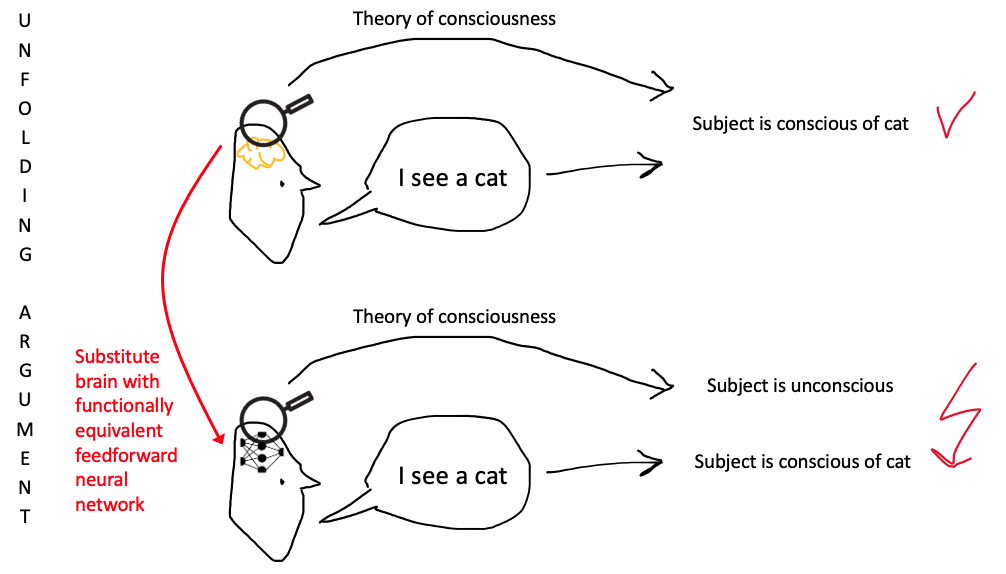
Any theory that says that feedforward networks cannot be conscious (such as IIT, see Oizumi et al., 2014) will (ideally) match the subject’s report before their brain got substituted, but not after, even though the subject’s behavior stayed 100% the same. Moreover, we have to go by the report, because what other means could we have to infer the subject’s level of consciousness in a theory-independent manner than the subject’s report? Since such a substitution is always possible (in principle), any theory for which implementation matters is supposedly either false or untestable.
[* Guess who introduced this issue? Functional equivalence is discussed at length in Oizumi et al., 2014 and also in Albantakis et al., 2014. To cite: “Note also, however, that any task could, in principle, be solved by a modular brain with given an arbitrary number of elements and time-steps.”]
Replies to date
A bit more than a year later, several replies have been published, which have pointed out various issues with the unfolding argument and the conclusions drawn by its authors.
As discussed by Tsuchiya et al., 2019, the unfolding argument advocates a rather extreme form of methodological behaviorism. Clearly, we can empirically distinguish the feedforward neural network from a real brain by looking inside the subjects’ heads and we are allowed to use that knowledge in our inference. There is no reason to treat the two subjects as black boxes. The assumptions on which the argument is based thus do not accurately represent the reality of experimental research on consciousness.
However, as shown by Kleiner & Hoel, 2020 the unfolding argument can be extended to a more arbitrary set of observations used for inferring consciousness. Kleiner and Hoel formalized the unfolding argument in mathematical terms and also rebranded it the “substitution argument.” The crucial requirement is “the independence between the data used for inferences about consciousness (like reports) and the data used to make predictions about consciousness” (Kleiner & Hoel, 2020).
Properly formalized, it turns out that according to the unfolding/substitution argument, falsification is an issue for all theories of consciousness that rely “non-trivially” on physical systems (which is argued especially well in Kleiner, 2020). This includes “Global Neuronal Workspace Theory, Higher Order Thought Theory and any other model of consciousness which is functionalist or representationalist in nature”, except for strict input-output functionalism. To the extent that the original unfolding argument put forward by a group of functionalists was a shot at discrediting IIT in particular, one could now quip that it backfired.
Addressing the argument from a different angle, the notion of falsification advertised in the original publication (Doerig et al., 2019) has been criticized as overly strict (Negro, 2020). Moreover, Negro nicely points out that there are valid pre-theoretical reasons to exclude feedforward systems from being conscious, in an argument that parallels Ned Block’s “Blockhead argument” (Block, 1981).
Finally, it should be pointed out that the proposed substitution with a feedforward network is not practically possible in the case of the brain, as the feedforward network would have to be giant, constituted of many more neurons than the actual brain. Indeed, we have shown that there are evolutionary reasons why we are not a feedforward neural network (Albantakis et al., 2014). However, the unfolding argument does not depend on the practicality of the substitution, it only requires that it is possible in theory. Hanson and Walker (2019) have also shown that for certain (small) networks it is possible to substitute them by a feedforward network with the same number of neurons, but that does not add anything further to the unfolding argument.
So do we have to draw the dire conclusion that consciousness is in fact outside the realm of science and all efforts to date have been a huge waste of time and effort? No. Actually, the fact that we have made considerable progress in the scientific study of consciousness over the past decades, including the development of novel paradigms that contrast experience and report, should make us somewhat skeptical about the validity of the unfolding/substitution argument. Nevertheless, I think the foremost reason why the unfolding/substitution argument is flawed has not been made sufficiently explicit yet.
Why the argument is a non-starter
There are two ways the unfolding argument may play out: (1) we accept report as our basis for inferring consciousness, then causal structure theories are falsified (see my sketch above), (2) we do not accept report as an indicator of consciousness, then we find ourselves outside the realm of science. However, this is a false dichotomy. Not all reports are the same when it comes to inferring consciousness.
In short, consciousness cannot be studied or tested in systems that are physically very different from us, because without a theory we have no way to tell.
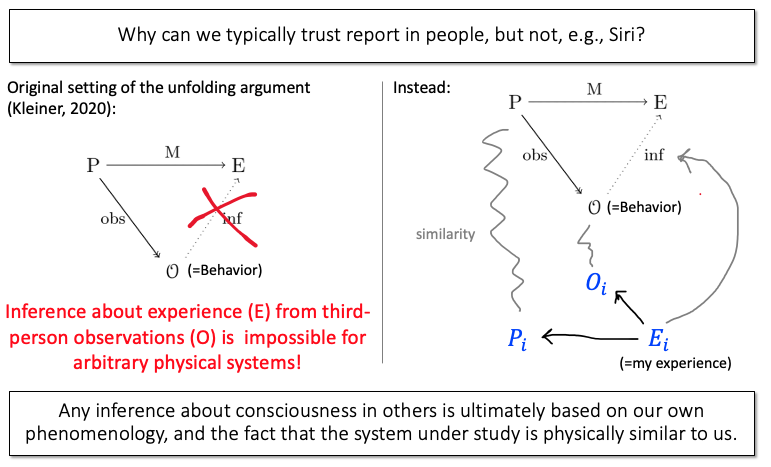
Here is a simple example: Would you trust Siri (or Alexa for that matter) if they claimed to be conscious? I’m pretty sure you would at least have some doubts about such a claim. On which basis then can we decide whether your smart phone is conscious or not? [Insert your favorite indicator of consciousness]? Why? The problem is that we actually have no theory-independent way to tell whether any arbitrary physical system is conscious or not.
[Note that this is not just a property of consciousness. The same issue arises, e.g., with notions such as “being alive”. The crucial difference between life and consciousness, however, is that what we call life is in fact nothing but whatever set of properties we define it to be, whereas phenomenology is directly observable (see below) and thus cannot be explained “away” in the same reductionist manner. Consciousness as the explanandum, what we want to explain, is not a function of the brain (even if the explanans might be in the end). To be conscious is to have an experience, to exist for oneself.]
What about intuition (see for example Aaronson (2014) whose intuitions supposedly falsified IIT long before the unfolding argument)? Since consciousness is not directly observable in others (from a third-person perspective), we do not have intuitions about consciousness. Our intuitions are always about (intelligent) behavior only and thus of no use for identifying conscious systems.
But here comes the crux: consciousness is directly observable by the experiencer. I can observe my own; I experience it and I can introspect on it; I just cannot directly measure it in others. Now, the only reason that I can study consciousness in others (e.g., other humans and possibly animals) is their physical, structural similarity to me.
I have tried to capture this point in a semi-formal diagram, based on the one drawn in (Kleiner, 2020) to depict the unfolding argument. A model (theory) of consciousness (M) makes a prediction about the experience (E) of a physical substrate (P). In order to test the model, the prediction is then compared to an inference about the system’s experience from a set of empirical observations (O), which indicate report or behavior more generally. However, such an inference is not actually possible for any arbitrary physical system. Instead, a theory-independent inference ultimately has to be grounded in “my own” (or the experimenter’s) phenomenology. This is reasonable (albeit never perfect) if the system under study is physically similar to me (the experimenter).
[Note that one could argue that instead of physical similarity, we could base our inference on functional similarity. However, physical similarity only implies that consciousness is somehow related to a physical substrate, which includes the possibility that consciousness is functional, whereas using a purely functional similarity already presupposes that consciousness is functional in nature. In the latter case, theory and inference would not be independent.]
For the unfolding, or more generally, the substitution argument, this means that once the subject’s brain gets replaced by an artificial system with very different physical properties, the subject’s report cannot be used to infer consciousness. Therefore, this scenario is not suited to falsify a theory of consciousness.
However, there still are plenty scenarios left under which we can sufficiently trust the subject’s report. Whenever the subject shows similar behavior to my own and is physically similar to me, I can rely on my own experience to infer the experience of the subject based on their report.
As an example, take sleep as a common experimental condition to study consciousness. It has been suggested that the reason we compare wakefulness and sleep to study consciousness “is based on the premise that outward behavior is an accurate reflection of internal subjective experience” (see Jake Hanson’s blog post). This is decidedly not the case. After all, we distinguish between dreamless sleep and dream experiences, and one of the most interesting new developments in the experimental study of consciousness is a within-state paradigm that compares these two conditions (Siclari et al., 2017). Yet, from the outside, there is no difference. For emphasis: sleep is interesting with respect to consciousness solely because we all seem to lose our consciousness every night in deep sleep, whereas dreaming is very similar to wake by our own experience.
Another important point to make here is that our inferences about consciousness are not deductions. They are never perfect and are not beyond any doubt. In the case of sleep and dreams, for example, memory is always a confounder. What we rely on instead are inferences to the best explanation. Through painstaking experiments, including studies on lucid dreaming, we can now be pretty sure that our dream content is based on very similar neural activity as wake experiences and not confabulated upon wake.
Are there still problems with report even if we rely on healthy adult human subjects? Yes, indeed. Some predictions may be hard to test even in humans. For example, IIT’s prediction that inactive neurons may contribute to shape the content of an experience while inactivated neurons may not (Oizumi et al., 2014), is hard to test directly based on similar consideration as the unfolding argument. However, there are plenty of approaches to distinguish a theory of consciousness from a theory of report.
How should we proceed? Inference to the best explanation!
I will quote from the scholarpedia entry on integrated information theory: A theory of consciousness “must first be validated in situations in which we are confident about whether and how our own consciousness changes … . Only then can the theory become a useful framework to make inferences about situations where we are less confident”.
To that end, we should work on devising new ways of testing theories of consciousness that are compatible with straightforward, reliable reports (for example, based on prolonged visual stimuli, the structural equivalence of predicted and reported experience, the spatio-temporal scale of consciousness (see also Tsuchiya et al. (2019), Tononi (2015) and Tononi et al. (2016))).
Will that be enough? Will we ever be able to sufficiently constrain our working theory of consciousness such that we can confidently apply it to judge systems that are very different from us? Well, that remains to be seen, but I would argue that there is still plenty of constraining that can be done for now.
[Part of the argument I have made here has already been mentioned by Tsuchiya et al., 2019 and some of the other replies to the unfolding argument also mention the possibility to use phenomenology as an observable in itself. However, I hope that stating the argument explicitly helped in clarifying exactly how phenomenology enters the argument.]
Integration and the intrinsic perspective
Commentary
Sep 22, 2020
https://www.consciousnessrealist.com/integration-intrinsic-perspective/
Experience is unitary—my experience is always one. Everything I am conscious about appears within one unified experience and therefore no part of my experience is truely independent from the rest. This is one of IIT’s starting points, the axiom of integration.
Every axiom in IIT has a corresponding postulate that formalizes a requirement for a physical substrate of consciousness. The logic here is that any characteristic feature of phenomenology must be reflected in its physical substrate. For example, if our experience is unitary, or integrated, its physical substrate cannot be composed of two or more completely independent systems. Being “integrated” is thus a necessary requirement for any physical substrate of consciousness. But what does that mean and how do we evaluate it?
The integration postulate according to IIT
According to the IIT formalism (Oizumi et al., 2014), a system is integrated if any unidirectional partition of the system into two or more parts will make a difference to the system’s cause-effect structure. A unidirectional partition means that we eliminate all causal dependencies from one part of the system to the rest but not necessarily vice versa.
A consequence of formulating the integration postulate in this way is that feedforward systems are excluded from being physical substrates of consciousness. This is because in a feedforward system the upstream parts do not depend in any way on the more downstream parts: layer n does not influence layer n-1 (or any previous layer) at all. Eliminating the dependencies from layer n to n-1 does not make a difference, since there are no causal dependencies in the first place. The feedforward system can thus be partitioned unidirectionally without loss, which means . It follows that being strongly connected, or recurrent, is a necessary (but not sufficient) requirement for being integrated.
Note that this is directly in line with the integration axiom as formulated above: no part of my experience is truely independent from the rest. In a feedforward system, however, any upstream part is completely causally independent from the more downstream parts. To the extent that the content of a system’s experience somehow depends on the activation states of its components, a feedforward system thus cannot account for an integrated experience.
Why causal integration?
One thing I smuggled in here is that IIT cares specifically about causal dependencies. From a purely information theoretical perspective, layer n-1 in a feedforward system may well correlate with layer n, which means that the mutual information between these two layers is nonzero and mutual information is a symmetric measure (if layer n has x amount of mutual information about layer n+1, the same is true vice versa). Moreover, the various layers of a feedforward system may jointly perform a particular function and, as highlighted by the recent discussion about the unfolding argument, any input-output function can in principle be implemented by a feedforward network (see my commentary here).
Couldn’t we formulate the integration postulate based on information more abstractly, or maybe in functional terms (as recently suggested in Hanson & Walker (2019))?
The first thing to clarify here is that the unity of experience is not the same as “multi-sensory integration”. We are not trying to capture a convergence of information to perform a certain task. Instead, what we want to account for is that all the various parts of our experience are integrated into one whole. This gets confused sometimes.
The reason we care about causal dependencies between system components in IIT is that consciousness is observer independent, while information and function typically are not. Information, in an abstract sense, does not exist by itself; my consciousness does. Similarly, a system is not directly aware of its input-output function. External behavior is exactly that: external to the system, and only relevant with respect to the environment. Intrinsic existence is another axiom/postulate of IIT.
For information to be meaningful to the system itself, it has to be able to make a difference to the system and thus needs to be physically implemented. We have to assess what is meaningful for the system from the intrinsic perspective of the system itself. For example, standard information measures are typically computed using an “observed distribution” of system states. However, any kind of summary distribution across multiple system states is not intrinsic. Nothing in the system’s here and now corresponds to such an average distribution of itself. What is there, in the here and now, is ultimately only the system’s internal mechanisms in their current state. Functionally equivalent systems can have very different internal mechanisms and thus specify different intrinsic information about themselves, as I have discussed in a recent publication. This is why implementation matters for consciousness.
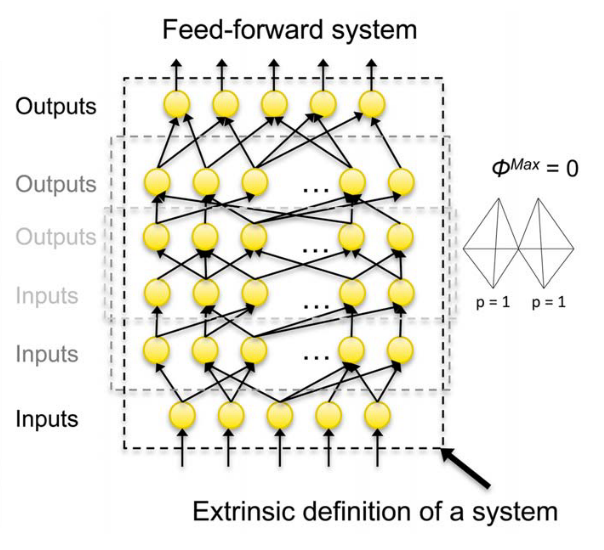
Back to integration: A system is integrated, according to IIT, if its mechanisms constrain each other. In that case, the system constrains itself and exists above a background of external influences. It can be viewed as a partially autonomous entity (Marshall et al., 2017). A feedforward network, however, is never independent of its environment and thus ultimately cannot form an entity in itself. Any borders drawn around it are extrinsic, specified by an external observer (see the image taken from Oizumi et al. (2014), Fig. 20). A system that does not exist by itself cannot be a physical substrate of consciousness. These “pretheoretical” notions are what informed IIT’s formulation of the integration postulate in mathematical terms (and not the other way around; see also Negro (2020) for a related case against “integrated” feedforward systems).
Empirical evidence against feedforward structures
IIT’s formulation of the integration postulate, inferred from the properties of our own experiences, also explains various empirical observations: neurons that have purely afferent or efferent connections to the cortex do not seem to contribute directly to our experience. Visual experiences, for example, do not directly correspond to the activity of retinal neurons, as vivid visual experiences are possible during imagination, hallucinations, and dreams. Moreover, in binocular rivalry experiments, both images are “represented” on the retina, while we are only conscious of one.
What is more, recording the activity of cortical neurons (which means creating a feedforward connection) does not seem to alter our experiences. You don’t become conscious of the processes within the fMRI machine while you are lying in the scanner. Likewise for brain stimulation. This might sound silly, but note that, for instance, the mutual information between the fMRI recording and the brain being recorded can be very high.
Case closed? Maybe not 100%. However, I hope that it became clear that accounting for our integrated phenomenlogy takes more than convergent pathways. Any proposal on how to reformulate the integration postulate needs to address the issues outlined above.
Sentience and the Origins of Consciousness: From Cartesian Duality to Markovian Monism
Review
Friston KJ, Wiese W, Hobson JA (2020) https://www.mdpi.com/1099-4300/22/5/516
Oct 6, 2020
https://www.consciousnessrealist.com/sentience-and-the-origins-of-consciousness/
Summary
By conditioning on a system’s “Markov blanket”, which corresponds to the border between its internal and external states, the dynamics of a temporally sustained system can be interpreted in two different ways: as probabilistic “beliefs” about the external environment of the system and as the temporal evolution of the system’s internal states. These interpretations give rise to a duality of information geometries: an extrinsic information geometry which specifies “beliefs” of the system about the external world, and an intrinsic information geometry corresponding to information about the system’s own future states. On this basis, the authors propose that the extrinsic information geometry could account for “mental” properties assigned to the system, or even “qualia”. However, because the two interpretations are mutually reductive, the proposed metaphysical interpretation is termed “markovian monism” and categorized as a form of reductive materialism. Nevertheless, the existence of an extrinsic information geometry is not in itself deemed sufficient for consciousness.
Why discuss this paper?
This is not the first attempt to connect aspects of the free energy formalism to consciousness (see, e.g., Clark (2013), Hohwy (2013), Williford et al. (2018), and Karl Friston himself in Aeon). Here, a metaphysical interpretation is proposed at the most basic level of the FEP formalism: “proto-mental” qualities are ascribed to the information that can be derived from the internal states of a system about its external world, a system’s “beliefs”. I have two major issues with this proposal: (1) the so-called “beliefs” do not correspond to information that is available to the system itself and thus cannot account for subjective experience; (2) the authors want to have their cake and eat it: since the most straightforward interpretation of the system’s “beliefs” as qualia would lead to literally every thing being conscious, ad-hoc functional criteria are superimposed to distinguish between conscious and unconscious systems (which is a particular pet peeve of mine).
The paper is also long and complex: a lot of notions are woven together in the spirit of Markov blankets. Below I will attempt to disentangle the proposed connection between Markov blankets and consciousness.
Commentary
[Disclaimer: I am still—to this date—struggling to understand Karl Friston’s mathematical framework around the free energy principle, predictive coding, active inference etc., despite my efforts. So if I get anything wrong below, please feel free to call me out on it in the comments. For those working on or with the FEP: Can we have a simple toy model that shows how everything actually works? Please?]
Technical Background:
Let’s start with Markov blankets. The Markov blanket of a set of nodes in a causal (directed acyclic) graph simply corresponds to all nodes that can influence that set, which are termed the “parents”, all nodes that are influenced by the set, i.e. the “children, and also other nodes that may influence the children. Once the state of all these nodes is accounted for, no other information about nodes outside the system is required to determine the system’s dynamics (“conditional independence”).
Importantly, everything has a Markov blanket. The only exceptions are fully connected systems and isolated system, as those do not have external states. A feedforward system has a Markov blanket, and if a neural network has a Markov blanket the same network plus or minus some neurons also has a Markov blanket. While the Markov blanket makes it possible to separate a system into external and internal nodes/states which are conditionally independent given the state of the Markov blanket, the notion of a Markov blanket alone is of little use for identifying the borders of a system if they are not already known.
So which Markov Blankets are interesting? The Free Energy Principle (FEP) formalism imposes a strict (maybe too strict?) condition for something to exist over time by requiring that the dynamics of the system must converge to an attracting set which is assumed not to change throughout the lifetime of the system. For humans that would mean from conception to death, or maybe decomposition. During that interval we are wandering from state to state according to our nonequilibrium steady-state probability density.
Any system that maintains itself (its attracting set) in the above way possesses the following properties: if we look at its internal and active states (“autonomous states”), it will seem as if the system is trying to minimize the surprisal (self-information, or, on average, the entropy) of its “particular states” (the internal plus blanket states).
From the above, it necessarily follows that one can infer information from the blanket states about the system’s internal state and the external world (if the blanket state is x, the most likely internal state is y; moreover, the blanket state constrains which environmental states could have caused it.) The blanket state thus connects the conditional probabilities of internal and external states in a one-to-one mapping. Note that this inference is purely extrinsic, in the sense that it is not something the system “does”, but something we can do by observing the system, its blanket states and the environment.
[There is an interesting parallel to the role of mechanism states in IIT, where a set of nodes within the system constrains its causes and effects in a similar manner as assumed here for the Markov blanket. The crucial difference is that in IIT these constraints are internal to the system, information the system has by being in a state about its own causes and effects within the system.]
This relationship between internal and external states can be formulated in terms of an information geometry, which is called the “extrinsic” information geometry, because it specifies “beliefs” of the system about its external world. Importantly, a “belief” here is simply a conditional probability distribution, nothing more and nothing less (as the authors themselves state multiple times these “beliefs” are not in any way propositional in nature.) This all simply means that by being what it is, the system specifies some information about its external world. If my fusiform face area neurons fire, there likely was a face presented to my eyes. Again, the neuroscientist can infer this correlation, the system itself cannot.
The system also specifies an information geometry about its own future states, which is termed the “intrinsic” information geometry. The internal states of the system thus give rise to a duality, as the two information geometries are two aspects of the same process. “However, the existence of a dual aspect information geometry does not, in and of itself, give a system mental states and consciousness, but only computational properties (including probabilistic beliefs)” (p. 11).
Metaphysical interpretation:
So far the formalism. The novel (and unfortunately less consistent) part starts in section 9, which discusses the metaphysical implications of the dual aspect information geometries. While it is acknowledged that there might just not be any metaphysical meaning whatsoever to the above observations, the authors’ favored metaphysical flavor is one of “Markovian Monism.” I cite:
“Markovian monism consists of two claims: (1) Fundamentally, there is only one type of thing and only one type of irreducible property (this is why it is a Markovian monism). (2) All systems possessing a Markov blanket have properties that are relevant for understanding the mind and consciousness: if such systems have mental properties, then they have them partly by virtue of possessing a Markov blanket (this is why it is a Markovian monism).”
A proper dualism is excluded because the two information geometries are reducible to each other. Instead, Markovian Monism is likened to “panprotopsychism” and “Neutral Monism.” Here is the issue though: everything has a Markov blanket and all that follows is that such systems “seem” like they represent probability distributions about the world and perform computations based on those “beliefs” even without actively doing so. If we take the information geometries per se to be of metaphysical relevance with respect to mental or phenomenological properties, then simple systems like single-cell organisms might end up having a mind and … the authors don’t like that.
So how can we distinguish between conscious and unconscious systems? Unfortunately, the only thing presented to address this issue is a list of everyone’s favorite contenders: macro variables, sufficient complexity, intentionality, etc. No operational distinction is offered to disambiguate systems that only “seem” to have “beliefs” from those that actually do. Instead consciousness should be thought of as a vague concept, with borderline cases.
If we take consciousness as phenomenology, then what on earth would be an edge case? Consciousness is not like life in that respect. While we cannot agree on whether a virus is alive or not, the virus couldn’t care less. Maybe there are organisms or other systems for which we will never be able to clearly tell whether they are conscious, but from their own perspective either the light is on or it isn’t.
The main problem I see is a complete disregard of the intrinsic perspective of the system itself. The FEP formalism is first of all descriptive. If we have a temporally sustained system, a lot of math follows, which can explain why certain things seem like they have certain properties to us observers. But do they actually? How do we get a self-sustaining system in the first place? What mechanisms and dynamics are required? This is not provided by the FEP formalism. In fact, the specific system dynamics are irrelevant. Since the FEP can account for everything, it risks accounting for nothing in particular. Likewise, proposing an interpretation of the extrinsic information geometry as proto-mental does not bring us any closer to being able to distinguish conscious from unconscious systems.
IIT comparison
To end, I am briefly going to address the comparison between the FEP and IIT made in this article: While interpretations of IIT’s axioms in terms of the FEP are given, in most cases, the essential property is not actually captured in the FEP formulation. I have already mentioned the lack of intrinsicality: the conditional probabilities in the extrinsic information geometry are not intrinsic in the IIT sense. The system itself cannot have “intrinsic” information about anything outside itself, as it cannot take anything past its Markov blanket into account. Such extrinsic information only exists from the perspective of an observer of the system. “What is this [intrinsic] information about…?” (p. 22) the authors ask. In IIT, the meaning has to come from the internal cause-effect structure: how all pieces of information specified by the system’s mechanism are related to each other, without explicit reference to the external world.
With respect to integration, having a Markov blanket has nothing to do with being an integrated system. We can, for example, describe any pair of cells, or humans, with one joint Markov blanket including joint information geometries etc. While the joint “beliefs” will be represented by probability distributions over the state space of both individuals, they are still (largely) reducible to the beliefs of their parts.
Lastly, as the authors point out themselves, the notion of hierarchical Markov Blankets does not square with IIT’s formulation of the exclusion postulate. Hierarchical generative models supposedly have “beliefs” about “beliefs” and it is postulated in this article and others (see above) that “Markov blankets within Markov blankets” might be necessary for phenomenal consciousness. But what does that mean with respect to the extrinsic information geometries? Do all overlapping Markov blankets have their own? How do I identify which Markov blanket is the one that subsumes all others? Again, I can have one Markov blanket of a pair of humans. Yet, to account for consciousness I must somehow identify the Markov blankets that delimit individuals. Moreover, the notion of “beliefs about beliefs” is extrinsic again. Every Markov blanket itself only has “beliefs” about its outside. How do the beliefs of various Markov blankets come together to form one mind and where are its borders?
The Greek Cave: Why a little bit of causal structure is necessary... even for functionalists
Commentary
Oct 20, 2020
https://www.consciousnessrealist.com/greek-cave/
By now we are fairly certain that our conscious experiences arise from within our brains and that the content of these experiences somehow has to do with neurons firing and interacting in specific ways. Empirical studies of consciousness are thus conducted under the banner of neuroscience, anesthesiology, and neurology. Occasionally, renowned physicists become interested in the problem of consciousness (e.g., Tegmark (2015)), but their contributions are typically philosophical in nature. It may be premature to try to connect consciousness to the (micro) physical. However, by focusing exclusively on brains, neuroscientists often forget one of the biggest problems in studying consciousness: that every person has their own.
The individuation problem of consciousness
One of the easiest ways of testing a theory of consciousness is to apply it to a room full of people — 5 awake adults let’s say. If the theory cannot identify (at least) five consciousnesses there is a problem. Yet, almost no proposal to date has the theoretical tools to approach this problem without presupposing brains as the seats of experience (IIT being a notable exception, see also Fekete et al. (2016)).
Crucially, causal analysis is the only way to address this individuation problem as I will argue below by means of a thought experiment inspired by Searle’s Chinese Room Argument. The reason is that identifying individuals in general requires intervening upon the system under study. The implication is that no theory of consciousness can do entirely without assessing causal structure. Pure functionalism is out.
[In this way, the current post takes another stab at clarifying inconsistencies in the recent discussion about the unfolding argument, see my earlier commentary here. A related point was made by Kleiner (2020), arguing that all theories of consciousness (should) depend non-trivially on physical systems.]
The Greek Cave argument
From the outside the setup of my though experiment is identical to Searle’s. For a change though, let’s imagine a cave in the Greek mountains: travelers can ask any question they want to the cave (a black box), written or spoken, does not matter, but it has to be in Greek. They will then receive an answer from within the cave, also in Greek.
In the original Chinese Room setup, the questions are answered by a person who does not speak a word of Chinese but is able to perform the task by looking up the correct answer to any given question from a giant look-up table. The conclusion drawn by Searle is that true understanding doesn’t necessarily come along with the ability to perform a certain function. Therefore, the Turing test is inadequate.
In the Greek Cave, there also is a person that does not speak a word of Greek. However, the way the questions get answered is different. Looking inside the Greek Cave (see sketch below), we find three people. One, a Greek-English bilingual, receives the question and translates it for the English monolingual. The monolingual answers in English. This answer is then translated back to Greek by a third person, also a Greek-English bilingual.
[To be technical, the third person should not be able to hear the first one. However, it is not crucial for the argument that the interaction is unidirectional only. For example, it would be OK for the monolingual to ask clarifying questions to the first person. Also, we should assume that no person in the cave knows the actual setup.]
[Note also the analogy to sensory inputs and motor outputs in the brain and the question whether they contribute to the experience, or where the actual neural correlates are located.]
Clearly, the Greek Cave can pass the Turing test. By contrast to the look-up table in the Chinese Room, in the case of the Greek Cave there is no doubt its implementation is possible in principle. From the outside it looks as though someone is understanding and answering the questions in Greek. Here is the point: no one actually answers any question in Greek; no one has the conscious experience of answering questions in Greek; and it would be wrong to conclude that a conscious being must have performed the task.
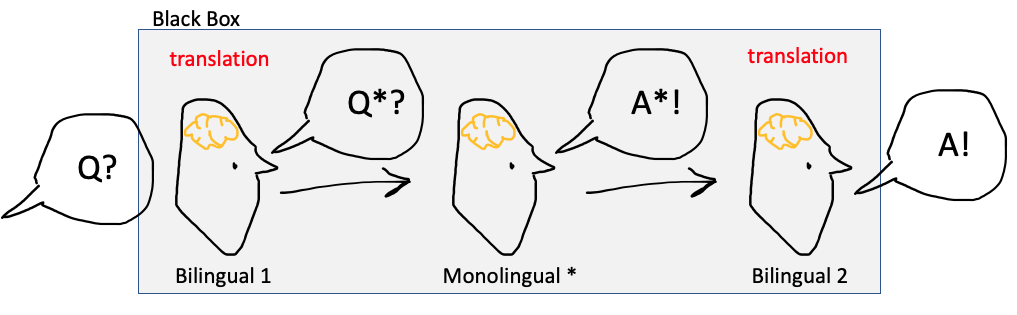
To emphasize this last point: all three people are necessary to perform the task. The function of answering questions in Greek is distributed across the three individuals. While answering questions in Greek is certainly indicative of consciousness in humans, it is not sufficient in case of a black box. The cave as a whole is not conscious (but see below).
One may object that we could still conclude that somewhere inside the cave there is at least one conscious being. Maybe. Maybe not. But what if the third person falls asleep? Should we then conclude that nobody is home? Also, in the end our goal is to say something about the quality of the experience. Yet, no one in the cave experiences answering the submitted questions in Greek. The only “being” that could have those experiences would be the system of all three people jointly.
We can conclude that performing the same (complex) function can come associated with very different experiences and be split into different numbers of consciousnesses (possibly including zero, but that does not follow directly from this thought experiment).
What if we had a joint recording of the brain activity of all three people in the Greek Cave?
As a possible objection, a machine-state functionalist might argue that we can map the brain states of the English speaker in the middle onto those of a Greek speaker answering the same questions, maybe not perfectly but close enough. We can thus identify the middle person as the minimal functionally equivalent system, granting them a consciousness of their own. Fine. But there must also be a possible mapping of the three-people system, which after all is actually performing the task. If that gets excluded, functional equivalence is insufficient by itself.
Moreover, we can imagine a person who knows Greek pretty well, but is not fluent. That person may first translate the question into their native language. Then think about the answer in, e.g., English, and translate it back. The difference to the Greek Cave scenario is that now, the experiences of translating and answering happen within one consciousness, yet there might be a more minimal functional kernel which may be mapped onto the states of a Greek person answering.
Identifying three conscious people in the cave requires perturbation
Of course, there is an easy way to identify the three people if we can access the cave: we just talk to each of them directly. However, for each one, we have to modify their inputs and/or outputs, which means that we have to perturb the system into states that it otherwise would not take. For example, we would have to query the English monolingual in English to get reasonable answers (see figure below).
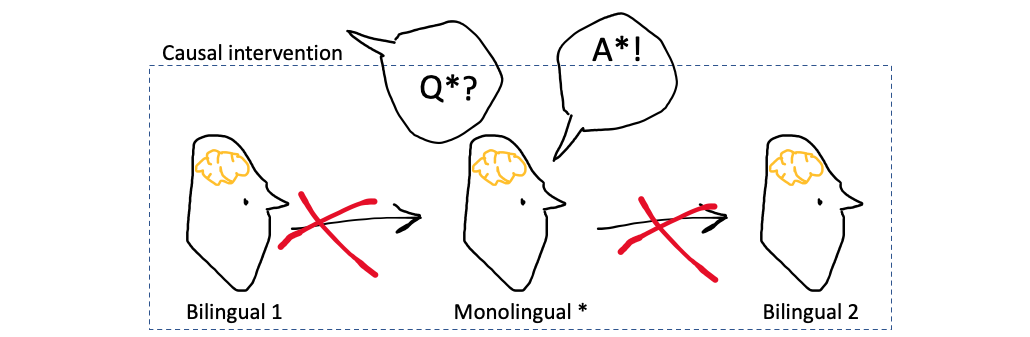
Interacting directly with the people inside the cave corresponds to perturbing the system, which amounts to causal analysis and may vary with implementation.
In the absence of predetermined boundaries, we can only fully understand a system by assessing what each element is capable of in isolation and in combination with any other subset of the system. This is exactly what the IIT algorithm is based on: perturbing the system in all possible ways. Systems that map onto each other considering all the various ways in which they can be perturbed are causally identical and thus will have the same value of integrated information.
The Greek Room argument may not be detrimental to every variant of functionalism (I would be happy to receive comments in this regard). However, I would conjecture that those flavors of functionalism that survive the argument implicitly contain some notion of causal structure.
Finally, we can of course avoid the above conclusions by accepting that the cave (or the system of three people within it) is in fact conscious. Yet, the individual consciousnesses surely remain and would also have to be account for.
Why IIT cares about physical not functional states
Commentary
Nov 11, 2020
https://www.consciousnessrealist.com/physical-vs-functional-states/
While the postulates of IIT are often demonstrated in small, simulated, artificial systems (e.g., Albantakis et al., 2014), IIT does not consider such simulations conscious, no matter their “virtual” -value. Just like the simulation of a hurricane is not actually windy and wet, simulating a system of interacting physical components does not emulate its subjective experience.
The amount of integrated information of a computer, it is argued, has to be evaluated based on its physical, not functional, states and standard computer architectures constituted of massivly parallel chains of transistors (not unlike the cerebellum) do not possess the right causal structure for high , no matter how complex the software they run (Koch and Tononi, 2015; Findlay et al., 2019*).
[* Full paper version will eventually appear.]
But why this emphasis on physical states? Doesn’t the IIT algorithm depend only on a system’s complete state transition probabilities? Those can easily be simulated. After all, there must exist a mapping between the states of the physical system and some set of functional states in the computer when the computer is simulating the temporal evolution of the physical system. Shouldn’t the state transition probabilities, and thereby the amount of integrated information of the system, also be preserved?
This is an issue that tends to come up time and again, so let me try to explain:
In short, the reason for IIT’s focus on physical states stems from IIT’s axioms of “existence” and “intrinsicality” (please bear with me for a moment).
[The axioms in IIT correspond to essential properties of every experience. They are the starting point from which a corresponding set of requirements for the physical substrate of consciousness are obtained through abduction (termed “postulates”).]
Consciousness exists. Existence in physical terms amounts to having cause-effect power (you only exist if you make a difference to something and if something can make a difference to you). So in order to be a substrate of consciousness a system must exist in terms of cause-effect power.
Consciousness, moreover, exists intrinsically, from my intrinsic perspective as the experiencing subject. A substrate of consciousness must thus also exist intrinsically, from its own perspective, without the need of an external observer. It must have cause-effect power onto itself, meaning it must make a difference to itself, which must again be independent of interpretation by an external observer.
The state transition probabilities as the input to the IIT analysis are thus required to be causal, not merely correlational. In other words, they must describe a dynamical causal network in which edges denote causal dependencies (e.g., Albantakis et al., 2019). This means, that the probabilities are maintained under perturbation of the system or its components (Pearl, 2009).
But isn’t this also true for a simulated system? After all, if I set the simulated system into a particular state, it will update according to the same transition probabilities as the corresponding physical system.
Virtually, yes. The problem with the simulated system is that it is not observer independent. Thus, its virtual causal powers are not intrinsic. The virtual system does not exist by itself.
To see why that is, let’s consider what it means to simulate a physical system. First, a simple (extrinsic) mapping from the states of the physical system P over time onto the states of a different system S (the simulator) is not sufficient for S to simulate P (Chalmers, 1996), otherwise “pancomputationalism” would follow and even a rock could be said to simulate any finite state automaton (FSA) (Putnam, 1988).
Instead, Chalmers (1996) argues for a notion of implementation which requires that the state transitions of the simulator are causal in a counterfactual sense: if the simulation requires S to transition from state into , then it should do so no matter how the system S ended up in state (including upon perturbation). Crucially, this needs to be the case independent of environmental (background) conditions and it needs to hold even for possible states of P that do not happen on a particular run or trajectory (starting from a particular initial state).
The physical states of the simulator S thus do play a significant role in determining whether S implements a simulation of P. In other words, the virtual states cannot be considered without their physical implementation, even just for deciding whether the system S actually simulates P.
A standard computer running a simulation of a physical system P according to P’s state transition probabilities is an implementation in the above sense if we consider the state of the computer as a whole. However, the virtual states of the simulation only correspond to a small subset of the physical elements within the computer at any given time. Moreover, this mapping is typically not persistent in time and space. The state of element A, for example, may be stored at a different physical location within the computer with every update of the virtual system.
Note that IIT’s causal analysis is closely related to Chalmer’s definition of implementation. The IIT analysis requires the state transition probabilities for all system states, and background conditions are fixed to their actual state as they are not intrinsic to the system. Fixing all computer components that do not directly correspond to the functional states of the simulation, the simulation wouldn’t run.
[For the same reasons, the virtual system itself does not have a “Markov Blanket” and thus does not exist according to the free energy principle (FEP), even if the computer does. Just as I was typing up this post a new preprint was published by Wiese and Friston (2020), which makes this exact point based on very similar arguments about the nature of computation as my summary above. Please check it out!]
Within the computer, the virtual states of the simulated system thus require interpretation. In addition to the initial state of the physical system, an input specifying the dynamical evolution of the physical system (e.g., its state transition probabilities) must be provided to the computer to model the physical system in simulation. This corresponds to telling the computer which program to run and means that information from outside the system itself is required to perform the simulation. A different software program would lead to different transitions, both at the virtual and physical level. Obviously, the original physical system itself does not require this additional input because it is its own causal model (and nothing else).
Thus, virtual states do not make a difference to themselves, because their implementation may change in the course of the update and their effects have to be mediated by parts of the computer external to the virtual system. The functional states of the simulation are thus only shifting sub-states of the full causal model that actually implements the simulation.
For these reasons IIT requires causal models to correspond to actual physical systems and it evaluates the causal interactions between actual physical components.
[Subsets of elements within a larger system may be considered (and actually have to be considered to identify the set of maximal ). In that case, however, the rest of the system is treated as a fixed background condition, as mentioned above.]
From the perspective of IIT, standard computer architectures have cause-effect structures that do not fare well in terms of their amount of integrated information, as they typically include feedforward components, or are only weakly integrated. Moreover, the way in which the various constituents of the computer interact is largely independent of which program the computer is running and does not even remotely reflect the cause-effect structure of the system being simulated.
[Note here that, while the computer as a whole may simulate the physical system P, it typically does a whole lot more then that at the same time. Even from a functional point of view, the computer as a whole is thus not doing the same thing as the original physical system.]
IIT does provide a way to move up levels from a system’s micro physical implementation by causal coarse-graining (Hoel et al., 2016), or black-boxing (Marshall et al., 2018) of the system’s micro elements into physical/causal macro elements. By contrast to arbitrary mappings of the global system state, these macroing procedures require a stable mapping between micro and macro components, where every micro element must be mapped into one and only one macro element (macro elements thus cannot physically overlap, and no micro element can simply be ignored).
Typically, there is no possible mapping of the computer’s basic elements into macro elements that could reproduce the cause-effect structure, and thus phenomenal experience, of the system being simulated. An exception could be detailed neuromorphic computers that emulate the causal structure of the original system in their implementation, but those are very different from our standard computer architectures with CPUs, clocks, and data registers.
In conclusion, the reason IIT cares about physical not functional states is that functional states are virtual not real, because the simulated system within the computer does not exist for itself.
[Acknowledgements: An informative discussion of the meaning of “computation” and “information processing” with respect to cognition and brain function can be found here (Piccinini and Shagrir, 2014). (Piccinini, 2007) discusses the notion of “pancomputationalism” with respect to computational theories of mind. While I do not agree with all their points, the two papers contain a lot of food for thought and many useful references.]
Information in the brain
Commentary
Dec 22, 2020
https://www.consciousnessrealist.com/intrinsic-extrinsic-information/
[I originally wrote most of the piece below in preparation for an article about intrinsic information and causal composition. Ultimately, it didn’t make the cut into the final article (Albantakis and Tononi, 2019) aimed primarily at elucidating the role of causal composition within the formal framework of IIT. Nevertheless, I think the snippet here includes several noteworthy points about information in the brain, how it is typically assessed and whether it matters to the brain itself. So here you go.]
Neural networks, biological and artificial, are complex systems constituted of many interacting elements. These systems and their dynamical behavior are notoriously hard to understand, predict, and describe, due to the intricate dependencies between their parts, including nonlinearities, multi-variate interactions, and feedback loops. They also underlie many systems with specific relevance to us, including our communication networks, power grids, biological organisms, and ultimately, ourselves, that is, our brains, guiding our behavior and giving rise to our experiences. Mathematical tools for studying neural networks originate from, and are being developed within, a wide range of disciplines including information theory, computer science, machine-learning, and dynamical systems theory.
Often, the objective amounts to predicting the system’s behavior or dynamics. However, prediction neither requires a mechanistic understanding of the system under investigation, nor does it necessarily provide such an understanding (Carlson et al., 2018). A system’s behavior, for example, can often be predicted to some degree even if the system itself is treated as a black box (Figure (a)). In contrast, especially in neuroscience, characterizing the functional role of particular parts of the system (the brain) and the way in which they interact has always been a main line of inquiry.
Because the brain is commonly viewed as an “information processing” system, which receives inputs from the environment and reacts to those inputs by eliciting motor responses, information theoretical approaches seem highly appropriate for studying the functional role of the brain and its parts. More recently, also machine-learning based techniques such as “decoding” have gained popularity and have been utilized to investigate content-specific neural correlates of consciousness (Hanes, 2009; Salti et al., 2015).
The goal is to measure or identify the presence of information about some external variable or stimulus in a specific part of the brain. This part is then said to “represent” the variable or stimulus as its informational content (Rumelhart et al., 1986; Marstaller et al., 2013; Kriegeskorte and Kievit, 2013; King and Dehaene, 2014; but see Ritchie et al., 2017 for a critical discussion).
For example, the neural response of a particular brain region may be correlated with a statistical feature of a stimulus set presented to the subject, which can be quantified by the mutual information (Figure (b)). By contrast, decoding approaches aim to infer a particular stimulus or stimulus feature presented to the subject from the subsequently recorded neural response (Figure (c)).
[Recently, researchers have also begun to employ similar approaches in order to gain a better understanding of artificial neural networks (information theory, e.g.: Schwartz-Ziv and Tishby, 2017; Tax et al., 2017; Yu et al., 2018; causal information: Mattsson et al., 2020; and machine-learning, e.g.: Lundberg and Lee, 2017).]
While neurons are typically viewed as the units of information processing, the brain is also functionally compartmentalized at the level of macroscopic brain regions. An important insight from early applications of decoding techniques to neurophysiological and neuroimaging data is that populations of neurons (Pouget et al., 2000; Panzeri et al., 2015) and patterns of fMRI voxels (Haxby et al., 2001) can contain additional information compared to individual neurons or voxels. Current neural decoding approaches thus focus on multivariate approaches, such as multivariate pattern analysis (MVPA) (Haynes, 2011; Haxby et al., 2014), or also representational similarity analysis (RSA) (Kriegeskorte and Kievit, 2013), based on the underlying assumption of a “population code”.
Panels (a-c) in the figure below summarize the current techniques used in complex system science, and neuroscience in particular, that we have reviewed above.
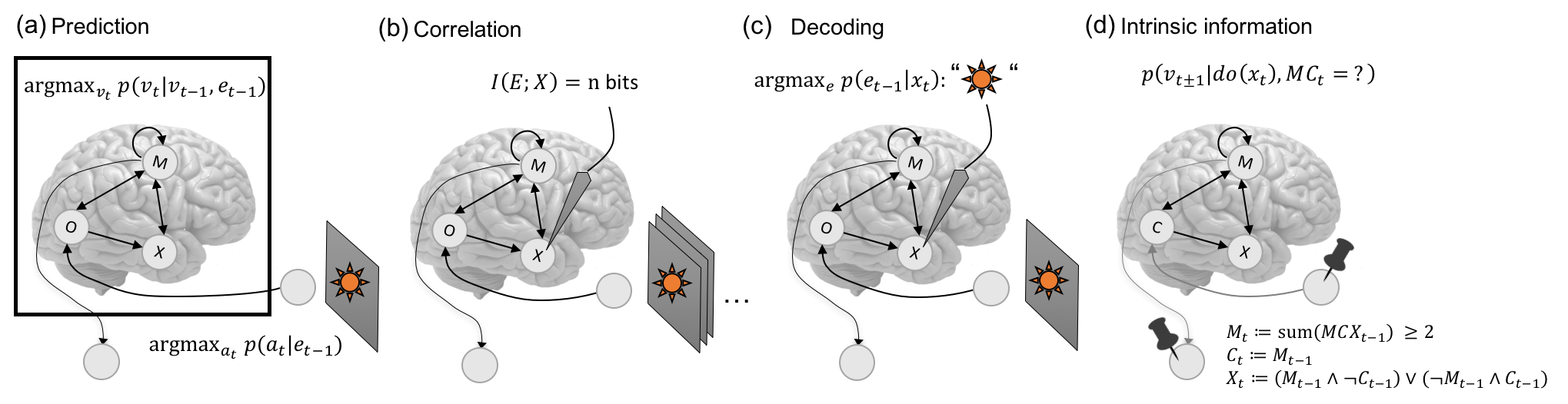 Figure: Extrinsic and intrinsic information. Extrinsic information is correlational, based on observational data, and typically relates a system’s actions or internal states with states of the environment. (a) Predicting a future action or internal state of the system. Predictive information about the most likely action of a system can be obtained based on the stimuli it receives from the environment while treating the system as a black-box (indicated by the black line). Alternatively, future system states can be predicted based on observational data of past system states and inputs to the system . (b) Positive mutual information between external variables and system subsets (e.g., ) is often taken as an indicator of the presence of external information in the respective part of the system. (c) While mutual information quantifies correlations between variables, decoders aim to infer features of the input stimuli from system subsets in a state-dependent manner. (d) Intrinsic information is causal, based on interventional data, and evaluates what the current state of the various parts of a system specify about its past and future states in a compositional manner. External variables are taken as fixed background conditions but are not further considered otherwise. See (Albantakis and Tononi, 2019) for details on the toy model system and computation.
However…
… the information that is decodable from the brain is not necessarily used by the brain itself (Haynes, 2009; Weichwald et al., 2015; Carlson et al., 2018). This is because the notion of information that is evaluated is still correlational or predictive, and thus detached from neural mechanisms. More explicitly, the fact that a stimulus feature correlates with a statistical property of the neural (population) response does not imply that this property plays a causal role within the brain (Victor 2006; Weichwald et al., 2015). Particularly in the case of information decoded from multiple variables (neurons, voxels, or also temporal patterns), it generally remains unknown whether a mechanism exists within the brain that is capable of “reading out” the decoded information. This issue is widely recognized for nonlinear decoding techniques, which are deemed “more powerful” decoders than the brain itself (see, e.g., Naselaris et al., 2011; King and Dehaene, 2014).
[The maximal amount of “Shannon” information about a visual stimulus, for example, is present in the retina and can only decrease down the processing pipeline (Cox, 2014) by the Data processing inequality. Any external feature in the input can thus, in principle, be decoded from the retina, although the retina itself clearly lacks the necessary mechanistic structure to “process” or “read out” this information.]
Linear classifiers, however, are commonly considered “biologically plausible approximation[s] of what the brain itself does when decoding its own signals” (from Ritchie et al., 2017; see, e.g., DiCarlo and Cox, 2007; King and Dehaene, 2014). Yet, even linear decoders may extract correlational information from specific brain regions that is not causally relevant to the brain itself (Williams et al., 2007; Ritchie et al., 2017; Carlson et al., 2018). On the other hand, neurons—the units of information processing—have nonlinear (integrate-to-threshold) input-output functions (Koch and Segev, 2000), and also at larger scales, nonlinear processes may still play a significant role in shaping the brain’s dynamics (Heitmann and Breakspear, 2018). Moreover, MVPA applied to sets of fMRI voxels may fail to decode information that can be retrieved from single-unit data from the same brain area (Dubois et al., 2015). Taken together, also linear classifiers may both over- and underestimate the information that plays a causal role within the brain (or other neural networks).
To sum up, understanding a complex system such as the brain requires more than successful prediction (see also Kay, 2018). However, neither standard information-theoretical, nor decoding-based approaches can ultimately capture the causal role of the parts of the system. This is because these techniques are based on observation and correlation with external variables. They evaluate the information present in the system from the perspective of an external observer. They do not determine whether the system itself possesses the necessary mechanisms to “read out” its own “messages”. Information processing requires processors, decoding requires decoders. Yet, what counts as a mechanism, information processor, or decoder from the perspective of the system itself remains poorly understood.
What is needed, is an account of intrinsic information that explicitly acknowledges the limited perspective of the system itself but also captures the information specified by all of the system’s components. One such account of intrinsic information and intrinsic mechanisms is offered within the formal framework of integrated information theory (IIT) (see Figure (d)). While above I have focused on the functional role of neural components within the brain, the problem with extrinsic notions of information also arises for consciousness and its contents. IIT’s account of intrinsic information is causal and compositional: it unfolds the full intrinsic causal structure of a system. But rather than diving into specifics now, I will leave you with a few references that highlight our recent efforts towards a principled account of intrinsic information:
Barbosa et al. (2020) discuss that standard information measures are not suited to capture information from the perspective of a part within the system, even in the context of quantifying information transmission, and proposes a novel and unique measure of intrinsic information.
Haun and Tononi (2019) provide a first demonstration of how the content of experience (here, the feeling of spatial extendedness) could be captured by the intrinsic causal structure of a particular model system—an account of how meaning could be generated from within.
Finally, my FQXi essay on the topic of intrinsic information provides more background on necessary conditions for intrinsic information and meaning from the IIT perspective (Albantakis, 2018).
Dynamical Emergence Theory
Review
Moyal R, Fekete T, Edelman S (2020) https://doi.org/10.1007/s11023-020-09516-9
Mar 16, 2021
https://www.consciousnessrealist.com/dynamical-emergence-theory/
Summary
Consciousness as phenomenal experience is structured. Research into the neural correlates of consciousness and its contents may reveal the neural mechanisms that support conscious experiences. However, knowing which type of neural population activity corresponds to which contents of consciousness does not yet provide an explanation for why the experience feels the way it does. Dynamical Emergence Theory (DET) aims to address this issue by proposing a link between the structure of a system’s collective dynamics and that of the experiences it is capable of producing.
To that end, DET combines aspects of Integrated Information Theory (IIT) (Oizumi et al., 2014) and Geometric Theory (GT) (Fekete, 2010), an earlier proposal advocated by the same authors. DET starts with two guiding principles, “Inherence” (observer-independence) and “Structure” (a formal isomorphism between phenomenal structure and the structure of the system’s emergent macro states and their transitions). These necessary conditions are also deemed sufficient for phenomenal experience.
Why discuss this paper?
There is a strong tendency in the field of consciousness science to focus solely on the objective aspects of consciousness such as reportability, neural activity, and related functions, to the point that some even consider the subjective aspects of consciousness outside the realm of science (Cohen and Dennett, 2011; Doerig et al., 2019). However, the subjective character of consciousness can and should be studied in objective terms.
[IIT has set out to do so by evaluating the essential properties of experience and postulating a fundamental identity between the phenomenal structure of an experience and the cause-effect structure of its physical substrate (see Haun and Tononi, 2019 for a first attempt to map the experience of spatial extendedness to the cause-effect structure of a spatially organized, grid-like neural network, and Tsuchiya et al., 2019 for a more general discussion.)]
As Moyal et al. put it: “The veracity of any proposed mapping between a system’s dynamics and phenomenal content is testable, even if one is only willing to admit a strictly operational definition of awareness.” Specifically, DET postulates a formal isomorphism between the structure of phenomenal consciousness and that of its underlying neural population dynamics, which have to be assessed in an observer-independent manner and thus have to be intrinsic to the system in question. Sounds familiar? DET shares essential aspects of IIT, but also diverges from IIT on important issues. Discussing the similarities and differences may shed some light on both approaches.
Commentary
What is DET? DET starts with two basic principles, “Inherence” and “Structure”. As the name “Dynamical Emergence Theory” suggest though, DET rests on the additional, implicit assumption that physical structure must correspond to a certain type of emergent dynamics. Specifically, it is assumed that changes in qualia correspond to transitions between separable macro states that emerge from the system’s collective dynamics. This assumption is not inferred from phenomenology itself, but instead largely rests on empirical observation (Moyal and Edelman, 2019) and a commitment to a multiply-realizable computational (as opposed to implementational) substrate of consciousness. Nevertheless, these properties together are taken as necessary and sufficient: Any physical system with collective dynamics that are captured by intrinsically discernable macro-state transitions possesses some degree of phenomenal experience.
Formally, DET proposes to evaluate phenomenal experience based on three measures: Representational Capacity (RC), the Amount of Experience (AE), and the Nature of Experience (NE). These measures are supposed to summarize various aspects of the structural properties of the computational substrate (CS), which corresponds to the possible macro-state transitions. The measures are not taken to be unique, but rather intended as one set of computationally tractable, practical measures with predictive and explanatory power and are only sketched in the present paper.
[Roughly, the RC represents the overall level of consciousness or arousal of a system, which is thought to depend on the topological complexity of the system’s dynamical structure taking all possible trajectories into account over a certain finite amount of time. The AE aims to capture the richness of the experience, which is constrained but not fully determined by the RC (compare for example a rich multi-sensory experience against silent meditation with closed eyes). Formally, it is proposed that the AE might correspond to the topological complexity of an individual state space trajectory, evaluated, for example, by convergent cross mapping through time-delay embedding (Sugihara et al., 2012). While the RC and AE are scalar measures, the NE should provide a structure that captures the similarity between experiences (across time or also across different systems) based on the structure of a system’s CS-level macro-states and transitions.]
Experience in time — Structure right now?
Can an approach that evaluates a system’s dynamics over a certain period of time capture the structure of experience? After reading through the first two sections of this paper with enthusiasm, I realized that what I understand as the structure of experience does not seem to be addressed at all within the DET (as described). Right now, I sit in front of my computer, there are books and papers and coffee cups around me, all positioned in their place, with their respective colors; I am looking at the text that I’m writing, while I hear the clicking of the keyboard etc. etc. My experience right now is structured. However, according to DET my whole structured experience right now corresponds to one macro state. The NE measure is then supposed to capture similarities between experiences by similarities between macro states.
Granted, any physical property associated with experience should have a similarity structure that is isomorphic to the similarity structure between experiences and that is an important insight that goes beyond mere neural correlates. However, there is a gap between matching the similarity structure across different experiences and accounting for phenomenal content of a particular experience. How do I get from the macro state as a node in the NE to why that macro state feels the way it does?
Going back to Fekete and Edelman (2011), the authors discuss this issue at some length and conclude that transient activity patterns must “somehow carry within them the causal constraints that force their orderly instantiation.” This certainly matches the idea behind IIT’s state-dependent causal analysis. Fekete and Edelman instead conclude that an experience must correspond to a temporally extended dynamical transient. To match human experience such a trajectory segment “should extend anywhere from hundreds of milliseconds … to seconds …”. In the current paper, however, the same interval is thought to correspond to a discrete macro state.
[If I am confused about the authors’ intent, the authors seem to be confused about the relation between their “structure” principle and IIT’s “composition” axiom and postulate. Composition in IIT specifically refers to the structure of a particular experience (i.e., me sitting in front of my computer right now). IIT then postulates an identity between the experience and the cause-effect structure of a physical system, which corresponds to the unfolded causal powers of the system in its particular state and all of its subsets. The composition postulate thus implies that we have to look at the system state not just as an (unstructured) whole, but as composed of many subsets with their own causes and effects, which can be related or not (Albantakis and Tononi, 2019; Haun and Tononi, 2020). In IIT it is the information axiom and postulate which highlight that the specific content of an experience makes it what it is and different from other experiences (Tononi et al., 2016). The DET Structure principle is thus more closely related to Information in IIT than to Composition.]
In any case, the content of the experience in DET (and GT) seems to depend on the dynamical structure of the system far beyond the 500 ms time interval. At the same time, the authors emphasize actuality, criticising IIT’s dependence on all possible counterfactuals, including states that the system might never visit. But how could the content of my current experience depend on my actual past and future life trajectory (beyond being the system I am right now)?
[In this respect, I couldn’t help to notice that the algorithm outlined in (Allefeld et al., 2007) and cited here as a way to map micro states to macro states assumes that it is possible to reach any system state from any other state.]
Finally, the issue with dynamical trajectories is that they have to be defined over a certain time interval. The three measures proposed to evaluate the complexity and structure of the trajectory space certainly depend on that time interval to some degree, but the paper only refers to “some time interval of interest” throughout. However, experience is what it is and the time interval to determine the content of experience cannot be arbitrary in the end; this would also violate DET’s Inherence principle. Consciousness is definite in its content and its duration. This is IIT’s exclusion axiom. And while nobody seems to like it (including Moyal et al.), exclusion does a lot of work when it comes to accounting for experience in a non-arbitrary, consistent framework and DET is lacking at least some of its aspects (see more on this below).
The boundaries of experience
DET distinguishes between the implementation level: the system defined as a set of elements with variable states evolving over (continuous) time, according to a set of differential equations, and a multiply realizable, emergent computational level. This macro level is supposed to be self-organized and observer-independent, stable over time, discrete, and connected to the micro-level description through a mapping that preserves the topological structure (Allefeld et al., 2007).
By moving phenomenology to the macro level, the hope is to circumvent the boundary problem of consciousness (addressed in IIT by the “Exclusion” axiom and postulate) and to allow for multiple realizability of phenomenal experiences (in Fekete and Edelman, 2011, macro states were not explicitly required). Instead of causal exclusion, all inherent macro levels are considered simultaneously valid and, if I understood correctly, are thought to contribute jointly to the experience of the underlying physical system. According to DET, the experience and its corresponding CS thus span multiple levels of organization.
The first question here is why the micro level or implementational substrate (IS) should not also contribute? Possibly because it is thought to be continuous, whereas the macro level or computational substrate (CS) is required to be discrete, or rather “quasi-discrete”. Otherwise, there really is no reason to exclude just this one level from the hierarchy.
[The issue whether physics at the bottom is discrete or continuous is an ideological question that, as of yet, has no decisive answer within fundamental physics (to the best of my knowledge—let me know if you happen to know more).]
But how many levels would DET predict and how separable are those levels? We are, after all, not conscious of the interactions between molecules in our brain or over temporal scales of more than a minute. Would there really be no quasi-discrete macro-states corresponding to these levels?
More critically though is the question what delimits the IS in the first place? The DET does not provide an answer here, which ultimately makes it incomplete: it does not solve or even address the problem of individuation. Why should I start with the IS of the brain and not that of the universe? Are ISs allowed to overlap? Leaving this issue unresolved is also inconsistent with the Inherence requirement: DET postulates observer-independence but does not provide a principled, observer-independent manner to identify the borders or the IS, which after all still determine the boundaries of experience.
Guiding principle vs. axioms and postulates
While the authors assert the need for an axiomatic basis or a set of minimal assumptions for a theory of phenomenal consciousness, there is a crucial difference between IIT’s axiomatic approach and starting from an (arguably arbitrary) set of guiding principles. IIT’s axioms aim to capture the essential properties of every experience, which are converted into requirements—postulates—for a physical substrate. It is because a physical system that fulfills all the postulates should be able to account for all essential properties of experience that IIT’s postulates should be taken as both necessary and sufficient. DET claims sufficiency, but can it account for the essential properties of experience?
DET’s Inherence largely corresponds to IIT’s “Intrinsicality” axiom and postulate: experience is observer-independent. Thus, whatever physical properties correspond to experience, they also must be observer-independent and intrinsic to the system itself. The rest of DET is then squeezed into the Structure requirement, which contains elements of IIT’s Composition and Information axioms and postulates (see note above). IIT’s remaining postulates are explicitly deemed “in some respects ill-defined, subsumed in the first two [Inherence and Structure], or unnecessary.” Yet, as I hope to have shown above, DET remains incomplete and cannot account for the definiteness of experience across elements or time (exclusion) and arguably also does not capture the structure of my experience right now (composition). Since DET does not delimit the IS, it also cannot account for the unity of experience (integration).
Notable points of agreement between DET and IIT
a) Simulated states are not observer-independent and thus computers aren’t conscious. While DET sets out to be a “computational” theory of consciousness and explicitly aims for multiple realizability of phenomenal experience, physical implementation still matters: “The Inherence requirement, importantly rules out digital computation in its familiar form as a candidate medium for phenomenal experience”, since “representational states in digital computers are defined by convention—by means of an externally imposed mapping between the values of physical variables and the symbols they stand for—and therefore not intrinsic to their physical substrate.” Same reasoning as in IIT, see my blog post on physical vs. functional states.
b) Phenomenal experience is causally effective. DET identifies phenomenology with physical structure in the form of state transitions between causally effective macro states. As such, phenomenology is causally effective, not just an epiphenomenon. The same applies for IIT, where the identity is postulated between the cause-effect structure of a system in its current state and the experience.
c) Multiple realizability. While the approaches differ, causal emergence in IIT (Hoel et al., 2016; Marshall et al., 2018) allows for multiple realizability of phenomenal experiences in a similar fashion as DET.
Then there is “the specious present” by William James and the problem with “fungible” elements, but I will leave those for another time.
Conclusion
The DET provides an empirically based account of consciousness that goes beyond evaluating neural correlates of consciousness as the similarity structure of experience is explicitly taken into account. The authors start from many of the same premises and concerns that motivate IIT and I urge everyone to look into (Fekete and Edelman, 2011). While I don’t agree with some of the conclusion drawn in this paper, the issues that are raised are important and too often neglected. It would be very nice to see the proposal worked out in more detail on some tractable toy examples. Moyal et al. emphasize practicality and aim for measures applicable to neurophysiological recordings. However, the value of toy examples to evaluate whether a proposal is consistent in a fundamental manner, irrespective of empirical limitations, should not be underrated.
Moyal R, Fekete T, Edelman S (2020) Dynamical Emergence Theory. Minds and Machines, 30, 1-25.
On the dangers of conflating strong and weak versions of a theory of consciousness
Review
Michel M, Lau H (2020) https://doi.org/10.33735/phimisci.2020.II.54
Apr 16, 2021
https://www.consciousnessrealist.com/fundamental-IIT/
Summary
Our contemporary science of consciousness is based in large on the notion of “neural correlates of consciousness” (NCC). Promoted by Crick and Koch (1990) the idea of focusing on empirically accessible questions moved consciousness back into the realm of science. Originally, the NCC were defined as the “minimal neuronal mechanisms jointly sufficient for any one specific conscious percept.” The goal is to establish objectively which brain areas and neural elements can or cannot support consciousness and its contents. In their article, Michel and Lau distinguish between NCCs, “markers”, and “constituents” of consciousness. While the NCC are supposed to be minimally sufficent, markers are neither necessary nor sufficient, but may still be useful as indicators of consciousness. Finally, constituents would be neural or physical states that are identical with—that is necessary and sufficient for—consciousness. On this basis, the authors argue that we should stick to the NCC project and stay clear of strong theoretical claims about constituents of consciousness, where integrated information theory (IIT) is meant to serve as the cautionary tale.
Why discuss this paper?
There are three main threads that are weaved together in the article: (1) a distinction between markers, NCCs, and constituents of consciousness, (2) a distinction between weak and strong versions of a theory of consciousness, and (3) the role of biological degeneracy with respect to consciousness. While each of these issues is interesting in itself and deserves some attention, the purported connection between the three topics is not very convincing and not supported by the example of IIT. Once the threads are disentangled, the authors’ pessimism about the prospects of explaining consciousness seems less warranted. We shouldn’t forget that the hope behind the NCC project has always been to arrive at a clearer understanding of phenomenology, of what consciousness is (Crick and Koch, 2003).
Commentary
Let’s start with markers of consciousness. Markers are useful indicators of consciousness, but do not have to be mechanistically relevant for consciousness. The ability to report, for example, is a marker of consciousness and NCCs can also be considered markers. With respect to IIT, given initially promising empirical data, one could consider integrated information a marker of consciousness and work on refining the measure purely based on its predictive power. This view has been labeled “empirical IIT” and there is nothing wrong with taking such an approach (except that it misses the point).
The goal of IIT is to offer an explanation of subjective experience in physical terms. At the heart of the theory is a postulated identity between an experience and the cause-effect structure (CES) of its physical substrate. This view has been termed “fundamental IIT”, but I will drop the “fundamental” now, except when necessary.
Who is conflating empirical with fundamental IIT?
Arguably nobody. It is certainly true that proxy measures of any theoretical quantity must be evaluated with all the necessary caveats. For example, experiments demonstrating that the perturbational complexity index (PCI) is an excellent indicator of consciousness at the level of individual subjects (Casali et al., 2013) indeed do not provide support for IIT beyond its “empirical” interpretation (and technically PCI does not even measure integrated information at all). Nevertheless, PCI was explicitly designed with the principles of IIT in mind and a failure of the PCI measure would have been a blow to fundamental IIT. At least in broad terms, support for empirical IIT is support for IIT, because a failure of integrated information as a marker of consciousness would have been detrimental for IIT.
The question that remains is how we may test fundamental IIT specifically? One obvious answer lies in the postulated identity itself. We need to demonstrate that the cause-effect structure of a physical substrate indeed matches the phenomenal structure of its experience. Initial work on this important line of reasoning has already been started on the example of spatial experiences (Haun and Tononi, 2019). Incidentally, the same example may serve to dissociate consciousness from cognition. Judging from my own perspective and communications, the appeal of IIT is not based on a misattribution of existing empirical evidence. Rather, IIT offers a possible path to move past markers of consciousness towards accounting for phenomenology. The path may be challenging, but don’t we want to go there?
NCCs vs. constituents of consciousness: minimally sufficient or necessary?
Distinguishing between NCC that are minimally sufficient and constituents that are necessary and sufficient for consciousness has interesting consequences when it comes to the possibility of degeneracy for the neural substrate of consciousness. In principle, one could imagine that two partially overlapping sets of neurons may both be minimally sufficient for a conscious experience to occur. In this case, neither one would be necessary. It would thus seem that claims of an identity between neural and conscious states become impossible. However, constituents are necessarily tied to particular experiences at a given moment (to see this, note that my color neurons are certainly not necessary for your color experience). In other words, we can allow for degeneracy across instances while requiring necessity and sufficiency at any given moment for the particular experience. Once this is realized, all problems resolve.
How does IIT relate to the distinction between NCC and constituents of consciousness?
Since the identity in IIT is not between the experience and the physical substrate itself, but with its cause-effect structure (CES), the same CES is, in principle, multiply realizable. However, differences in the CES have to correspond to differences in the experience. Moreover, IIT’s postulated identity is a structural identity. The identity or label of the underlying physical elements does not matter beyond their structural properties. Thus, two sets of neurons N1 and N2 may support the same cause-effect structure and have the exact same experience. For these reasons, the analogy to water as H2O is a bad one (except that there actually are three different H2O molecules with different hydrogen isotopes that are all water).
[Just to be clear, not every change to the substrate will necessarily lead to a change in the cause-effect structure. Changing the connections between two neurons in a large set, for example, may not have an impact on the cause-effect structure, even if the physical substrate corresponds to the level of neurons. In general, however, small/large changes to the state and connectivity of the substrate will translate to small/large changes in the CES. Special cases in which the theory would predict the two to dissociate may offer interesting avenues for testing IIT.]
In sum, IIT explicitly distinguishes between the physical substrate (a set of physical elements that can be manipulated and observed) and its cause-effect structure composed of causal distinction and relations. The definition of constituents as “neural, or physical states that are identical with consciousness” conflates the substrate with its causal structure and thus does not map well onto IIT.
How can we identify the substrate?
Whether ultimately correct or not, IIT’s postulated identity between conscious experiences and CESs highlights several important points about the physical substrate of consciousness beyond the NCC program: for example, 1) there has to be a reason why a particular level of organization seems to matter, while others do not, and 2) the substrate may be state-dependent.
The authors claim that “it is unclear what the substrate of consciousness is supposed to be, according to Fundamental IIT”. However, IIT provides a clear prediction about the substrate: it is the level and set of (macro) elements with maximal , that is, maximal cause-effect power. Moreover, given that changes in the cause-effect structure have to correspond to changes in the experience, it is clear that the relevant level has to correspond to the level at which interventions result in changes in the experience. Based on our current knowledge about the NCC, those are likely on the level of smaller or larger groups of neurons. Sub-neural changes that do not affect the state of individual neurons are thus not likely to matter (Tononi et al., 2016).
What does biological degeneracy have to do with consciousness?
For the authors, a lot seems to hinge on the question whether IIT allows for degeneracy in the physical substrate or not. However, biological degeneracy is about function, whereas consciousness (at least according to IIT and me) is not. There is no sense in which consciousness performs a function independent of its substrate.
[I recommend the two paragraphs on why IIT is not a functionalist theory on p. 6. One correction here: it is not possible to derive the measure of integrated information from the postulates in a mathematical, deductive sense. Instead, this is a matter of inference to the best explanation (where “best” should be read as “good enough” in practice).]
How much neural degeneracy is compatible with IIT and also with consciousness, more generally, is thus simply a question of the relevant level of organization. If groups of neurons seem to matter (make a difference) rather than individual neurons, there is plenty of room for redundancy and degeneracy in the neural constituents (here constituents is used in the IIT sense: the neurons that make up the substrate).
Should NCC make a difference?
At this point, it becomes relevant to acknowledge that this article was heavily motivated by an ongoing and heated debate about the role of the prefrontal cortex (PFC) for consciousness (see Boly et al. (2017); Odegaard et al., 2017). I won’t argue one way or another, but rather want to evaluate the claim of the present paper that something may be an NCC (rather than a marker) without being a constituent of the physical substrate.
First, the notion of minimal sufficiency is actually quite close to necessity. Indeed, there could be two partially overlapping minimally sufficient sets, neither of which is necessary. However, if there is a set that is necessary and sufficient, no superset can be minimally sufficient.
Let’s look at the example provided by the authors: “a group of neurons in the right PFC may be on their own minimally sufficient for a conscious experience to occur. But once lesioned, neurons in the left PFC may take over to perform the same function.”
Taken in isolation, this is perfectly consistent with the right PFC being a constituent at one moment, then we change things and now the left PFC is a constituent of a structurally identical experience (see above). But what does this imply for the right and left PFC before the lesion? For both to be part of the NCC, they do have to have separate roles, otherwise they wouldn’t both be part of a minimally sufficient set. This means that if both were part of the NCC before, lesioning one must have made some difference to the experience. I believe this reconciles Christof Koch’s view (see footnote 12) with the notion of NCC as minimally sufficient neural states. It may also be useful to turn the tables, and ask how we would establish that PFC is relevant for consciousness? It would need to make some difference, and the more the better.
[According to IIT redundant circuits may contribute to the same experience. If one were lost, this should correspond to a loss in “intensity”, not necessarily a change in type. Also, minimal changes may not be introspectable by the experiencing subject. Finally, changes in the background condition may actually affect the experience under certain circumstances even if the substrate remains in the same state. For example, if an evil neuroscientist injected every neuron in the NCC with the precise amount of current to keep it in its present state, this would result in a loss of consciousness according to IIT. All these confounds have to be taken into account wherever relevant. As the authors say in footnote 11, “there may be more complexity to these issues”. This is but one way in which actually applying the mathematical framework to toy examples is directly relevant for our understanding of experimental results.]
Rather than distinguishing NCCs from constituents (which is largely a question of their involvement in consciousness in general or particular instances), it is important to distinguish the actual physical substrate from neural correlates/constituents. Everything else being equal, differences in the substrate should lead to differences in the experience. If, for example, the substrate corresponds to groups of neurons and their average activity levels, the state of the neural constituents (the neurons that make up the substrate) is minimally sufficient, but not necessary due to multiple realizability.
Conclusion
In the end, I am tempted to label the paper “Much ado about nothing”. As with anything, it is important to bring many sources of evidence together and we should strive for the best explanation given the accumulated data. This goes for the role of the PFC in consciousness, and also for IIT as a (strong) theory of consciousness. Most charitably, the authors argue that the time hasn’t come yet for explanations of consciousness. Nevertheless, evaluated correctly, the formalism pertaining to fundamental IIT may shed some light on the possible confounds when it comes to neural correlates/constituents.
Why consciousness is not like life
Commentary
Aug 4, 2021
https://www.consciousnessrealist.com/LifeConsciousness/
Intuitively, it seems obvious what is alive and what is not and yet, defining “life” scientifically has proven quite a challenge. Nevertheless, ever since Schrödinger’s famous book “What is life?”, little doubt remains that science will ultimately explain how life is realized in physical systems.
In consciousness science, those who are weary of the endless debates surrounding the “hard problem” of consciousness (Chalmers, 1995) like to point to life as a model for a reductionist view of consciousness: just as we overcame vitalism to explain life, they say, we will overcome the idea that consciousness is a unique scientific problem and explain it in terms of cognitive functions. In other words, maybe the problem is not as hard as it seems, or maybe it will be dissolved, rather than solved (Seth, 2021).
A recent example of this view can be found in (Doerig et al., 2020): “It is possible that with more data and a more detailed view of the subprocesses of consciousness, the mystery will evaporate, similarly to what happened with the discussion about the ‘nature’ of life. Nowadays biologists understand what life is, but there is no ‘theory of life’ (Machery, 2012). It is the entirety of subprocesses such as homeostasis, reproduction, etc., that differentiates life from non-life.”
However, as Chalmers already pointed out in 1995, comparing life to consciousness is a bad analogy for various reasons, some of which I want to highlight below.
Life is just a bunch of functions; consciousness is a thing in itself
Anil Seth writes: “Once, biochemists doubted that biological mechanisms could ever explain the property of being alive. Today, although our understanding remains incomplete, this initial sense of mystery has largely dissolved. Biologists have simply gotten on with the business of explaining the various properties of living systems in terms of underlying mechanisms: metabolism, homeostasis, reproduction and so on. An important lesson here is that life is not ‘one thing’ – rather, it has many potentially separable aspects.”
Seth goes on to argue for a “real problem” strategy, in which we should aim to map descriptions of consciousness at the level of subjective experience to objective descriptions of brain mechanisms. While I agree that there is certainly a lot of room for progress on the “real problem” front, we should not lose sight of the fact that consciousness actually is one thing: subjective experience.
There are many functions associated with consciousness, but ultimately, what we set out to explain (the explanandum) are its phenomenal properties, not cognitive functions (Ellia et al., forthcoming). Consciousness is what it feels like to be, and we experience it directly. In this crucial way, consciousness differs from everything else, including life. “Experience exists” is the only datum directly and indubitably given to each of us and it cannot be explained away by reducing it to something else. Consciousness is a fundamental aspect of reality, and it comes before the physical.
Seth endorses phenomenal realism and yet insists on the utility of the analogy between consciousness and life. He gives two reasons in (Seth, 2021): first, that the analogy is useful in a historical sense, and second, that the subjective nature of consciousness does not preclude a successful science of consciousness.
In response to the first point, I would argue that appealing to historical precedent becomes unconvincing once we acknowledge that there is indeed something special about consciousness. It means we do not have a precedent for resolving the nature of something actually analogous to consciousness. With life there is no doubt that the explanandum itself is functional (and there never was much of a disagreement about this either, see (Chalmers, 1995)). Life does not have subjective quality (at least as long as it is not conflated with consciousness at the outset).
[You might say “but I know that I am alive”. But in which way do you know that? I would argue that it is through observation of other beings, forming a concept of “being alive” based on joint functional characteristics, and then applying this notion to yourself. This is not first-person, subjective knowledge. Descartes’ indubitability argument does not work for “life”.]
With respect to Seth’s second point, the fact that we can be objective about the subjective cannot be overstated. However, this insight surely does not rely on comparing consciousness to life. Instead, it is here that the disanalogy between life and consciousness becomes critical: Provocatively, one could say that “being alive” is just a label. It summarizes a set of functional properties, but it does not add anything above and beyond the observable processes that it comprises. This is why it could be “dissolved when biologists stopped treating life as one big scary mystery” (Seth, 2021). If we do the same with consciousness, we will have missed the target.
Life might be an illusion, consciousness is real
There are of course those who question the reality of phenomenal consciousness (e.g., Dennett, e.g. 2017; Frankish, 2016). In this view, all there is to explain are cognitive functions—that there is something it feels like is just an illusion. If consciousness is defined in purely functional terms, the analogy with life may seem appropriate. But even here there is a disanalogy, because for consciousness we would still need to explain where the illusion of feeling comes from.
There is a different sense, though, in which life rather than consciousness might be an illusion. For all we know to date, “life” might not be real: there might not be a well-defined set of natural processes that corresponds to being alive. Not all “living” creatures necessarily need to share a common set of properties (Sagan, 2010). In other words, “life” might be a fuzzy notion similar to “games” (see Abbott and Persson (2021)).
Arguably, this would not be much of a problem (Machery, 2012). Take the classic case of a virus. Depending on how we define life, a virus may or may not count as “alive.” Yet the virus itself couldn’t care less about this label and neither need the virologist who studies it.
[In general, it is also useful to distinguish the notion of “being alive” that applies to individual organisms from the processes of life in general (Lachmann and Walker, 2019). While the capacity to reproduce is widely recognized as a defining feature of life, for example, it cannot be a requirement for individuals to be alive. An answer to the question “What is life?” may not provide us with the tools to decide whether an individual system is alive and vice versa.]
That consciousness may also be an ill-defined class with fuzzy boundaries has been suggested by Patricia Churchland (1996), based on the observation that some contents of consciousness seem more elusive than others (e.g., self-awareness). However, this misses the point that there are clear cut experiences, and thus phenomenal consciousness is most definitely a thing. For a sophisticated robot it either feels like something to be or it does not and that makes all the difference.
On the other hand, we might of course still discover a universal principle underlying the notion of life. While life is clearly compatible with physics, in a recent article with the provocative title “The ‘hard problem’ of life” Walker and Davies (2016) suggest that we might need to move beyond our current description of the universe to properly account for life. Although I am sympathetic to the endeavor, the two “hard” problems are again not analogous in the relevant sense (at least from my side of the life-consciousness divide).
First, life may or may not correspond to a well-defined phenomenon in our universe. For consciousness, we have first-person evidence that it exists.
Second, let’s say we discover a set of information-based principles associated with macro-physical entities that match our intuitive notion of life so well that we’d be happy to say “this is what life is.” While these laws may be emergent, the explanation is still reductive. Life would then be “nothing more” than an emergent informational signature. Consciousness, however, would still be defined first and foremost by its phenomenal properties, even if we can account for them in physical terms.
[All this does not exclude the possibility that life and consciousness are mechanistically related. In fact, I believe that the theoretical framework of integrated information theory, for example, may provide tools to identify and quantify causal autonomy (Marshall et al., 2017) and other notions connected to agency and autonomous actions (see a presentation of mine on that topic); similar considerations apply to the free energy principle (Friston, 2013).]
A definition of life, a theory of consciousness
Reflective of the above is that the goal for “life”, in general, is to agree on a definition that matches paradigmatic cases and ideally is also useful, for example, for identifying life on other planets. For consciousness, the goal is a testable theory that allows us to study subjective experience in objective terms. To evaluate consciousness in difficult cases such as patients with brain lesions, animals that are very different from us, or also increasingly sophisticated robots, we must move beyond intuition. Whether someone or something is conscious or not is not a matter of definition.
Phenomenal consciousness is a thing with essential properties and structure, which can and should be characterized and explained. It is precisely in this way that we can hope to account for phenomenal experience through the methods of science (see Ellia et al., forthcoming). Any attempt to explain consciousness by dissolving it into multiple functional processes will ultimately be unsatisfactory.
I do believe that a successful scientific theory of consciousness that takes its subjective character seriously may ultimately explain the nature of consciousness in a satisfying manner (though this is not guaranteed). We should indeed not underestimate science, but we also need to discuss and likely update our scientific methods and understanding of what counts as a satisfactory explanation. In the case of consciousness, the explanation cannot be reductive. The life-consciousness analogy is a red herring.
[Acknowledgements: I want to thank Jeremiah Hendren for his helpful edits on an early draft of this commentary.]
Being You - Part I
Book Review
Seth A (2021) https://www.anilseth.com/being-you/
Jan 13, 2022
https://www.consciousnessrealist.com/being-you-I/
Summary
In four separate sections (“Level”, “Content”, “Self”, and “Others”) Anil Seth explores what it means to be: to be conscious, to be a model of the world, to be a self, and other possible ways of being. Seth beautifully outlines his own dispositions on these matters, wittily and movingly recounts memorable moments that influenced his thinking, and expertly conveys the current state of research, as well as future avenues towards scientific progress on consciousness and the self.
Anil Seth’s central thesis is that, ultimately, we are conscious beast machines whose “perceptions and experiences, whether of the self or of the world, are inside-out controlled and controlling hallucinations that are rooted in the flesh-and-blood predictive machinary that evolves, develops, and operates from moment to moment always in light of a fundamental biological drive to stay alive” (p. 198).
The “controlled hallucination” view of consciousness promoted in the book places phenomenal consciousness in the generative model postulated by a predictive processing perspective of brain function. On this particular point (and the discussion of IIT), I believe a few critical remarks are in order.
Why discuss this book?
Before I say anything else, I will say that “Being you” is very much worth reading for everyone from high school student to consciousness researcher or philosopher of mind. The book contains a wealth of information which I will hardly touch upon (see for example the excellent section on the development of the PCI measure). It was a captivating read even for me, despite being largely familiar with the reported facts. I would go as far as to say that if everyone frequenting ASSC meetings would read and internalize Seth’s basic points about consciousness, perception, and the self we could make a lot of progress in the field in a short time.
Nevertheless, there are a few issues on which our positions do not align and outlining these differences could be illuminating (but note that there is about 95% agreement overall, compared to other factions within the consciousness science community).
Commentary
Below, I will follow the structure of the book and its four chapters. However, most of my comments concentrate on the first two sections, as my focus lies on consciousness rather than the self and I pretty much agree in full with Anil’s perspective on other minds and his concerns around machine consciousness.
I: Level
This first of four sections is dedicated to the question how consciousness can be approached scientifically. Notably, Seth equates consciousness with phenomenology, the quality of one’s experiences, what it feels like, rather than what can be done with it. As he notes, “[w]e can usefully distinguish the phenomenological properties of consciousness from its functional and behavioral properties.” (p. 14) and the phenomenological properties alone define the essence of consciousness. Subsequently, the functional and behavioral aspects of consciousness are set aside, and so are theories focussed exclusively on these aspects (GNW, HOT). This in itself is an unusual and refreshing choice.
Next, possible metaphysical stances towards consciousness are outlined nicely and succinctly, whereby Anil himself “tend[s] toward a functionally agnostic flavor of physicalism”. (p. 22) An important point highlighted here is that physicalism does not automatically mean functionalism, as implicitly assumed by many neuroscientists studying how the brain “processes information”. Functionalism assumes that it only matters what a system does, not what it is. As a consequence, functionalism implies that simulating consciousness means instantiating it, making it real (p. 20). But for many physical phenomena (e.g. the weather) this is not the case. Why should it be for consciousness?
[As you may know by now, I do not think that functionalism is a coherent approach to consciousness. See here for example: The Greek Cave]
Ultimately, Seth’s proposal is to set aside the hard problem, the question “why and how consciousness is part of the universe in the first place” (p. 25). Instead, he promotes a science of consciousness with the goals to “explain, predict, and control the phenomenological properties of conscious experience” (p. 25), which he calls the “real problem” approach. To the extent that this implies a need to take phenomenal consciousness seriously and that an objective science of the subjective is indeed possible, I’m all on board. In this sense, the “real problem” approach very much aligns with our recent article on ways to move beyond neural correlates of consciousness towards a characterization of its essential and structural properties (Ellia et al., 2021).
However, Anil Seth ties two additional notions into the “real problem” approach that I do not agree with. One is his suggestion that, “consciousness, like life, is not one single phenomenon.” (p. 33). I have already criticized this view in a recent post (Why consciousness is not like life) and will not start another rant here. Suffice it to say that consciousness decidedly is one thing: phenomenal experience. Everything else “of what being you is all about” (p. 33) either pertains to particular contents within consciousness (this includes the self, your perception of the world, and memories), or to the collection of your life-time experiences as a physically persistent entity. So while being you is not just about a single phenomenon, consciousness itself is.
The second problem I see is Anil’s insistence that developing a theory of what consciousness is is not only premature, but somehow counterproductive. Instead, I believe that we can and will overall make more progress with theory-driven “real problem” approaches. After all, the PCI measure, for example, is a direct output of integrated information theory (IIT), regardless of whether it is accepted as a successful test of the theory or not.
Our disagreement about theory in general is, of course, ultimately based on our respective experience with—and our take on—IIT. Factually, the description of IIT in “Being you” is accurate, highlights important distinguishing aspects of the theory, and is even largely favorable in my reading. The one exception is IIT’s postulated identity between consciousness and … and here is the problem. The discussion of IIT in “Being you” is exclusively focused on , the measure of integrated information of a system that, according to IIT, should correspond to the level of consciousness of that system. As if IIT had nothing whatsoever to say about content (and indeed there is no mention of IIT in chapter II).
Seth writes: “the best way forward is to retain the fundamental insight of IIT that conscious experiences are both informative and integrated, but to relinquish the conceit that is to consciousness as mean molecular kinetic energy is to temperature.” (p. 74) But the identity in IIT is not about a scalar like mean kinetic energy. It is about structure. IIT postulates that the structure of my current experience is identical to the causal structure of its underlying neural substrate within my brain in its current state. Consciousness in IIT is not one-dimensional, and thus the temperature comparison as a means to illustrate the postulated identity is insufficient (even if Giulio Tononi and others have used the same analogy for illustrative purposes in the past).
[One reason this core aspect of IIT tends to get ignored is that IIT’s predictions regarding the level of consciousness have been much easier to test and apply experimentally (but there is progress both in formulating content-specific predictions and testing them). Yet, addressing the content of consciousness is not a new development in IIT (see Tononi (2004) and Balduzzi & Tononi (2009)). IIT 3.0, in addition, explicitly ties the quantity of integrated information to the compositional causal structure of the system, in an acknowledgement of the fact that conscious level and conscious content “are not independent aspects of consciousness.” (p. 54)]
The problem with reducing the identity to a scalar is that it becomes inexplicable. Anil Seth writes “extraordinary claims require extraordinary evidence, yet it is precisely the ambition of IIT—to solve the hard problem—that renders its most distinctive claims untestable in practice.” (p. 63) While many specific predictions of IIT are experimentally testable, at least in principle (as Seth affirms), the identity claim in itself is not. This is correct. However, once we understand that the identity is structural, it becomes clear that no additional experimental evidence is required. The structural identity is nothing mysterious, or extraordinary. It is an inevitable consequence of a successful “real problem” approach.
Let’s imagine the following: let’s say IIT 10.0 turns out to be maximally successful in explaining, predicting, and controlling our experiences. Let’ say we also find a structural equivalence between the cause-effect structure and the experience, wherever we are actually able to establish as much. In other words, we have accounted for everything we can possibly hope to account for and everything is consistent. What conclusion should we draw but to postulate an identity? What would be the point to then say “but you cannot prove consciousness is integrated information”?
Today we are still far away from accepting IIT as a successful solution to the “real problem” of consciousness. But my argument is not specific to IIT. Let’s say we find instead that we can account for every discernable aspect of phenomenal experiences through a particular type of top-down predictions generated by the internal world model of a self-sustaining being. Shouldn’t we then conclude that this is what consciousness is in physical terms? How could we extrapolate from us to other beings without this assumption?
Case in point, later in the book Seth suggests that his “controlled hallucination view takes [predictive processing] and develops it to account for the nature of conscious experiences.” (p. 111). It might be conceited to imagine that IIT (or the controlled hallucination view for that matter) will hold up to scrutiny as in the scenario I outlined above. But assuming we can get there, ditching the identity would be like accepting all the evidence but denying the conclusion.
In my view, we have two options: either we blindly poke around, attributing phenomenal character to the next seemingly interesting phenomenon of choice and make slow but hopefully converging progress, or we ask what the essential properties of consciousness are in the first place and what it means to have those properties for a physical system. This is what IIT set out to do. Rather than being counterproductive, identifying what consciousness is should cut our search for “brain mechanisms [that] explain phenomenological properties (p. 111) short.
So much for chapter I. You can find my review of chapters II-IV here.
Seth A (2021) Being You. Publisher: Dutton.
Being You - Part II
Book Review
Seth A (2021) https://www.anilseth.com/being-you/
Jan 14, 2022
https://www.consciousnessrealist.com/being-you-II/
Commentary (continued)
This is part II of my review of “Being you” by Anil Seth. The first part is here.
II: Content
Our perception is generated by the brain. This is the take-home message of chapter II of “Being you” and I urge everyone to embrace it. That meaning comes from within might be the most important insight there is about consciousness and its contents, and Anil Seth makes a great case: “Imagine, for a moment, that you are the brain.” (p. 79) “When trying to form perceptions, all the brain has to go on is a constant barrage of electrical signals which are only indirectly related to things out there in the world, whatever they may be.” (p. 80) Yes!
In developing IIT, our number-one guideline is that we have to “take the intrinsic perspective” of the system itself. As a scientist, it is very easy to lose sight of this principle, because the whole idea of science is to take the role of an outside observer. But consciousness is intrinsic and observer independent. Perception, in this picture, becomes a “waking dream”, “a dream guided by reality”, or, as Seth prefers, a “controlled hallucination”. Personally, I prefer to highlight the dream-like nature of our conscious contents, because it emphasizes that dreams are conscious experiences too.
The brain is highly interconnected. Even neurons in the primary visual cortex, for example, receive most of their inputs from other, higher-level cortical regions, not from the eyes (Muckli & Petro, 2013). Perception is different from imagining or dreaming only in that the resulting experience is triggered in part by some outside stimulus. The neural activity underlying the experience is quite similar in all cases (Horikawa et al., 2013; Siclari et al., 2017).
Here, Anil Seth contrasts the “bottom-up” picture of perception as feature detection with a “top-down” perception-as-inference view. Clearly, our perception is shaped by the structure of our brain’s internal neural network. Perception is context dependent, and the context includes my brain and its current state. This is what happens in a highly recurrent system with certain dynamics. In this sense it should be completely uncontroversial to say that “When I look at a red chair, the redness I experience depends both on properties of the chair and on properties of my brain.” (p. 91). However, Anil Seth’s “controlled hallucination” view also entails that my experience of a red chair “corresponds to the content of a set of perceptual predictions” (p. 91) and this more specific claim should be dissociated from the critical insight that all of our experiences come from within.
There are two parts to the controlled hallucination picture (nicely summarized on p. 111): One is predictive processing, which is a hypothesis about brain function based on the idea that the brain engages in a “continual process of prediction error minimization.” (p. 110) Mechanistically, this means that at every stage in the processing hierarchy, the brain tries to cancel incoming sensory signals through top-down activity. An interpretation is that “the brain is constantly making predictions about the causes of its sensory signals, predictions which cascade in a top-down direction through the brain’s perceptual hierarchies” (p. 87) and only prediction errors make their way to the next level of processing. Whether the brain actually works this way is a subject of ongoing research. Last I know, there is not that much evidence in favor of predictive processing outside of a few specific domains (e.g., dopamine reward signaling), but that may change.
The second part to the controlled hallucination account is the “claim that perceptual experience […] is determined by the content of the (top-down) predictions, and not by the (bottom-up) sensory signals” (p. 88). Here is my biggest problem with that claim: it does not make sense from the intrinsic perspective. What are the contents of the top-down predictions? How is there suddenly meaning in the message of the top-down signals, but the bottom-up signals cannot do the job? I thought we had established that all there is is a “barrage of electrical signals” (p. 80). Top-down, or bottom-up, both are unidirectional. Why should one be sufficient but not the other? All there actually is is a bunch of interacting neurons. And that’s where the perceptual experience has to arise from.
Let’s back up a step. In defense of the controlled hallucination view, Anil Seth first provides a nice overview of Bayesian inference and suggest that the brain “is approximating Bayes’ rule.” (p. 111). The part I did not follow is how “this connection licenses the idea that perceptual content is a top-down controlled hallucination” (p. 112) if this means that “conscious contents are not merely shaped by perceptual predictions—they are these predictions.” (p. 110)
[As best as I can tell, our divergent priors about neural dynamics are important here. Seth suggests that “the brain settles and resettles on its evolving best guess about the causes of its sensory environment, and a vivid perceptual world—a controlled hallucination—is brought into being.” (p. 120). But it is not clear to me that the brain ever really settles. For example, I can flash power point slides with unexpected images or forms at a relatively high rate and still see the images. Faces and other objects can be recognized within very short time intervals (<50 ms) (Gur 2018). Do I really only see them once everything percolated though the entire processing chain and back and prediction errors are again minimized?]
If conscious contents are predictions, what are these predictions in mechanistic terms? And whose predictions are they anyways? I have yet to receive a satisfying answer to these questions from supporters of predictive processing or the free energy principle. At this point, usually, the notion of a “generative model” is evoked. Unfortunately, all that is said in the book is that “[g]enerative models determine the repertoire of perceivable things” (p. 112) and that they “are able to generate the sensory signals corresponding to a particular perceptual hypothesis.” (p. 174) But the picture that somewhere in the brain we have this almost homunculus like generative model that predicts our perceptions and actions is almost certainly wrong.
Maybe the brain’s neural activity can be described as a generative model because we can interpret some of its activity as conditional information about perceptual stimuli (aka “predictions”, which btw are not necessarily about the future (p. 112).) In fact, the free energy principle (FEP) guarantees as much (see next section). But this is an extrinsic account. Later in the book (p. 191), a footnote mentions the difference between “being” a model and “having” a model.” This is critical and I would say that from the intrinsic perspective there is no such distinction. What is important for consciousness is what the system is, not how we can describe it. Without a mechanistic account of what is actually going on, the term “generative model” is just a metaphor, no better than the metaphor of the brain as a computer. By itself, the claim that our conscious contents are predictions is just as mechanistically empty as a hand-waving reference to software.
This said, the chapter on content ends with several fascinating experimental studies emphasizing how our expectations shape our perception. For example, “people were faster and more accurate at seeing houses when houses were what they were expecting” (p. 124). Yet, they only see the house once it is presented, not while they predict it ahead of the stimulus. In any case, Anil’s findings about our perception of objects, time, and change have many important implications. To cite just one crucial insight on the topic of change-blindness: “perception of change is not the same as change of perception.” (p. 138)
III: Self
I very much enjoyed the rest of “Being you”. Anil Seth provides a gripping account of our sense of self, the paradoxes surrounding it, and “the many ways in which the self falls apart following disease or damage” (p. 156). Seth makes a convincing case that our notion of self is ultimately a perception, not “the ‘thing’ that does the perceiving.” (p. 153) Moreover, the self is not one thing, but has many different aspects (in contrast to consciousness itself, see Part I). There is the “feeling of being alive” (p. 157), the perspectival self, the volitional self (p. 158), the narrative self, and the social self (p. 159).
While the “experience of being me” (p. 160) is almost by definition a content of consciousness, there is a more general sense in which I do exist as the experiencer, the subject that has subjective experiences right here and right now. And this is an insight that we do owe at least in part to Descartes, even if he was on the wrong side of the debate around the connection between life and mind, as Anil Seth convincingly argues.
In IIT, there is an emphasis on consciousness being right here right now. Consciousness is not a process across time. Yet, we “generally experience ourselves as being continuous and unified across time.” (p. 175) The book provides a nice explanation for our “false intuition that the self is an immutable entity, rather than a bundle of perceptions” (p. 176): change blindness. While “[o]ur perceptions of self are continually changing—you are a slightly different person now than when you started reading this chapter—[…] this does not mean that we perceive these changes.” (p. 176) But while we may go as far as to call the sense of a persistent self an illusion, my existence as an experiencer right here and now is indubitable.
The stability of our experiences over time is due to our self-maintaining physical substrate. Self-maintenance is an essential property (and maybe the defining property) of living beings. In this context, Anil provides a brief overview of the free energy principle (FEP), acknowledging the struggles it takes to make sense of the formalism. There is indeed a lot of confusion about the FEP and its presumed implications. The way I came to understand the FEP (after many struggles of my own), is somewhat different from how it is portrayed in the book. Instead of a principle “even more fundamental” than the “drive to stay alive” (p. 212), in my understanding, the FEP (merely) provides an after-the-fact explanation for why it seems like systems actively minimize surprise. Instead of “I predict myself, therefore I am” (p. 210), at best we can say “I am, therefore I predict myself”. The FEP applies whenever there is a gradient of some kind. But the gradient comes first and the FEP does not provide an explanation for the gradient itself. Take for example the objection that a living system could minimize its free energy by “retreating into a dark and silent room and staying there, staring at the wall” (p. 210). The reply typically alludes to longer time scales. Instead, I think, the reason this is not what living beings do is that the need to stay alive comes first and the description in terms of the FEP comes after. Of course it wouldn’t stay in the room, because then it would die. As an analogy: Whenever something is rolling down a hill, it has angular momentum. But that doesn’t mean that there is a principle of angular momentum that makes things roll down hills. I might be wrong on this, so take it with a grain of salt. As Anil also points out, “it is not necessary to comprehend or accept the FEP in order to follow the story of controlled hallucinations and beast machines” (p. 212).
IV: Other
At this point my review is already much longer than I had anticipated. I’ll keep the rest short. As I said initially, I very much agree with Anil Seth’s perspective on other minds and his concerns around machine consciousness. While trivial, it needs emphasizing that report is not the way to go when judging whether another being is conscious or not. Even though “[i]ntelligence is not irrelevant to consciousness”, “[c]onsciousness and intelligence are not the same thing. Using the latter as a litmus test for the former commits a number of errors” (p. 238) (as I have also argued before).
“Not only can consciousness exist without all that much intelligence—you don’t have to be smart to suffer—but intelligence can exist without consciousness too.” (p. 254) Yet, “[in] the nearish future, it is entirely plausible that developments in AI and robotics will deliver new technologies that give the appearance of being conscious, even if there are no conclusive reasons to believe that they actually are conscious.” (p. 264)
For extrapolation we should rely on shared mechanisms, not superficial similarity. Whether consciousness corresponds to the mechanisms associated with top-down predictions, or the integrated information of neurons that interact in specific ways, the case is strong that consciousness is indeed “more closely connected with being alive than with being intelligent.” (p. 239)
Conclusion
Go read the book. Then, if you like, come back to compare your notes with mine.
Seth A (2021) Being You. Publisher: Dutton.
Of small and large networks and their capacity for consciousness
Commentary
Feb 28, 2022
https://www.consciousnessrealist.com/small-large-networks/
Recently, a comment that today’s large neural networks may be “slightly conscious” has stirred up the AI corner of twitter. Apart from giving everyone a chance to proclaim their own intuitions about consciousness and its abundance or scarcity in nature, the tweet sadly put a spotlight on the fact that we are still far away from any sort of science-based public discourse on this issue. And while everyone seems to be laughing at the proposition, there is no consensus what exactly is so funny about it.
What does it even mean to be conscious?
The first problem is of course that people mean very different things when they talk about consciousness. What we all should mean is subjective experience, that it feels like something to perceive a scene, to endure pain, or to reflect on the experience itself (Tononi et al., 2016). The capability to perform any kind of function in itself (meaning regardless of any accompanying feeling) is beside the point and should be easily testable in general.
How are we to judge whether anything is conscious?
Testing for subjective experience is tricky business. When it comes to humans, we typically just ask (using more or less sophisticated ways to obtain a report). But already in humans, asking has obvious limitations (someone might be aware, but paralyzed, or might not be able to hear the question). How could we ever judge whether an artificial system is conscious?
One strategy is to identify neuronal correlates of consciousness (NCC) in humans under conditions where we can be (almost) certain about whether or not the person is conscious, or whether or not they consciously experienced something (extrapolating from our own experiences). Close examination of these NCC may then allow us to form hypotheses about general features of conscious systems. For example, there is growing consensus that the complexity of our cortical neuronal activity reliably indicates the presence or absence of consciousness (Sarasso et al., 2021).
Another way to address the issue is to think about the essential properties of subjective experience directly, and to ask what properties a physical system must fulfill in order to be a substrate of consciousness (Ellia et al., 2021). This is the starting point of integrated information theory (IIT).
What we should not do is conflate consciousness with intelligence, judge by intuition (which typically also conflates consciousness with behavior), or make up theories of consciousness divorced from experimental evidence on the neural correlates of consciousness or the properties of subjective experience. Thus, any reply to the “slightly conscious” tweet pointing out the functional limitations of current ANNs without reference to a theory of consciousness is tangential at best.
Can artificial systems be conscious at all?
One issue with the NCC approach is that we do not have and never will have theory-independent empirical evidence about whether any kind of artificial system is conscious or not. If you judge by similarity of behavior, you presuppose input-output functionalism. On the other hand, absence of evidence isn’t evidence of absence.
In the end, the question whether artificial systems can be conscious or not has to be evaluated based on inference to the best explanation. It’s a matter of reason and argument, not testable in itself, but based on theories that are testable in human beings (with all the inherent caveats). If, for example, it turns out that IIT holds up and we can account for every discernable feature of our experiences based on the causal interaction structure of a particular patch of neurons in the cerebral cortex, what reasons would we have to exclude an artificial neuron-by-neuron copy of this structure from being conscious?
[Even according to IIT, there could still be reasons why this artificial system might not be conscious in the same way as the brain. For example, each artificial neuron could itself be more integrated than the brain, and then we might not find a maximum of integrated information at the level of the interacting artificial neurons by IIT’s exclusion postulate.]
The real issue is that most of today’s artificial neural networks (ANNs) are not organized in the same way as neurons in the human brain. The brain is massively interconnected. Even the primary visual cortex receives many more back connections from other cortical regions than feedforward connections from the retina and LGN (Muckli & Petro, 2013). The human brain also still has many more connections and neurons than today’s large neural networks. But, of course, there are also creatures with as few as ~300 neurons (C. Elegans). Is C. Elegans slightly conscious?
Does it make sense for anything to be “slightly conscious”?
In healthy human beings, consciousness seems rather binary: either the light is on, or it is off. However, in patients with damage to smaller or larger parts of the cerebral cortex it seems reasonable to talk about degrees of consciousness. A graded notion of consciousness also makes intuitive sense across species. In IIT, there is a quantity () corresponding to the level of consciousness of a maximally integrated system that forms a physical substrate of consciousness. Nevertheless, there is some debate about the question (Bayne et al. 2016).
What should be less controversial is that the contents of consciousness may range over different modalities and may differ in scope for different organisms/systems. Different cortical substructures seem to give rise to different aspects within our experience, and localized lesions can lead to the loss of specific conscious contents. In this way, we can conceive of a slightly conscious being, which might lack emotions, a sense of smell, or touch, abstract concepts, pain and pleasure, etc., but still have all the necessary and sufficient properties for being conscious.
Does network size matter?
When it comes to complex systems, more may be different (Anderson, 1972). In other words, quantitative changes may under certain circumstances lead to qualitative ones. For example, relative size seems to matter for the ability of ANNs to learn robustly (Bubeck & Sellke, 2021). On the other hand, large ANNs are not really doing anything qualitatively different from small ones. If a small ANN capable of simple image recognition is not conscious, a large ANN of the same type capable of more sophisticated image recognition on a larger data set is not going to be conscious either. What distinguishes different types of networks is their internal structure, no matter the size. That’s the premise of Melanie Mitchell’s hilarious “Captcha” counter to the “slightly conscious” tweet (see image below).
Network Captcha. Image credit: Melanie Mitchell.
Intended or not, this tweet is pretty deep. It plays on all the questions raised above and highlights an issue which has been called the “small network argument” by Herzog et al. (2007), who showed that many theories of consciousness imply that small networks with fewer than ten neurons can, in principle, be conscious. This holds for all current computational and causal structure theories, including global workspace theory, higher order thought theories, and IIT (Doerig et al., 2020). Once a theory defines necessary and sufficient criteria for consciousness, it is possible to construct a small system that fulfills the respective characteristics. In other words, any theory of consciousness will give you a minimal network that is “slightly conscious” and that won’t fit with our intuitions about consciousness.
The only way to avoid the issue is by postulating additional, arbitrary requirements (such as a minimal size or complexity). However, this would be unscientific, because, again, we do not have independent evidence about whether these small systems are conscious or not. Larger networks may have a larger capacity for consciousness. However, consciousness doesn’t just jump into being once the network processes X amount of information or forms a particular network structure constituted of Y amounts of neurons. A theory of consciousness should be able to answer Mitchell’s network captcha based on principled reasons. Instead of trying to overcome the “small network” issue, we should embrace it, as done by IIT.
Which network structures support consciousness?
Which of Mitchell’s networks would count as “slightly conscious” according to IIT? First, the networks would have to be physically implemented, not simulated. Next, none of the feed forward architectures qualify, deep or not, because purely feed forward systems have no intrinsic boundaries and cannot form the substrate of a unified experience (Oizumi et al, 2014). The rest might be slightly conscious. Critically, however, it would still feel like not much at all to be such a system. Specific contents require specific substructures.
For example, IIT proposes that grid-like network structures may underlie our experience of spatial extendedness (Haun & Tononi, 2019). While grids are simple structures that are easy to describe, a grid-like neural network may give rise to a rich causal structure with many irreducible higher-order interactions. Interconnected stacks or “pyramids” of grids may form the basis for our perceptual experiences: More than a third of our cerebral cortex (at least 38%) is topographically organized as pyramids of grids (see figure below). This includes large portions of the posterior cortex, which is part of the current best anatomical candidate for full and content-specific neural correlates of consciousness in the human brain (Koch et al., 2016).
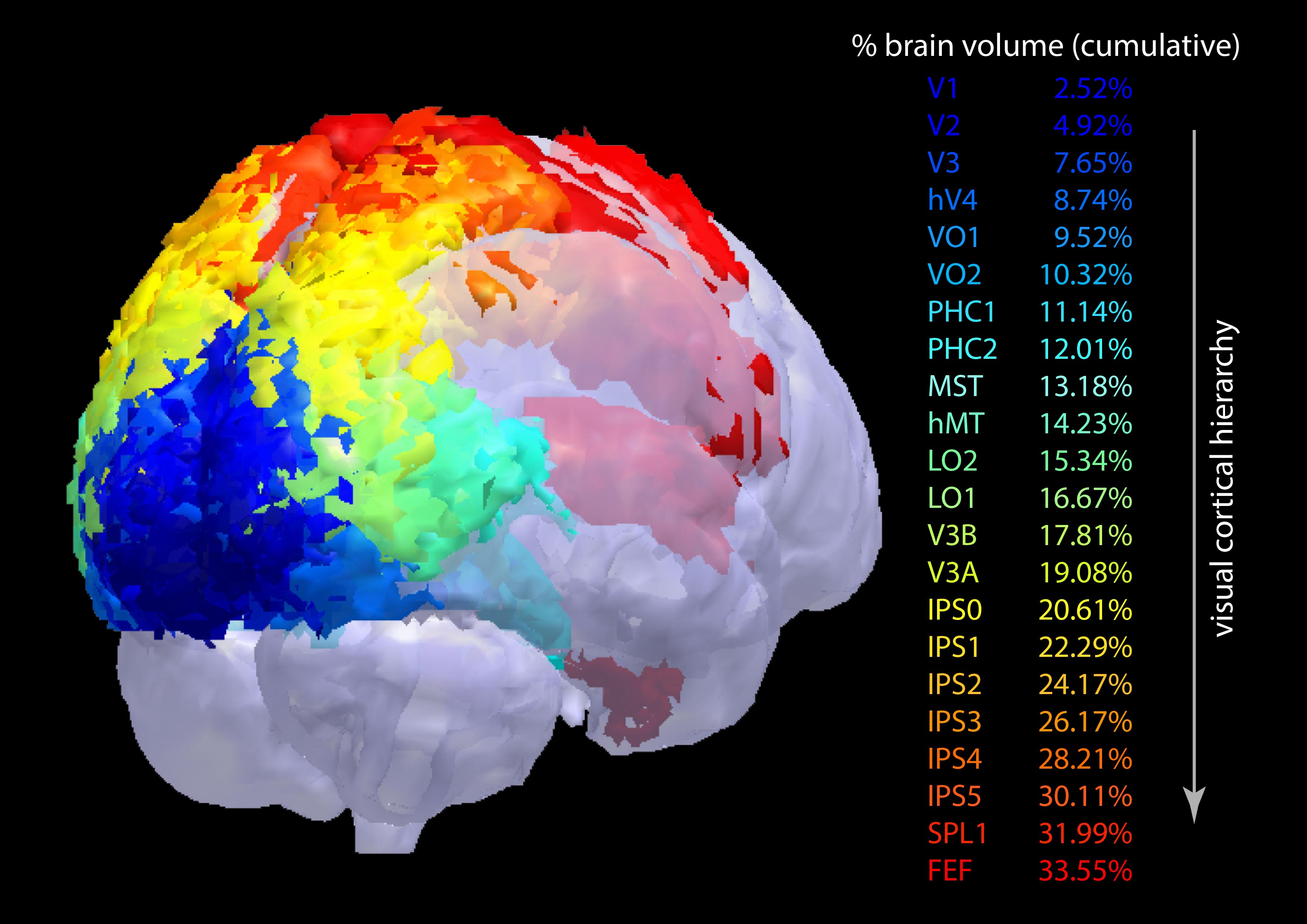
Topographically organized regions in the brain. Image credit: Chen Song. Based on data by (Wang et al., 2015) and (Sereno & Huang, 2014).
Would a patch of topographically organized neurons in isolation (with the right background conditions) form a slightly conscious system, experiencing spatial extendedness and nothing else? According to IIT, this is a possibility. As pointed out by Cohen and Dennett’s (2011) “perfect experiment”, we cannot test this claim directly. However, there are current efforts to determine whether access or reportability are necessary for consciousness based on not-quite-perfect experiments in combination with inferences to the best explanation (Melloni et al., 2021; see also the preregistration).
Conclusion
Given the progress in AI and also biomedical research, there are difficult questions about the presence or absence of consciousness ahead of us. Due to the experimental challenges inherent to a science of consciousness, we must rely on the results of many different types of experiments, combined with a coherent theory of consciousness that offers a good explanation for the experimental observations. When it comes to today’s large neural networks, all major theories of consciousness would deny them any sort of experience. However, as the small network issue demonstrates, our theories of consciousness will not always align with our intuitions and we should be prepared for that, too.
Helgoland
Book Review
Rovelli C (2021) https://bookshop.org/books/helgoland-making-sense-of-the-quantum-revolution/9780593328880
Sep 6, 2022
https://www.consciousnessrealist.com/helgoland/
Summary
Carlo Rovelli takes us along on his life’s journey trying to come to conclusions about the nature of reality, the physical world, and the mind. The book starts with an account of the early years of quantum mechanics, the major players, their original motivation and inspiration. While the predictions of quantum mechanics have been confirmed time and time again, the theory has shattered our metaphysical belief in a reality made up of particles that move along defined trajectories. What should we make of this? Rovelli briefly discusses various pictures of reality painted by several proposed interpretations of quantum mechanics, but ultimately dismisses them all as unsatisfactory. His real focus is on the “relational” interpretation, freed from metaphysical assumptions. The relational perspective assumes that the world we observe is (nothing but) a dense web of interactions. A reality made up of relations rather than objects (p. xvi), where facts are relative rather than absolute. Things exist in context. Next: Did you know Lenin and a less well-known Marxist named Aleksandr Bogdanov argued about Mach’s “empiriocriticism”? I didn’t, and Rovelli’s account of the cultural influences preceeding the discovery of quantum theory is fascinating. The remainder of the book explores how a relational perspective of the physical world can impact our understanding of meaning and consciousness. It is mostly this last part that I am concerned with in the following.
Why discuss this book?
The book is a quick and delightful read. I very much enjoyed the history of science part, as well as the perspective the book provides on the cultural influences preceeding quantum mechanics, which anticipated the take down of an absolute reality by quantum physics. Personally, I had hoped that this book would provide me with a better understanding of the mysteries of quantum mechanics and how Rovelli’s perspective might shed light on quantum weirdness. In that respect, I didn’t find what I was looking for. Rather than clarifying how a relational interpretation can account for quantum observations, the book is a meditation on a world made up of relations, without any metaphysical fundament to ground it. In a way, the book itself is a relational account of its author and his many interests that are tied together in sometimes surprising ways on a path towards insight. Ultimately, “Helgoland” remains light, almost ephemeral in its conclusions. The book draws connections between information, evolution, meaning, consciousness, quantum mechanics, “samsa̅ra”, and socialist political philosophy. Regarding the relational interpretation, I must admit that I could have done with a bit more substance (pun intended). And yet, Rovelli’s worldview resonates with my own intuitions—and the assumptions behind integrated information theory (IIT)—to a remarkable degree. It is those passages that I want to highlight and discuss below. Rather than a conclusion, the book provides a starting point, one that should be taken more seriously and promoted more widely.
Commentary
What does consciousness have to do with quantum mechanics, or the other way around? Neither my, nor Rovelli’s goal is to account for consciousness through quantum mechanics (p. 161). And yet, if we want to gain insights on how consciousness fits into our conception of the physical world, it matters what we believe this world to be.
As Rovelli says, “if […] the world is better described in terms of relations, if nothing has intrinsic properties except in relation to other things, perhaps in this physics we can better find elements able to combine […] to be the basis of […] consciousness.” (p. 164). In such a world “the rigid distinction between a mental world and a physical one fades. It is possible to think of both mental and physical phenomena as natural phenomena: both products of interactions between parts of the physical world.” (p. 165) This is awfully close in spirit to IIT!
Take IIT’s 0th postulate or “principle of being”: to exist physically means to have cause-effect power—being able to take and make a difference. In other words, physical existence is defined purely operationally, from the extrinsic perspective of a conscious observer, with no residual “intrinsic” properties (such as mass or charge) (from “Only what exists can cause: an intrinsic view of free will (Tononi et al., 2022)).
Both IIT and Rovelli (p. 145) refer to the Eleatic principle as an ancient expression of a relational, causal definition of what it means to exist. Here is Rovelli: “Individual objects are the way in which they interact. If there was an object that had no interactions, […] it would be as good as nonexistent. […] It is not even clear what it would mean to say that such objects ‘exist’.” (p. 76)
For Rovelli, quantum theory is a manifestation of a relational reality. He writes: “The discovery of quantum theory, I believe, is the discovery that the properties of any entity are nothing other than the way in which that entity influences others.” (p. 77) “Quantum theory invites us to see the physical world as a net of relations. Objects are its nodes.” (p. 79)
In IIT, we describe (simplified models of) the physical world by a transition probability matrix (TPM) that reflects the conditional probability of how the state of every elementary unit responds to the state of any other unit. A TPM can be deterministic or probabilistic, and there are reasons to think it should be probabilistic at the bottom that arise from within IIT (Tononi et al., 2022). Nevertheless, IIT’s TPMs, while relational, still correspond to a classical picture of reality (albeit one with indeterminism).
To account for quantum phenomena, Rovelli posits an additional aspect of the relational view: “Facts that are real with respect to an object are not necessarily so with respect to another.” (p. 81) While “it is possible to think of quantum physics as a theory of [relative] information” (p. 103), this information takes a weird shape: it is finite, but at the same time it is always possible to obtain more of it (p. 104).
What shape and form do interactions between objects take in Rovelli’s picture? Here is what I gathered: “The ‘quantum state’ is always a relative state.” (p. 83) In the classical picture of IIT (and even the quantum extension I am working on), there is still an absolute (but possibly mixed) state associated with a set of units. Unfortunately (for me), “Helgoland” is rather light on the formal workings of the relational interpretation of quantum physics. I guess I will have to check the primary literature.
Here are a few more hints: “The relational perspective takes the theory [QM] as is […] with its sketchy description of the world, and accepts indeterminacy, as QBism does. But while QBism is about the information of a subject, the relational understanding of quantum theory is about the structure of the world.” (p. 87), and then there is a footnote on p. 81.
[Footnote p. 81: “The problem with quantum mechanics is the apparent contradictions between two laws of the theory: one describes what happens in a ‘measurement,’’ and the other in the ‘unitary’ evolution, namely when there is no measurement. The relational interpretation is the idea that both are correct: the first regards the events relative to the system in interaction, the second regards the events relative to other systems.”]
“An object does not have one wave, it has one with respect to every other object with which it interacts. Events that take place in relation to one thing do not influence the probability of events that occur in relation to others.” (p. 83) And yet, “there is method in this madness” (p. 100) While properties are relative, they still end up being consistent. I will have to see what that really means.
For now, let’s turn our attention back to consciousness. If everything is relational, what are we left with? Rovelli’s answer: Nothing, really. Chairs, for instance, only exist in relation to us (p. 145). “The world is not divided into stand-alone entities.” (p. 146). And also the “I”, the self or “ego”, does not exist. Everything is empty, an illusion, nonexistent—“samsa̅ra”. (Here, Rovelli took much inspiration from the Buddhist philosopher Na̅ga̅rjuna. I haven’t read Na̅ga̅rjuna’s work myself, so I will rely on Rovelli’s account only.)
Now I don’t know about Carlo, but I certainly exist. Not as a persistent self, not as a process extended in time—so far, I’m with Rovelli. But at every instance that I experience, there is existence. There is something rather than nothing. There may not be an “I” in the colloquial meaning, but there is subjective experience. This subjective experience is unified, and it is bounded, it has a specific content, not more and not less. By a good inference, I can assume that there are other conscious entities but my own. My experience is thus evidence that there are, in fact, (interacting, but still) stand-alone entities, and we have to account for that if we want to arrive at a complete picture of the natural world (Ellia et al., 2020).
Rovelli rejects Ernst Mach’s proposal of assuming “elements and functions” as fundamental (p. 149), as well as any kind of proto-consciousness pan-psychism based on intrinsic qualities (p. 164). Fine with me. By contrast, what IIT offers, is a way to obtain entities that exist, intrinsically, for themselves, out of a physical substrate that is purely operational. While objects exist only in relation to others, subjects exist in relation to themselves. If we can agree on a definition of existence as interaction, or cause-effect power, a system exists for itself if it has cause-effect power onto itself (above a background of external interactions).
Rovelli writes: “what quantum theory describes, then, is the way in which one part of nature manifests itself to any other single part of nature.” (p. 75). This is a beautiful notion and really captures the essence of consciousness according to IIT—if we turn it onto itself: consciousness is the way in which a part of nature manifests itself to itself. “The rigid distinction between a mental world and a physical one fades.” (p. 165) As Rovelli points out, such a view is neither dualism, idealism, nor (naive) materialism (p. 183), but really offers a different perspective on the mind-body problem (which also explains why IIT resists attempts to be pressed into any of these categories, and I would include functionalism in that list.)
While I see great potential in combining a relational picture of quantum physics with the ideas of IIT, Rovelli’s reflection on meaning and consciousness go into a different direction. The reason, I believe, is that his primary objective is to capture intentionality, the notion that our mental states or processes refer to something “outside”. In broad strokes, Rovelli attempts to pair relative information (correlation), with evolution, to obtain a notion of “relevant relative information” (p. 173). While this strikes me as a useful notion in a biological context, it falls short of connecting to consciousness. The reason is that “relevant relative information” remains an extrinsic quantity.
[Rovelli presented these ideas in a prize-winning fQXi essay titled “Meaning and Intentionality = Information + Evolution”. Rovelli shared the first prize with, guess who … yours truly (and a third essayist, Jochen Szangolies). I only mention this here (!), because my essay on intrinsic information is also a reply to Rovelli’s, outlining the difference between extrinsic and intrinsic meaning.]
As Rovelli emphasizes several times throughout the book, a correlation between two objects only manifests itself with respect to a third object interacting with both. “That two objects (the sky and you) have relative information is hence, in the final analysis, something that regards a third object (me observing you). Relative information, remember, is a dance for three, like entanglement.” (p. 177) But here is the problem: while your eyes might have sensors that react to a certain frequency of light, no other part of your brain has direct information about the sky. There is no third object within the brain that can observe the correlation with something outside and your sensors. Rovelli mentions the possibility of a “correlation between the external world and my memory.” But nothing in the brain (leaving out the sensory neurons in the retina) can actually assess such a correlation. Our intrinsic meaning, seeing (experiencing) the blue sky, is not explainable by a correlation between the actual sky and the brain. It must arise solely from the interactions within our brain. We can see blue skies in our dreams, even if it is dark outside.
The notion of relevant relative information is certainly useful with respect to the question how our brain evolved and developed to be connected the way it is. But once we have a functioning brain, it is only internal interactions that we can rely on to account for our experiences. While Rovelli recognizes the dream-like character of our waking experiences (p. 194), the predictive coding view he advertises in the final section of the book does not provide a solution to the problem of intrinsic meaning, nor the problem of identifying conscious systems. (See my review of Anil Seth’s book on that topic.)
“We are such stuff as dreams are made on” (p. 198 from Shakespeare’s The Tempest), but dreams are not ephemeral illusions, they are subjective experiences that exist for themselves.
Rovelli C (2021) Helgoland. Publisher: Riverhead books.
IIT criticisms and replies (a non-exhaustive list)
Commentary
Oct 20, 2023
https://www.consciousnessrealist.com/IIT-criticism-replies/
In light of recent events, I have thought quite a bit about constructive ways to address some of the concerns raised about Integrated Information Theory (IIT). At least for the time being, I refer to Tim Bayne, Erik Hoel, and Anil Seth for direct responses to the ominous letter, which mainly objected to IIT’s portrayal in the media rather than the theory itself. The community’s support means a lot and will be more impactful than anything that I could add to the matter.
Nevertheless, one issue that has surfaced in the subsequent discussion is the perceived silence of the IIT camp with regard to criticisms against the theory proper, published in recent papers or blog posts. This is a fair point to some extent, and there is a main reason why replies have been sparse: Time is short and (we thought) better spent on advancing the theory with valid criticisms in mind, rather than addressing each critical publication one-by-one. Especially when a critique is based on an obvious misreading or misrepresentation of the theory, it seemed more efficient and less inflammatory to let the theory papers and (future) empirical results speak for themselves. (Lack of time is also the reason why this is the first blog post of mine in a while.)
This said, we also noticed that many are apparently unaware that we have actually addressed several points of criticism directly or indirectly in subsequent publications. Below is a non-exhaustive list that highlights a few representative critiques of IIT and corresponding replies. I largely focus on critiques regarding the validity of the theory rather than its philosophical commitments or extra-scientific considerations.
IIT’s axiomatic foundation
IIT starts from consciousness itself and first aims to identify its essential properties. Starting with IIT 3.0 (Tononi et al., 2012; Oizumi et al., 2014) these essential properties were made explicit as a list of “axioms.” The label, as well as the claim that the axioms are “self-evident,” has caused some push-back, e.g.:
Bayne T (2018) On the axiomatic foundations of the integrated information theory of consciousness.
In response, we have reformulated the axioms to clarify their intended meaning and explained the use of the term “axiom” in IIT 4.0: “Traditionally, an axiom is a statement that is assumed to be true, cannot be inferred from any other statement, and can serve as a starting point for inferences.”
We have also emphasized that the axioms should be seen as irrefutable, rather than self-evident. Of course they might be misunderstood, but in their intended (very basic) meaning, denying them leads to contradiction. While there would be no IIT without introspection, the axioms do not rely on the accuracy of our introspective capacities. I have highlighted this specifically for the information axiom in my reply to the critical article by Merker et al. (2021), which has also received a reply by Tononi et al. (2021).
IIT’s latest presentation, moreover, explicitly describes the translation of axioms into postulates as an “inference to a good explanation” (and therefore subject to falsification, but also refinement). Finally, other qualities that might be considered as candidates for axiomatic status (such as time, see e.g. (Hunt, 2016)) are discussed in IIT 4.0, but ultimately considered non-essential (because there are, or could reasonably be, human experiences that lack these properties).
For more on how to understand IIT’s axioms please also see this recent guest post by Boki Milinković.
Φ (“Phi”) is not well-defined
The article mentions three problems with Φ as defined in IIT 3.0. The first problem has been resolved in IIT 4.0 by an updated, intrinsic difference measure based on IIT’s postulates (Barbosa et al., 2020). The other two issues are that IIT’s mathematical formalism assumes a discrete system with Markovian dynamics. Practical issues aside, these assumptions concern the ultimate nature of our universe and it is not clear at the moment whether continuous dynamics are real or not, or whether the universe is Markovian or not. Nevertheless, IIT should connect to micro-physics, and we have made a preliminary attempt to apply the IIT 4.0 formalism to (finite-dimensional) quantum systems in (Albantakis et al., 2023) (see also references therein for previous formulations). For attempts at a continuous formalism of IIT’s principles see (Esteban et al., 2018) and (Kalita et al., 2019), and for a generalized account of the mathematical structure of IIT 3.0 that addresses the issue of discrete time and Markovian dynamics see (Kleiner and Tull, 2021). Nevertheless, as mentioned in the IIT 4.0 paper, it still remains to be determined whether IIT is compatible with current physics.
Hanson JR, Walker SI (2023) On the non-uniqueness problem in integrated information theory.
This paper is concerned with the problem of “ties” in evaluating IIT quantities, see also (Moon, 2019) and (Krohn and Ostwald, 2017). Several things to be said here. First, it is true that PyPhi, the Python toolbox to compute IIT quantities in simple example systems only returns one of the tied objects, chosen arbitrarily but consistently (the documentation has been updated to reflect this in response to the preprint). We have assumed the resulting Φ value to be representative, if not necessarily unique. This is fine as long as examples are used in a representative context, which was the case for most of our publications cited by Hanson and Walker, with the exception of the cell-cycle analysis paper. In this case, we are planning a proper reply to the article, so suffice it to say that the problem is largely resolved by IIT 4.0, as the substrate is now identified by the system integrated information, before computing its cause-effect structure, though certain ties can still occur and should be resolved in a manner consistent with IIT principles (see IIT 4.0, supplementary information S1 Text). Finally, I would argue that the problem of ties is not a detrimental issue but mostly an artifact of the symmetric properties of the simple example systems used to demonstrate the formalism. Similar issues arise, for example, in classical mechanics under specially chosen initial conditions.
IIT is not a functionalist theory… therefore it is either false or unfalsifiable
Under this title, I would list the following papers (among others):
The unfolding argument (UA) paper has caused quite a response in the consciousness science community, despite the fact that it ultimately just highlights the unique challenges of the field. One reason might be that many consciousness researchers are (consciously or unconsciously) functionalists by conviction and/or fall prey to the “fallacy of misplaced objectivity” (Ellia et al., 2021).
Replies to the UA abound. Here is my post (by which I still stand). Moreover, as formally proven by Kleiner and Hoel (2021), the UA in fact applies to any minimally informative theory of consciousness (including any functional theory that does not simply equate consciousness with report). The UA thus ultimately amounts to the claim that there cannot be a science of consciousness, which should raise suspicion regarding its validity. For more, see e.g. (Negro, 2020), (Tsuchiya et al., 2020), and (Usher, 2021). In essence, there is no theory-independent way to assess the consciousness of systems that are physically very different from us. Therefore, such cases cannot be used to falsify a theory of consciousness. Yet, a science of consciousness is possible in human subjects, because I can make an inference about their level and state of consciousness based on my own experiences (which constitutes theory-independent evidence). One upshot of the UA discussions is that it would be generally useful to mechanistically explain how introspection aligns with a given theory of consciousness, which is on the to-do list for IIT.
The papers by (Hanson and Walker, 2019; 2021) make similar points to the UA, but using actual toy example systems that have the same behavior but different Φ values. As an extension of the UA, “behavior” here includes not only the input-output function of the system, but also its global dynamics (i.e., its state-to-state transition diagram). Somehow the idea seems to be that if two systems can be mapped to the same global transition diagram, they should be identical in every relevant way including their amount of consciousness. As I have shown in the discussion section 4.2 of (Albantakis & Tononi, 2019), this idea fails already for notions such as agency and autonomy (which many view as prerequisites for consciousness). For example, maintaining the global dynamics of a larger agent-environment system under a remapping of its states does not in general maintain the dynamics of the agent itself. This means that under a state remapping that maintains the global dynamics of a system with several conscious beings, there is no guarantee that these beings can also be found in the new system. To be clear, the systems presented in (Hanson and Walker, 2019; 2021) are physically distinct from each other and the dynamics of their subsets differ because they are implemented in different ways. Why should the global dynamics matter but not the dynamics of the subsets?—especially if the system itself is usually just a subset of a larger system.
[This last point highlights a general problem with certain functionalist accounts of consciousness that give special relevance to the so-called algorithmic level, which supervenes upon, but is distinct from the level of implementation: there is hardly ever just one algorithmic level and it is generally not well-defined in the first place. I also want to point again to my “Greek Cave” thought experiment, which presents an argument against purely functional approaches to consciousness, reminiscent of the Chinese room and China brain thought experiments, but more practical.]
Some parts of IIT are not testable
The core of IIT is not testable
That IIT does make testable predictions is largely accepted by now (I hope). However, some have argued that this does not mean that IIT itself is testable, because its core assumptions are untestable either in principle (see the UA above and replies) or in practice. Accordingly, IIT’s testable predictions are then either trivial or not direct evidence of IIT because other theories might make the same predictions. See for example:
I have discussed this paper here. Nevertheless, a few clarifications: First, while a positive experimental outcome may not be direct evidence in favor of IIT specifically, a negative experimental outcome would be evidence against it (or at least against the assumptions that led to the prediction, as always). In other words, IIT is clearly falsifiable. Moreover, others have argued that a theory should not be measured (solely) by testability, but rather by whether it moves the field forward (Negro, 2020). While I appreciate and endorse this philosophical clarification, the accusation that IIT makes only non-specific or untestable predictions is simply false in the first place, see e.g. (Ellia et al., 2021), (Haun and Tononi, 2019), and (Tononi et al., 2016).
IIT has untestable implications …
Another concern regarding IIT’s testability is that IIT makes (wild) predictions about the consciousness of certain non-human and artificial systems that are untestable in principle, and we should avoid such speculation (Fleming et al., 2023). As discussed above, the available test cases for consciousness science are necessarily limited (to human subjects and animals with similar brain structures). Therefore, any theory that is more generally applicable will make untestable predictions. Accordingly, we distinguish between “predictions” (testable in principle) and “extrapolations” (implications of a theory that are not testable, even in principle) in IIT publications.
… and I don’t like them
Any theory of consciousness that is sufficiently formulated will necessarily specify a minimal system that fits all criteria for consciousness according to that theory but will defy our intuitions. Doerig et al. (2020) called this the “small network argument”. We can either accept this or conclude that the theory only provides necessary but not sufficient criteria for consciousness. However, any additional criterion proposed should increase the theory’s explanatory power (for testable cases). Otherwise, it would be ad-hoc and thus unjustified.
This last point is also the gist of the official reply to Scott Aaronson’s (in)famous expander-graph argument against IIT (plus the fact that we can’t use expander graphs as evidence against IIT, see replies to the UA above). In Scott’s reply to the reply he pointed to a few things that were not accurate: as shown in (Haun et al., 2019) grid-like neural networks, including 1-D grids, have the minimally necessary causal structure to account for spatial experiences. Moreover, we do not know whether or not the cerebellum in itself is conscious. What we do know is that it does not seem to contribute to our consciousness even though it is very much connected to the rest of the brain. This is what requires explanation and we have since been more careful about our description of the cerebellum example.
Some have argued that a way to (temporarily) avoid uncomfortable extrapolations is to refrain from a detailed formulation in the first place (Mediano et al., 2022). Why scare people away by exploring a theory’s extrapolations when there is still a lot of experimental work to be done that does not require a detailed formulation? I have a lot of sympathy for this approach, although I ultimately think it amounts to throwing the baby out with the bathwater. In my opinion, the current debate around IIT shows that it is time to face some of the philosophical challenges surrounding a scientific approach to consciousness, rather than sweeping them under the rug for later.
It would do the field a lot of good if other theory proposals were formulated in sufficient detail to apply them to toy example systems. The goal is not to compare which theory makes the wildest extrapolations. Applying a theoretical framework to simple example systems allows us to evaluate its internal consistency and to test whether the theory, properly implemented, makes conceptual sense in the first place. Insights gained from such theoretical work can then be used to develop more specific predictions.
Conclusion
Despite the recent update to IIT version 4.0, the theory remains under development. I certainly would not rule out an alternative formulation that, for instance, is more palatable in terms of its extrapolations, and I would encourage everyone with ideas in that direction to go for it. The measures of success, however, must remain explanatory power and conceptual consistency, not intuition or personal bias.
Acknowledgements: Many thanks to Tom Bugnon, Jonathan Lang, and my fellow IIT contributors affiliated with the Center for Sleep and Consciousness at UW Madison for their help with compiling the references, and to Jeremiah Hendren for detailed edits.